Best Greyhound Betting Sites – Bet on Greyhounds in 2026
Loading...
- The Odds Are Not a Prediction — They Are a Price
- Fractional vs Decimal Odds — The UK Standard
- Starting Price (SP) — How It Works
- Fixed Odds and Early Prices
- Best Odds Guaranteed (BOG)
- Tote Pools and Parimutuel Betting
- Betfair Exchange and Greyhounds
- Calculating Returns — Practical Examples
- Price Is What You Pay, Value Is What You Get
The Odds Are Not a Prediction — They Are a Price
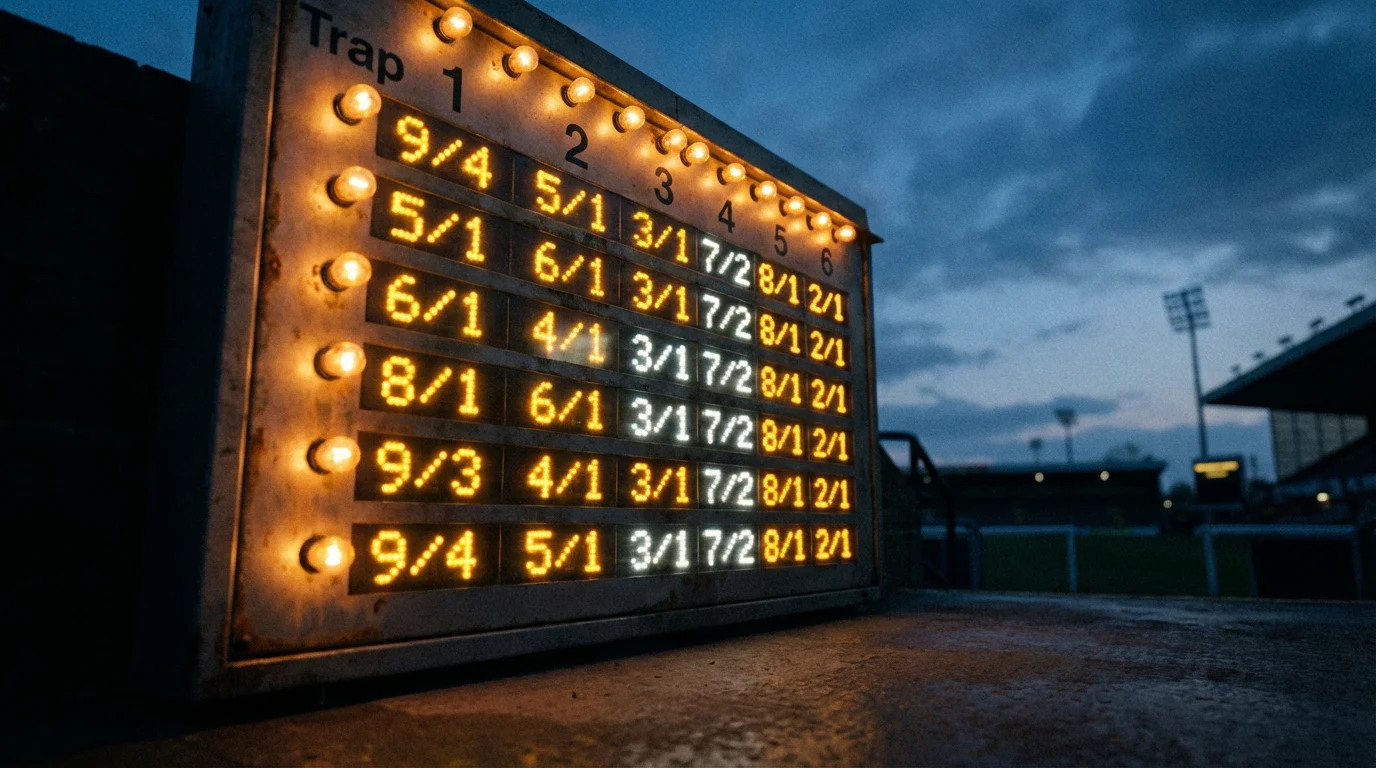
Every number next to a greyhound’s name is a market opinion — and markets can be wrong. This is the single most important thing to understand about odds before you place a bet on a UK greyhound race. The 3/1 next to Trap 4 does not mean the dog has a 25% chance of winning. It means the bookmaker, or the exchange market, or the Tote pool, has priced it as if it has roughly a 25% chance — minus a margin. The difference between the price and the true probability is where profit and loss live.
Greyhound odds in the UK come through multiple channels, each with its own mechanics. Traditional bookmakers offer fixed odds that you lock in at the moment of the bet. The starting price is declared at the moment the traps open. Best Odds Guaranteed bridges the two, giving you whichever is higher. The Tote offers pool-based betting where the dividend is set by the collective weight of money. The Betfair Exchange lets you back or lay at odds set by other punters. Each system prices the same race differently, and understanding those differences is a practical skill that affects your returns on every card you bet.
This guide walks through each pricing mechanism in detail — fractional and decimal odds, the SP calculation, fixed-price strategy, BOG, Tote pools, and the exchange — followed by a section on calculating returns across different bet types. The goal is not to make odds theory interesting (it is not, particularly). The goal is to make sure that when you look at a number on a screen, you know exactly what it means, where it came from, and whether it represents a price worth paying.
Because that is all odds are: prices. And like any price, they can be fair, generous, or poor. Your job is to tell the difference.
Fractional vs Decimal Odds — The UK Standard
British punters grew up with fractions, but decimals are taking over — and for good reason. Fractional odds express your potential profit relative to your stake. At 5/1, you win five pounds for every one pound staked, plus your stake back. At 7/2, you win seven pounds for every two pounds staked. Fractions are traditional, deeply embedded in British racing culture, and still the default display on most UK bookmaker sites and on-course boards.
Decimal odds express the total return per unit staked, including the original stake. The decimal equivalent of 5/1 is 6.0 — you get six pounds back for every pound bet, of which five is profit and one is your original stake. The equivalent of 7/2 is 4.5. To convert any fractional odds to decimal, divide the first number by the second and add one.
The practical advantage of decimals is that they make comparison easier. Is 11/8 better or worse than 6/4? In fractions, you need to do the division to find out (11/8 = 1.375 profit per unit; 6/4 = 1.5 profit per unit — so 6/4 is better). In decimals, the same comparison is 2.375 versus 2.5, which is immediately obvious. When you are scanning odds across multiple bookmakers looking for the best price, decimals save time and reduce the risk of error.
Decimals also simplify accumulator calculations. The return on a three-leg accumulator in decimal odds is simply the three prices multiplied together. A treble at 2.5, 3.0, and 4.0 returns 30.0 times your stake. In fractions, the same calculation involves converting 6/4, 2/1, and 3/1 into returns, multiplying the returns, and then working backwards to a profit figure. It is doable, but it takes longer and is more prone to mistakes.
Most UK bookmakers let you toggle between fractional and decimal display in your account settings. If you are used to fractions and the switch feels unnatural, give it a week. The initial discomfort fades quickly, and the calculation advantages become second nature. For anyone already comfortable with both formats, the only thing that matters is understanding the implied probability behind any price — and that works identically regardless of format. Divide one by the decimal price, and you have the implied probability. At 4.0, that is 25%. At 6.0, it is 16.7%. At 2.0, it is 50%. Those percentages are what you are really betting on, however the number is displayed.
Starting Price (SP) — How It Works
The SP is declared at the moment the traps open — it is the on-course bookmakers’ final assessment. For any greyhound race at a GBGB-licensed track, the starting price is the official price used to settle bets placed at SP and to calculate Computer Straight Forecast and Computer Tricast dividends. It is the reference point around which the entire pricing structure of UK greyhound racing revolves.
How SP Is Determined
The starting price for each dog is determined by an independent SP reporter who records the odds displayed by on-course bookmakers at the moment the traps open. The reporter surveys the boards — the display of odds offered by the bookmakers standing at the track — and compiles a representative price based on the general market. This is not a simple average. The methodology weighs the most commonly offered price, with adjustments for any significant outliers.
In practice, the SP tends to reflect the consensus of the on-course market in the final minutes before the race. Money flowing into the track-side bookmakers in the last two or three minutes before trap rise — late bets from informed connections, kennel representatives, or experienced on-course punters — can move the boards rapidly. A dog might be 4/1 on the boards five minutes before the race and 5/2 by the time the traps open, indicating that significant money has arrived for it. Conversely, a dog that opens at 2/1 and drifts to 3/1 at the off has seen its support weaken.
The SP is distinct from the odds you see online. Bookmaker websites display their own odds, compiled by trading teams, and these are the prices you lock in if you take a fixed-price bet. The SP is the track price, declared at the moment of the race, and it can differ from the online price in either direction.
When SP Beats Your Fixed Price
If you take a fixed price of 3/1 on a dog and the SP is declared at 4/1, the market has drifted — meaning less money came in for your dog than expected, or more money went elsewhere. In this scenario, an SP bet would have returned more than your fixed-price bet. Had you waited and taken SP instead of locking in 3/1, you would have received the higher price.
The reverse also happens. If you take 3/1 and the SP contracts to 2/1, your fixed price is better. The market shortened because money came in for the dog late, confirming its form, and the price tightened accordingly. In this scenario, your early price locked in value that the SP bettor missed.
There is no universal answer to whether fixed odds or SP is the better approach. It depends on whether you can accurately predict which direction the market will move. If you consistently back dogs before they shorten, fixed prices win. If you are often on the wrong side of market moves — backing dogs that drift — SP would have served you better. Tracking your results over a few months, comparing your fixed prices with the eventual SP, gives you the data to decide which approach suits your betting patterns. Most experienced punters take early fixed prices when they believe the dog will shorten, and take SP when they expect the market to drift or when they are uncertain about the direction.
Fixed Odds and Early Prices
Taking an early price locks in value — but only if you are right about the direction the market will move. Fixed odds, sometimes called “board prices” or “early prices,” are the odds displayed by a bookmaker at a given moment. When you place a bet at those odds, the price is fixed — locked in regardless of what happens to the market before the race begins. If the dog shortens from 5/1 to 3/1 after your bet, you still get paid at 5/1. If it drifts to 8/1, you are stuck at 5/1.
UK bookmakers typically release greyhound odds for evening meetings during the afternoon and for afternoon BAGS meetings in the morning. These “early” prices are the opening market, compiled by each bookmaker’s trading team based on their assessment of form, trap draw, and expected market demand. The early prices often differ noticeably from the final SP, sometimes by significant margins, because the morning market is based on projection while the SP reflects actual betting activity right up to the off.
The strategic case for taking early prices rests on one question: do you think this dog will be shorter at the off than it is now? If a dog is 6/1 in the morning and you believe the form points to a strong run that the market has not yet fully recognised, taking 6/1 early makes sense. By the time the informed money arrives closer to the race, the price may have contracted to 4/1 or shorter. Your early bet captured value that no longer exists for later bettors.
The risk is the opposite scenario: you take 6/1 and the dog drifts to 10/1 by the off. Maybe new information emerged — a poor trial, a kennel issue, a track condition that disadvantages the dog — or maybe the morning traders simply overrated the dog. In either case, you are locked into an inferior price. There is no mechanism to adjust a fixed-odds bet once it is placed.
For greyhound racing specifically, the window between early prices and SP is shorter than in horse racing, and the volume of money entering the market is smaller. This means early prices can be less accurate — there is less liquidity to correct for errors in the opening line — which creates opportunity for the punter who does their own form analysis. But it also means the prices can be volatile, with large percentage swings between morning and evening, especially on mid-card graded races where the bookmaker’s opening assessment is based on limited information.
Best Odds Guaranteed (BOG)
BOG is the simplest edge any bookmaker hands you — and most punters ignore it. Best Odds Guaranteed is a promotion offered by many UK bookmakers that guarantees you the higher of two prices: the fixed odds you took when placing your bet, or the starting price declared at the off. If you back a dog at 5/1 and the SP is 7/1, you get paid at 7/1. If the SP is 3/1, you still get your fixed 5/1. The arrangement eliminates the gamble of choosing between fixed odds and SP — you always receive the more favourable outcome.
Which Bookmakers Offer BOG on Greyhounds
Not every bookmaker extends BOG to greyhound racing. The promotion is more widely available on horse racing, and several firms that offer BOG on horses exclude the dogs or limit the offer to specific meetings. The situation changes frequently as bookmakers adjust their promotional offerings, so it is worth checking the current terms at each firm before assuming BOG is available on your bet. As of 2026, a handful of the major UK-licensed bookmakers offer BOG on selected greyhound racing, but the coverage varies — some apply it to all GBGB meetings, others restrict it to evening licensed fixtures and exclude afternoon BAGS cards.
The terms also vary in detail. Some bookmakers cap the maximum BOG payout at a certain odds level — for example, BOG may only apply on dogs up to 10/1. Others cap the total enhanced payout at a fixed amount. Read the small print. A BOG offer with a cap at 6/1 is less valuable than one that applies at all prices, and a cap at a fifty-pound maximum enhancement is worth less than an uncapped offer.
How to Use BOG Strategically
The strategic implication of BOG is that it reduces the penalty for taking early fixed prices. Without BOG, taking an early price that later drifts means you are stuck with the shorter odds. With BOG, you get the drift for free. This tilts the decision towards taking early prices at bookmakers that offer the guarantee, because you capture the upside if the dog shortens and are compensated if it drifts.
The optimal approach under BOG is to take the early fixed price at the bookmaker offering the best combination of price and BOG terms, then let the market do whatever it does. If the price shortens, your early bet was the smart move. If it drifts, BOG pays you the SP instead. Either way, you end up with the better outcome. No other promotional offer in betting so cleanly eliminates a genuine decision dilemma, and yet the majority of greyhound punters either do not know BOG exists or do not factor it into their bookmaker selection.
Tote Pools and Parimutuel Betting
Tote odds are not set by a bookmaker — they are set by everyone who bets into the pool. The Tote operates a parimutuel system, where all bets on a particular market are combined into a pool, the Tote takes a percentage as commission, and the remaining pool is divided among winning bets. The final dividend is not known until after the race, because it depends on the total amount wagered and how that money is distributed across the runners.
Win, Place, Exacta, Trifecta Pools
The Tote offers several pool types on greyhound racing. The Win pool pays the backer of the first-placed dog. The Place pool pays backers of dogs finishing first or second in a six-runner field. The Exacta is the pool equivalent of a forecast — you need the first two in the correct order. The Trifecta requires the first three in order, equivalent to a tricast.
Each pool has its own commission rate, which the Tote deducts before calculating dividends. The commission on greyhound pools is higher than on horse racing pools — the industry standard for Tote greyhound pools runs around 20-30% depending on the pool type, with Trifecta pools typically carrying the highest deduction. This commission reduces the value of every Tote bet compared to its fixed-odds equivalent, all else being equal. The question is whether “all else” is equal — and often it is not.
Tote vs Fixed Odds — When Pool Betting Pays Better
Tote dividends can exceed fixed-odds returns when the result is unusual and the pool money is concentrated on other outcomes. If the public money has piled into the favourite and it loses, the Tote pool for the actual winner — which attracted less money — pays a larger dividend per winning ticket. In races with a heavily backed favourite that gets beaten, the Tote Win dividend frequently outpaces the SP.
Exacta and Trifecta pools are where the biggest discrepancies occur. Because these pools are small on greyhound racing — far less money flows into them than on horse racing — the dividends can be volatile. A popular combination might pay less through the Tote than the Computer Straight Forecast would. An unpopular combination might pay substantially more. The lack of liquidity in greyhound Tote pools is both the risk and the opportunity: the dividends are less predictable, but when the pool falls in your favour, the returns can be significant.
The practical approach is to compare. Before placing a forecast or tricast bet, consider whether the Tote pool is likely to offer better value than the CSF or Computer Tricast. If the public money is concentrated on a few obvious combinations and your selection is against the crowd, the Tote may pay better. If you are backing the same combination as everyone else, fixed odds will usually win.
Betfair Exchange and Greyhounds
The exchange lets you be the bookmaker — and in six-dog fields, that is more attractive than you might think. The Betfair Exchange is a peer-to-peer betting platform where you can back a dog (bet that it will win) or lay a dog (bet that it will not win) at odds set by other users. There is no bookmaker margin built into the odds — the prices are whatever backers and layers agree on. Betfair charges commission on net profits instead, with the standard rate starting at 5% and potentially reducing through loyalty discounts.
Back and Lay Basics
Backing on the exchange works identically to placing a bet with a bookmaker, except that the odds are set by the market of users rather than a trading desk. You select a dog, choose your stake, and request odds. If another user is willing to lay that dog at your requested price, your bet is matched. If no one matches, the bet sits unmatched until either the price moves or you cancel.
Laying is the inverse. When you lay a dog, you are offering to pay out if it wins, in exchange for keeping the backer’s stake if it loses. Your liability — the amount you stand to lose if the dog wins — is the difference between the odds and one, multiplied by the backer’s stake. At decimal odds of 5.0 (4/1), laying a ten-pound bet means your liability is forty pounds. If the dog loses, you keep the ten pounds. If it wins, you pay forty. The risk-reward ratio is inverted compared to backing, which is why laying requires a high strike rate and careful stake management.
The absence of a bookmaker margin means that exchange odds are typically closer to the true probability than fixed-odds bookmaker prices. On greyhound races, the exchange market often offers slightly better odds for backers than the bookmaker price — particularly on outsiders, where bookmaker margins are widest. For layers, the exchange provides access to a market that does not exist with traditional bookmakers: the ability to profit from a dog losing, without needing to correctly identify the winner.
Greyhound-Specific Exchange Tactics
Greyhound exchange markets are thinner than horse racing markets. Liquidity — the volume of money available at any given price — is lower, which means large bets can move the odds and smaller bets may not get matched at all. This is the primary limitation of exchange betting on greyhounds. At major evening meetings, liquidity is usually adequate for bets up to a few hundred pounds. On afternoon BAGS meetings, the market can be so thin that placing anything beyond a modest stake is impractical.
The thin liquidity also creates opportunity. Because fewer sophisticated punters trade greyhound exchange markets, the prices can be less efficient than horse racing exchange markets. A knowledgeable greyhound punter can sometimes find exchange odds that significantly overrate or underrate a dog’s chance, particularly in the last few minutes before a race when the market is still forming. This is the flip side of low liquidity: fewer participants means fewer people correcting mispriced odds.
In-play exchange betting on greyhounds is available but extremely fast-moving. A race lasts under thirty seconds, and the exchange odds update in real time as the dogs run. In-play trading requires instant decision-making and a fast internet connection. It is not for beginners, and the liquidity issues that affect pre-race markets are amplified in-play, where only a small number of traders are active. For most punters, the pre-race exchange market is where the practical value lies.
Calculating Returns — Practical Examples
Before you click “place bet,” you should know exactly what your return will be in every scenario. Calculating returns is not complex, but it requires attention to detail — particularly when each-way bets, accumulators, and exchange commission are involved. Here are the core calculations every greyhound punter should be comfortable with.
A straight win bet at fractional odds is the simplest calculation. Multiply your stake by the odds, then add your stake back. A ten-pound bet at 7/2 returns forty-five pounds: ten multiplied by 3.5 equals thirty-five, plus the ten-pound stake. In decimal odds, the same bet at 4.5 returns forty-five pounds: ten multiplied by 4.5. The decimal version includes the stake in the calculation, so there is no separate addition step.
An each-way bet requires two calculations. The win part is calculated as above. The place part uses the place fraction — usually one quarter of the win odds for greyhound racing — applied to the same stake. A ten-pound each-way bet at 8/1 costs twenty pounds total. If the dog wins, the win part returns ninety pounds (ten times eight, plus ten) and the place part returns twenty-five pounds (ten times two, plus ten, where 2/1 is one quarter of 8/1). Total return on a win: one hundred and fifteen pounds. If the dog finishes second, only the place part pays: twenty-five pounds, against a total outlay of twenty pounds. Net profit on a place: five pounds.
Accumulator returns compound across legs. A treble on three dogs at 3/1, 2/1, and 5/1 produces combined decimal odds of 4.0 multiplied by 3.0 multiplied by 6.0, which equals 72.0. A five-pound stake returns three hundred and sixty pounds. In fractions, you can calculate the same result by converting each set of odds to a return per pound (4, 3, and 6), multiplying them together (72), and then multiplying by the stake. The compound nature of accumulators is what makes the potential returns attractive and the probability of winning low — each additional leg multiplies both.
Exchange commission affects your net return on winning bets. If you back a dog at 5.0 on the exchange and win a hundred-pound profit, Betfair takes 5% commission on that profit, leaving you with ninety-five pounds. On lay bets, the commission is taken from your net winnings across all settled bets, so individual lay wins are not reduced — but your cumulative profit at the end of the settlement period is. Always factor commission into exchange return calculations. A price of 5.0 on the exchange with 5% commission is effectively equivalent to 4.8 at a traditional bookmaker after the deduction.
For forecast and tricast bets, the return is determined by the CSF or Computer Tricast dividend, which is declared after the race. You cannot calculate the exact return in advance. What you can do is estimate the likely range based on the prices of the dogs you are selecting. Two short-priced dogs in a forecast will produce a lower CSF than a short-priced dog paired with a long-priced outsider. Building that expectation before the bet helps you decide whether the risk is proportionate to the probable reward.
Price Is What You Pay, Value Is What You Get
The odds market is a conversation — and the best punters learn to disagree with it. Every price on a greyhound race card is an invitation. The bookmaker, the Tote pool, the exchange — each is saying, in effect, “this is what we think this dog’s chance is worth.” Your job is to decide whether you agree. If you do, there is no bet to be had. If you do not — if your analysis says the dog’s chance is better than the price implies — then you have found value, and the bet is justified regardless of whether the dog wins or loses.
That last point deserves emphasis. Value betting is a long-term concept. A dog at 6/1 that you assess as a genuine 4/1 chance is a value bet even if it loses. The price was better than the probability, and over a hundred similar bets, that gap will produce positive returns. The individual result is noise. The aggregate result is the signal. Understanding this distinction is what separates punters who bet on prices from punters who bet on outcomes — and only the first group has a chance of making greyhound betting sustainable.
The pricing mechanisms covered in this guide — SP, fixed odds, BOG, Tote, exchange — are not competitors. They are options. Each has a specific scenario where it offers the best return, and the informed punter moves between them depending on the race, the market conditions, and the available information. BOG at a bookmaker offering a generous early price is the best of both worlds. The Tote pool on an upset result can blow any fixed-odds return out of the water. The exchange offers both sides of the market, with tighter margins and the flexibility to back or lay.
The punter who understands all of these channels — and knows when to use each one — has a structural advantage over the punter who defaults to a single bookmaker for every bet. That advantage is small on any individual race. Over a season of racing, it compounds into the difference between treading water and moving forward. Price is what you pay. The effort to understand how prices work is what decides whether what you get back is worth it.