

Contents
Six Traps, One Finish Line — Why Greyhound Betting Plays by Different Rules
Greyhound racing is not horse racing in miniature. That is the first thing any serious punter needs to understand, and the sooner it sinks in, the sooner you stop losing money on assumptions that belong to a different sport. A horse race might feature twenty runners, a jockey making tactical decisions mid-race, and a contest that unfolds over two miles and four minutes. A greyhound race has six dogs, no human intervention once the traps rise, and a finish line that arrives in less than thirty seconds. The betting logic is entirely different, and so is the edge available to anyone willing to learn the mechanics.
The UK remains the heartland of professional greyhound racing. Eighteen licensed stadiums operate under the Greyhound Board of Great Britain, hosting more than thirty meetings a day between them through the BAGS service that feeds betting shops and online platforms from morning until night. That volume matters. It means there are hundreds of races every week, each one a fresh data point for punters who understand form, track geometry, and trap statistics. It also means the market is liquid enough to find genuine value if you know where to look — and thin enough that a single well-placed bet can shift the price.
This guide is the manual that sits behind all of that. It covers every bet type available on a greyhound card, from a straightforward win single to a combination tricast. It walks through the form guide symbol by symbol, explains how trap bias works and why it differs from one stadium to the next, and lays out a core betting strategy built on sectional times, value identification, and bankroll discipline. There are sections on how odds are formed, where to watch live racing, and what the UK regulatory framework means for anyone placing a bet.
Whether you are a horse racing punter looking to diversify, a casual visitor to the track who wants to stop guessing, or someone who has been betting on the dogs for years but never formalised a method — this is where you start. Six traps, one finish line, and a sport that rewards preparation more generously than almost any other betting medium in Britain.
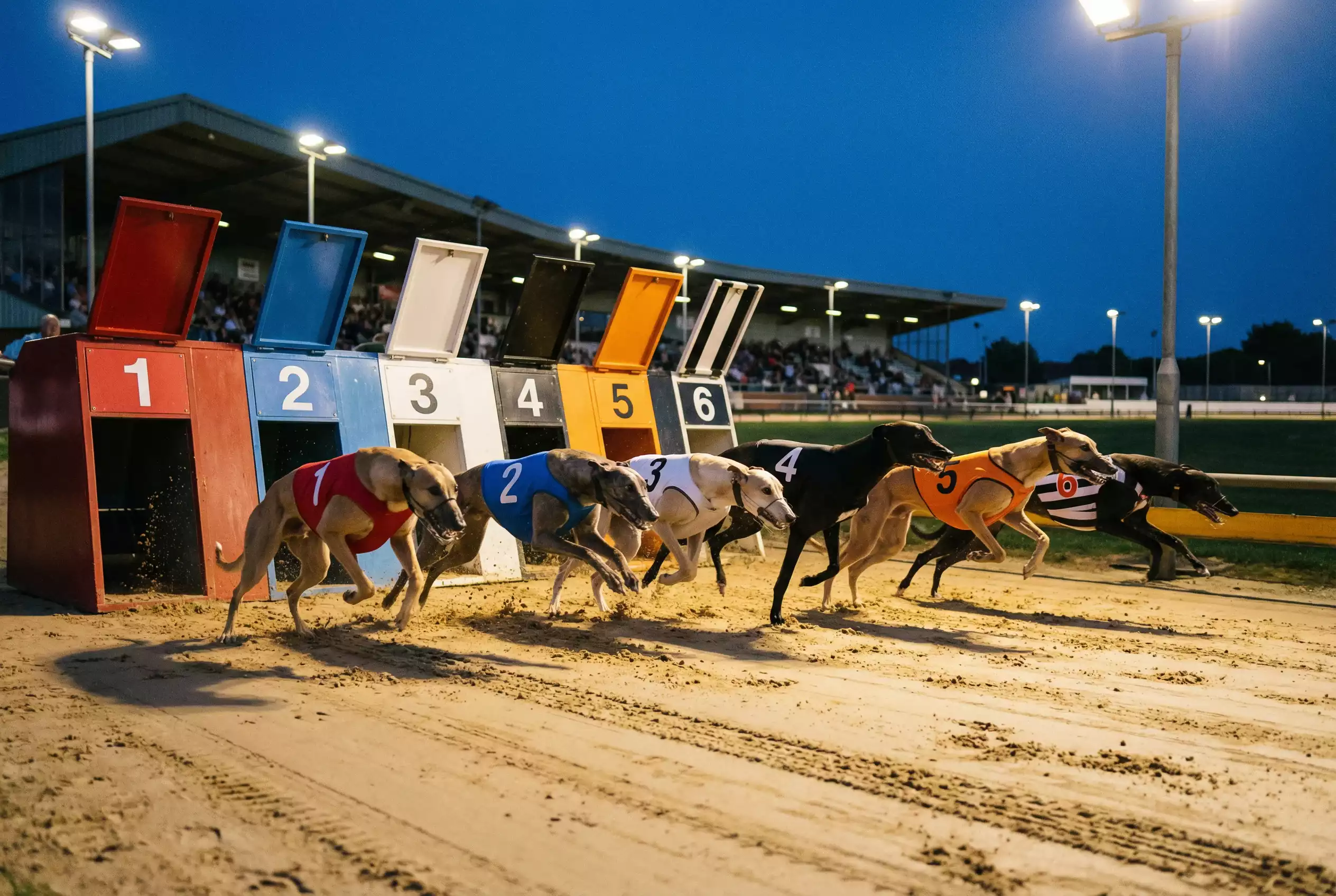
What makes greyhound betting unique? Every race features exactly six runners, each assigned to a fixed numbered trap with a colour-coded jacket. There is no jockey, no riding tactic, and no mid-race instruction — once the lids rise, the result is determined entirely by the dog's speed, running line, and reaction to the pack. This six-runner format compresses the field and raises the base probability of any selection winning to roughly 16.7%, compared to single-digit percentages in a typical horse race. It also makes exotic bets such as forecasts and tricasts far more achievable, which is why greyhound markets offer some of the best-value combination betting in UK sport.
How UK Dog Racing Works — Structure, Regulations, Race Types
The GBGB oversees eighteen licensed stadiums — and every race follows the same mechanical choreography. Traps load, the hare accelerates, lids spring open, and six dogs chase an artificial lure around an oval circuit of sand. The simplicity is deceptive. Behind it sits a regulatory structure that governs everything from kennel standards and drug testing to how graders seed each race.
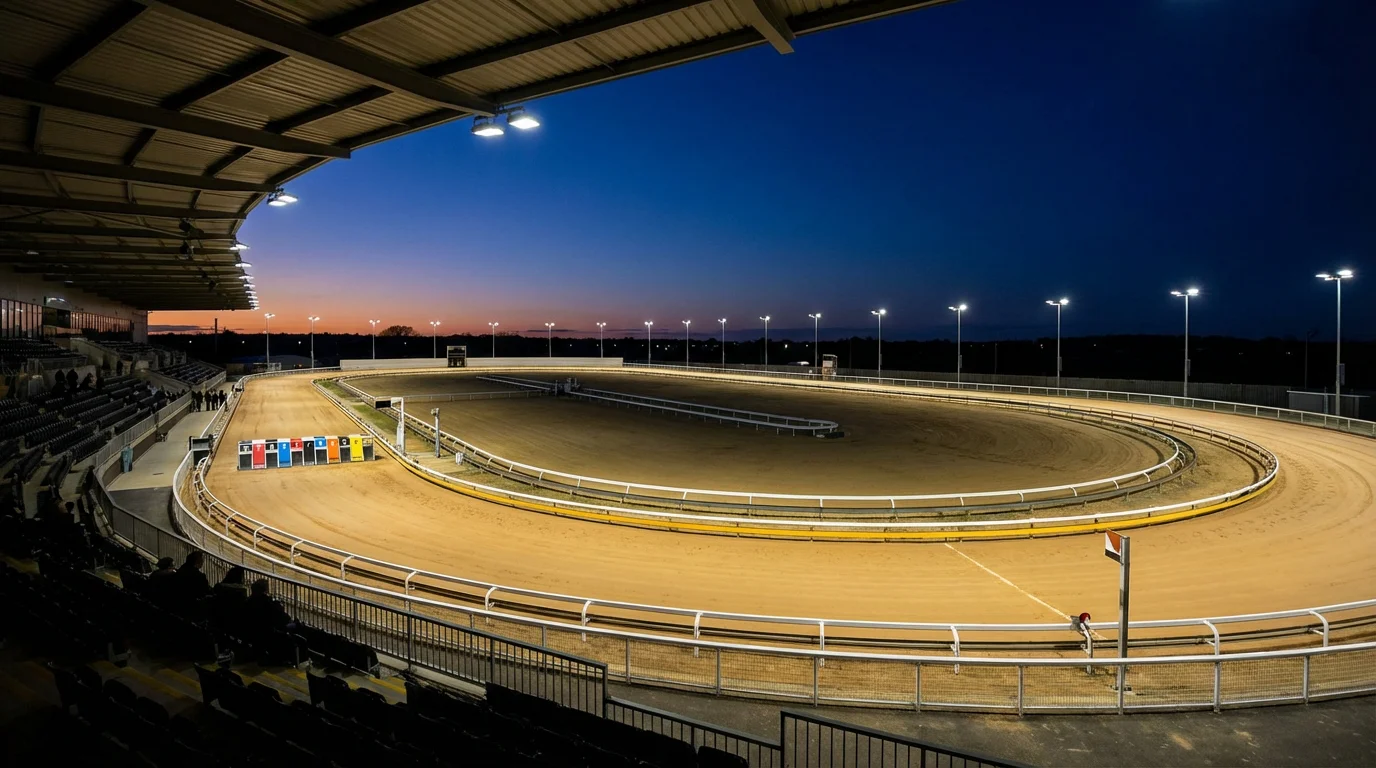
The GBGB and Licensed Racing
The Greyhound Board of Great Britain is the sport's governing body for Great Britain — England, Scotland, and Wales. It licenses stadiums, registers dogs, accredits trainers, and enforces the Rules of Racing — a document that was updated with fresh amendments effective from January 2026, including new requirements for racecourses to publish formal homing policies for retired greyhounds and injury retirement plans. Every racing greyhound must be microchipped, vaccinated, and covered by a retirement bond before it is allowed on track. Urine samples are taken from runners at every meeting, and the GBGB's integrity team conducts random testing across all venues.
Northern Irish tracks operate under the Irish Coursing Club rather than the GBGB. Scotland currently has no licensed GBGB stadiums, and Wales retains one — though the Welsh Government announced in early 2025 its intention to ban greyhound racing on welfare grounds, a decision still awaiting implementation.
Graded Races vs Open Races vs Trials
Most weekly racing at GBGB stadiums consists of graded races. Dogs are slotted into grades from A1 at the top down to D4 at the bottom, based on their recent finishing times and positions. The grader at each track assigns dogs to races and traps, seeding them as railers, middle runners, or wide runners to reduce crowding at the first bend. This seeding is a critical detail for bettors: it means trap draws are not random but reflect a dog's preferred running line.
Open races sit above the grading ladder. These are the sport's showcase events, carrying higher prize money and attracting entries from across the country. The GBGB's 2026 open race calendar features fifty Category One competitions and twenty-seven Category Twos, headlined by the Star Sports Orchestrate English Greyhound Derby at Towcester, which runs from late April through to the final on 6 June. Category One events must offer minimum prize money of twelve thousand five hundred pounds and be completed within fifteen days.
Trials are non-competitive runs used to assess a dog's time or fitness at a particular track. They carry no betting market but appear on race cards and provide useful form data — a trial time at a new venue can reveal how a dog handles unfamiliar bends.
Race Distances and Categories
Standard distances vary by track but generally fall into three bands: sprint (around 260 to 300 metres), middle distance (roughly 400 to 500 metres, including the classic 480-metre trip), and stayers' events (600 metres and above, sometimes reaching 900 metres at venues like Towcester). The majority of BAGS races — the backbone of the weekday betting schedule — are run over middle distances.
BAGS — the Bookmakers Afternoon Greyhound Service, a contractual arrangement between bookmakers and stadiums that provides a steady stream of daytime racing specifically for off-course betting. BAGS meetings generate the majority of the sport's off-course turnover.
Sprint races tend to favour early-speed dogs from inside traps, while staying events allow late-pace runners to close through the field — a distinction that matters enormously for bet selection.
Greyhound Bet Types — Every Market You Can Play
Before you place a penny, know exactly what you are buying. Greyhound betting offers a wider spread of single-race markets than most punters realise, and each one carries a different risk-reward profile. The compact six-dog field is the engine behind this variety: with fewer possible outcomes than a horse race, exotic bets become statistically plausible rather than purely aspirational.
Win, Place, and Each-Way
A win bet is the simplest proposition in the sport. Back one dog to finish first. If it does, you collect your stake multiplied by the odds. A place bet backs your selection to finish in the top two — the standard greyhound place market at most UK bookmakers, paying at one quarter of the win odds.
Each-way combines both: one bet on the win, one on the place, so your total stake doubles. If the dog wins, both parts pay. If it finishes second, you lose the win part but collect the place element. Each-way is most effective at longer prices — a 6/1 outsider finishing second still returns a meaningful amount, while each-way on a 2/1 favourite barely covers the extra stake. In six-runner fields, the arithmetic is kinder than in horse racing because place fractions apply to a smaller pool of competitors.
Forecast and Reverse Forecast
A straight forecast requires you to predict the first and second dogs in the correct order. The dividend is calculated after the race using the Computer Straight Forecast formula, based on the starting prices of the first two finishers. CSF dividends vary widely: a forecast involving two outsiders might return fifty or a hundred pounds to a one-pound stake, while one with the first two favourites might pay under five pounds.
A reverse forecast covers both possible finishing orders of your two selections — effectively two straight forecasts, so your stake doubles. If Dog A finishes first and Dog B second, or vice versa, you collect. Reverse forecasts make sense when you are confident two dogs will dominate but less certain which one leads.
Combination forecasts extend the principle further. Select three or more dogs and cover every possible first-and-second pairing among them. Three dogs produce six forecast combinations; four dogs produce twelve. The stake multiplies accordingly. These are useful in open races where form is inconclusive and several dogs hold legitimate chances.
Tricast, Combination Tricast, and Trifecta
A straight tricast asks you to name the first three finishers in exact order. The Computer Tricast dividend is calculated post-race from the runners' starting prices, and it is where greyhound betting produces its biggest single-race payouts. Getting three dogs right in sequence is difficult, but in a six-runner field you are working with far fewer permutations than in a twelve-horse race. A straight tricast has a one-in-120 chance of being correct if you pick at random — long odds, but not lottery territory.
A combination tricast covers all six possible orderings of your three selected dogs. It costs six times your unit stake. If your three dogs fill the first three positions in any order, you collect the tricast dividend for the specific order that occurred. This is the bet of choice for punters who can identify three strong contenders but cannot separate them. The Tote Trifecta operates on a pool basis rather than the computer formula, meaning the dividend is determined by the total pool and the number of winning tickets. Pool dividends and algorithm dividends do not always agree — in races where public money heavily backs the obvious trio, the Trifecta pool may pay less than the Computer Tricast, and vice versa.
Accumulators, Doubles, and Multi-Race Bets
Multi-race bets link selections from different races into a single wager. A double combines two selections: both must win. A treble links three. An accumulator chains four or more, with returns from each winning leg rolling into the next. The appeal is obvious — small stakes, large potential returns. The mathematics is unforgiving: each additional leg multiplies your payout but also multiplies the probability of failure.
Full-cover bets offer insurance. A Trixie covers three selections with three doubles and a treble. A Patent adds three singles for seven bets total. A Yankee covers four selections with eleven bets; a Lucky 15 adds four singles for fifteen bets. These structures let you collect a return even if one leg fails, though the increased stake eats into the upside. For greyhound accumulators, mix tracks and distances rather than stacking selections from the same meeting, where a single track bias or weather shift can wipe out the entire ticket.
Win Bet Example — Trap 3 at 7/2
Stake: £5.00
Odds: 7/2
Calculation: £5.00 x (7/2) + £5.00 stake returned
Total Return: £22.50
Profit: £17.50
Single-race markets test your judgement on one contest. Multi-race bets test your nerve across an entire card — and the maths shifts dramatically when you chain outcomes together.
Interactive Tool
Full-Cover Bet Calculator, and Trap Bias Comparison
Work out exactly how many bets a Trixie really is, and compare trap advantage directly at the same track.
Total Bets
-
-
Doubles
-
Trebles
-
Higher Folds
-
What this guide never states outright: "A Trixie covers three selections with three doubles and a treble." Unlike the Patent ("seven bets total"), the Yankee ("eleven bets"), and the Lucky 15 ("fifteen bets"), the guide never actually says the Trixie is 4 bets total — the number that ties it to the same formula as its bigger siblings.
Trap 1 Advantage
-
-
Trap 1 Win Rate
-
Trap 5 Win Rate
-
Win Ratio
-
What this guide never puts side by side: The worked example states Trap 1 at Crayford "may sit around 19-20%" and, separately, that Trap 5 "may sit around 13-14%" — but the two figures are never compared directly. Using the midpoints, Trap 1 wins 6.5 percentage points more often than Trap 5, a 1.48x edge.
Reading the Form Guide — What the Numbers and Letters Actually Mean
A greyhound form card is a compressed biography — every digit tells a story. The problem for most newcomers is that it reads like shorthand written by someone who assumed the audience already speaks the language. Once you crack the notation, though, a form card becomes the single most powerful tool in your betting arsenal. It tells you not just whether a dog has been winning, but how it has been running, where it has been struggling, and whether its current grade and trap assignment suit its style.
Race Card Layout and Key Fields
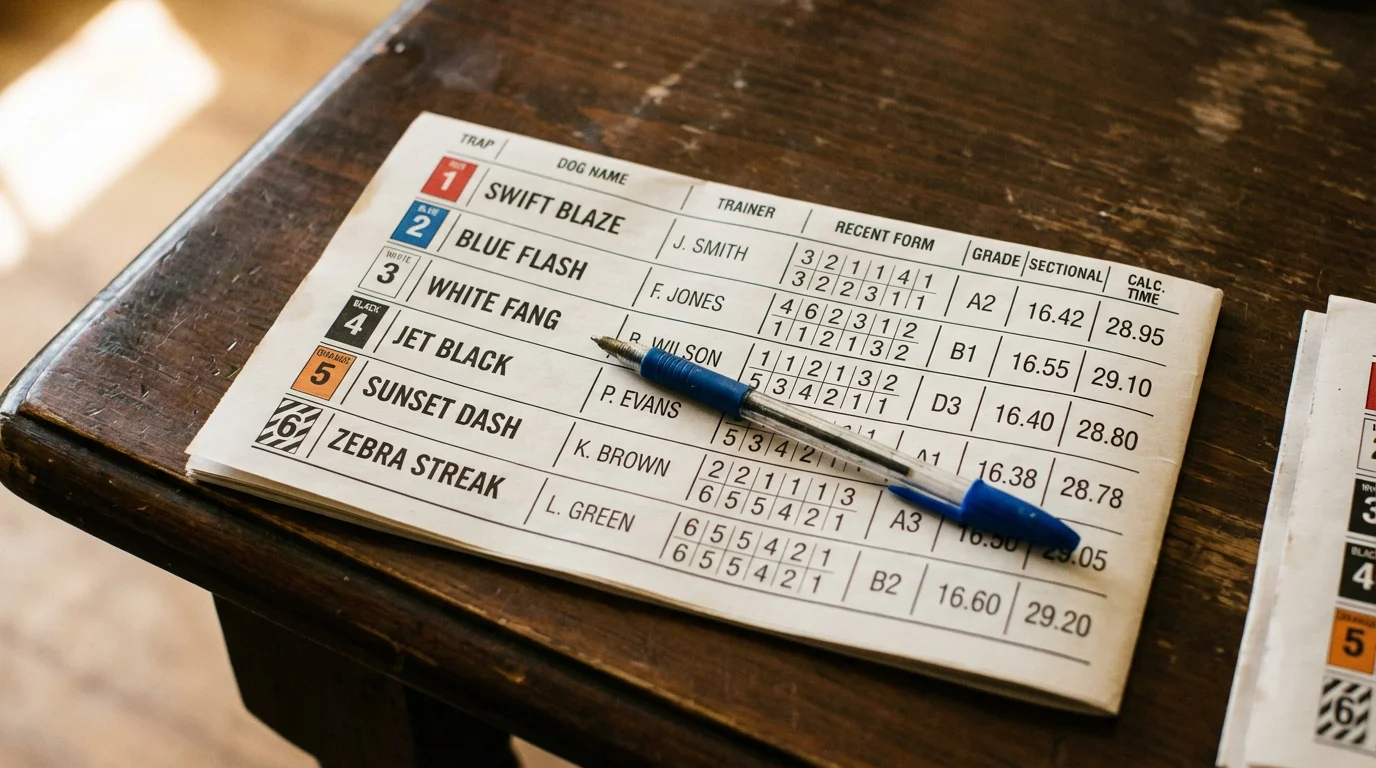
A standard greyhound race card line displays the dog's name, trainer, trap number, and recent form figures. The form figures are a sequence of digits — typically six — representing the dog's finishing positions in its last six races, read from left to right with the most recent run on the right. A line reading 3 2 1 1 4 1 tells you the dog finished third, second, first, first, fourth, and first in its last six outings, with that final 1 being the most recent performance.
Alongside the finishing positions, you will usually see the grade of each race (A1, A2, B1, and so on), the track where the race took place, the distance, and the dog's calculated finishing time. The finishing time is adjusted for going — a crucial detail, because a 29.50-second run on heavy sand is faster in real terms than a 29.30 on a quick surface. Look for the phrase "calc" or "adj" next to the time; that is the standardised figure you should use for comparison.
Weight is also listed and matters more than casual bettors assume. A greyhound that has gained a kilogram since its last run may have been rested or recovered from injury. A drop can signal intense training. Neither direction is automatically positive or negative, but stable weight across recent runs is generally a healthy sign.
Sectional Times and What They Reveal
Sectional times are the data layer that separates serious form analysts from casual punters. The first sectional — often called the split — measures how quickly a dog reaches the first bend from the traps. It is the single most predictive number on the card. A dog with a consistently fast split is an early-speed runner, likely to lead into the first bend and avoid the crowding that decides most races. A dog with slower splits but strong finishing times is a closer — reliant on racing room and clear bends.
Comparing sectionals across different tracks requires caution. A 4.05-second split at Crayford (tight, short run-in) is not equivalent to a 4.05 at Towcester (wider, longer approach). Always benchmark against the track average, not across venues.
The gap between the first sectional and the overall finishing time reveals a dog's finishing effort. A large gap suggests heavy deceleration — common in sprinters contesting middle-distance events. A narrow gap indicates sustained pace, which is valuable in staying trips and crowded fields.
Running Comments and Abbreviations
Running comments are the shorthand annotations that describe what actually happened during a race. They appear alongside or beneath the form line and are your window into the narrative that the numbers cannot fully capture. The most common abbreviations you will encounter on UK race cards include: Ld (led), which means the dog was in front at some stage of the race; EvPce (even pace), indicating the dog ran consistently without a significant burst or fade; Bmp (bumped), meaning the dog was knocked by another runner; CrdRnUp (crowded run up), describing interference on the approach to the finish; RlsStt (rails to straight), showing the dog raced on the inside rail before switching to the straight; and MidTr (middle track), meaning the dog ran a central path through the bends.
A running comment reading "EP,Ld1-Bmp3" tells you the dog showed early pace, led at the first bend, and was bumped at the third bend. That bump may explain a poor finishing position that the raw form figure makes look worse than it was. These comments are where the value hides: a dog whose form reads 5 4 6 might look dreadful until you see that it was bumped or crowded in every one of those runs. A clear run from a favourable trap draw could produce a dramatically different result.
Trap 1 — Red
The inside rail position. Favours dogs with early pace who can hold the rail through the first bend without drifting wide.
Trap 2 — Blue
Slightly off the rail. Gives the dog a cleaner first stride than Trap 1 but still close enough to take the inside line early.
Trap 3 — White
The centre-inside position. Statistically one of the most successful traps across UK tracks, offering a balanced path to the first bend.
Trap 4 — Black
Centre-outside. Suits versatile runners who can angle inward or hold a middle line depending on how the break unfolds.
Trap 5 — Orange
The wide-middle draw. Dogs here need to show pace quickly or risk being squeezed toward the outside rail on the first bend.
Trap 6 — Black and White Stripes
The widest trap. Suits wide runners with strong early speed who can clear the pack on the outside and cut in through the bends.
Trap Position and Track Bias — The Hidden Variable
Not all starting boxes
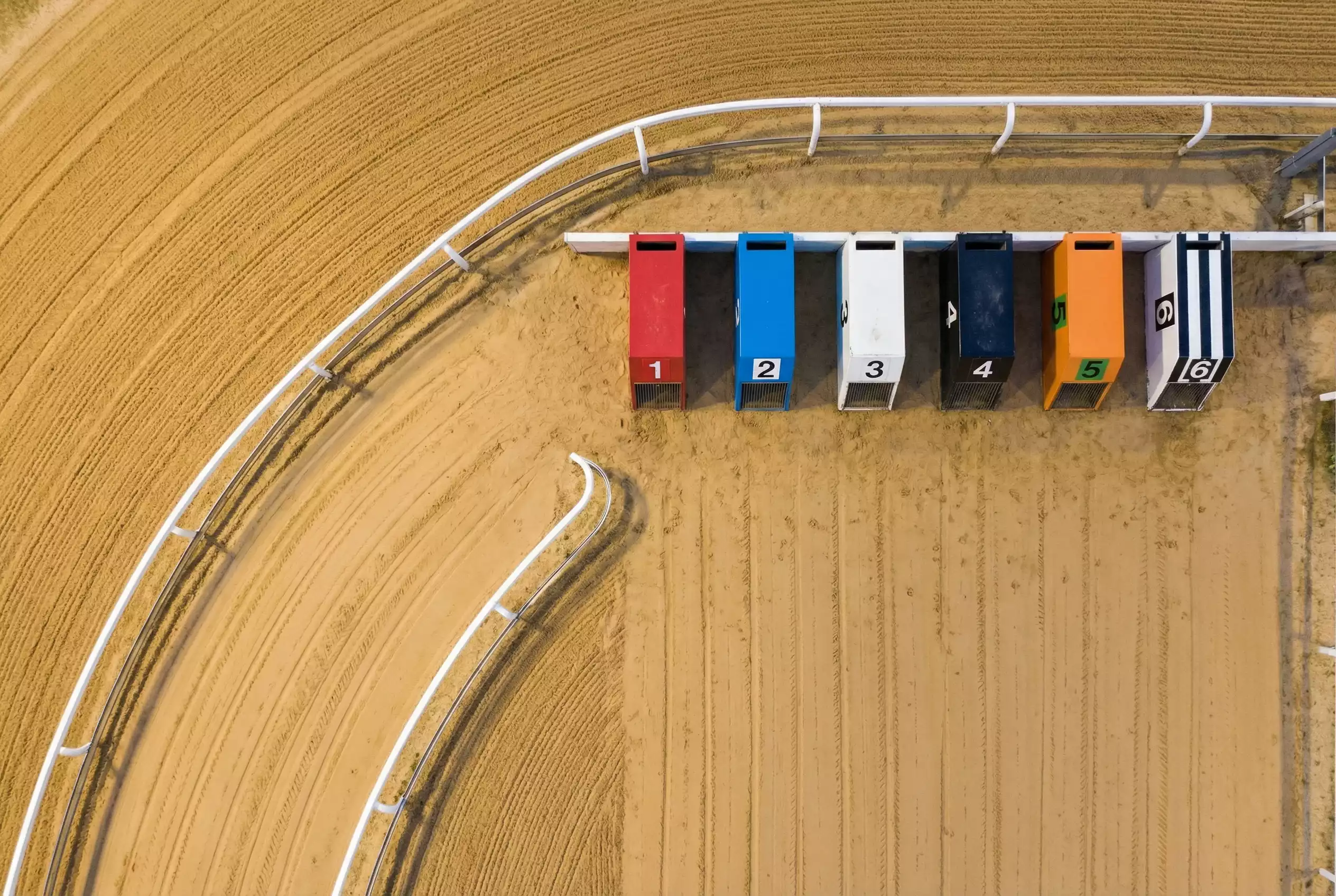
Are equal — and the data proves it. In a perfectly fair six-runner race, each trap would win approximately 16.7% of the time. In practice, the percentages shift according to track geometry, sand conditions, weather, and the way graders seed dogs into traps. Understanding these biases is not optional for anyone who wants to bet seriously on greyhound racing in the UK. It is one of the few areas where publicly available data gives you a genuine, repeatable edge.
The primary driver of trap bias is the distance from the starting boxes to the first bend. On tracks with a short run-in — Crayford is the classic example, with the traps positioned close to the turn — inside traps enjoy a structural advantage. The dog in Trap 1 has a protected rail, needs to cover less ground to reach the bend, and faces pressure from only one side. Across large samples at Crayford, Trap 1 historically records win rates in the region of 20% or higher, meaningfully above the expected average. Outside traps at tight circuits face a longer path into the first bend and more exposure to crowding, which drags their win percentages below the baseline.
Wide-running tracks with a long home straight tell a different story. At venues where the run to the first bend is generous, outside traps have room to establish position without being forced wide. The wider the circuit, the less punishing it is to break from Trap 5 or 6. Track-specific data from sites like GreyhoundStats.co.uk — which publishes trap-by-trap win percentages for every GBGB venue — allows you to quantify these differences rather than relying on anecdote.
Weather is the wildcard. When rain saturates a track, the inside rail often becomes the slowest part of the circuit. Water pools along the rail, and the sand closest to the inside edge drains last. On a sodden evening, you can see a complete reversal of normal bias: Traps 5 and 6 suddenly become dominant because the wide running line offers firmer ground. Wind matters too, particularly at exposed coastal or open-air venues. A headwind on the home straight punishes front-runners who have already spent energy leading through the bends, handing an advantage to closers who are still accelerating.
The practical takeaway is this: never apply a blanket assumption about trap advantage. Check the track-specific data before every meeting. Look at the night's opening results to spot an emerging session bias — if Trap 1 wins three of the first four races, the sand or the weather is doing something that the form cards did not predict. Bet accordingly, not retrospectively.
Worked Example: Comparing Trap 1 Bias at Crayford vs a Galloping Track
Step 1 — Gather the data. Check GreyhoundStats.co.uk for the current season's trap win percentages at both venues. At a tight circuit like Crayford, you might find Trap 1 winning around 19-20% of four-bend races. At a wider, galloping track, Trap 1 might sit closer to 16-17% — essentially at the theoretical expected rate.
Step 2 — Calculate the deviation. At Crayford, Trap 1 at 20% is running roughly 3.3 percentage points above the expected 16.7%. That is a relative advantage of about 20% over baseline. At the wider track, Trap 1 at 16.5% shows virtually no deviation. The edge exists at Crayford; it does not exist at the other venue.
Step 3 — Apply to the race card. You are considering a dog in Trap 1 at Crayford whose form suggests it is a front-running railer. The trap bias data confirms the structural advantage. If the same dog were drawn Trap 5 at the same track, the bias works against it — Trap 5 at Crayford may sit around 13-14%, well below baseline. The dog's form has not changed, but its probability has.
Step 4 — Factor in conditions. Check the weather. If rain is forecast or the track has been heavily watered, that 20% Trap 1 figure may not hold for the evening. Watch the first two or three races to see whether the bias is tracking its historical pattern before committing money.
Core Betting Strategy for Greyhounds
Strategy is what separates a punter from a gambler. There is nothing wrong with having a flutter on a dog because you like the name or the jacket colour — but if you want to show a profit over any meaningful sample of bets, you need a method. The good news is that greyhound racing, because of its small fields and abundant data, is one of the most system-friendly betting sports available. The bad news is that no system works without discipline.

Early Speed vs Late Pace — Reading the Race Before It Starts
The single most important factor in greyhound race outcomes is what happens at the first bend. Data across UK tracks shows that the dog leading at the first turn wins the race between 40% and 60% of the time, depending on venue and distance. That statistic alone should shape your selection approach. Before looking at grade, weight, or recent form, look at the first sectional times and ask: which dog is most likely to lead at the first bend?
Early-speed dogs break fast, take the shortest route to the rail, and control the race from the front. They are vulnerable to bumping if an adjacent runner has similar pace, but they are less dependent on luck than closers. Late-pace dogs need clear racing room through the bends and a weakening leader to close down. In sprints, early speed is almost everything. In staying events over 600 metres, late pace gains relative value because there are more bends and more time for the leader to tire.
The practical application: identify the dog with the fastest first sectional at that track, confirm its trap draw gives it a clean path to the first bend, and check whether any adjacent runner has comparable early pace. If your selection leads the split column and sits in a favourable trap, you have the foundation of a strong bet.
Value Betting and Odds Comparison
A winning bet at bad odds is still a losing proposition over time. Value exists when the bookmaker's odds imply a lower probability than you believe the true probability to be. If you assess a dog's chance at 25% but the market offers 5/1 (implying roughly 17%), that is a value bet — regardless of whether it wins.
Greyhound markets tend to be less efficient than horse racing. Less public analysis, fewer professional form students, and the sheer volume of BAGS racing means bookmakers often price cards algorithmically rather than through detailed assessment. This creates pockets of value, particularly in lower-grade races. Tools like Oddschecker let you compare prices across bookmakers in seconds. A dog at 4/1 with one firm and 7/2 with another represents a meaningful gap — over a hundred bets, that compounds significantly. Always check at least three bookmakers before placing a single.
Bankroll Management Basics
No staking plan can turn a negative-expectation selection process into a profit. What bankroll management does is protect you from the inevitable losing runs that even skilled bettors experience, and prevent a single bad evening from wiping out weeks of careful work.
Percentage staking is the simplest sound approach. Allocate a fixed bankroll and bet a consistent percentage on each selection — two to three percent is a common range. On a five-hundred-pound bankroll, that means ten to fifteen pounds per stake. If the bankroll grows, stakes grow proportionally. If it shrinks, stakes shrink too, slowing the rate of loss during a downturn.
Avoid progressive staking systems like the Martingale, which doubles the stake after a loss. These collapse in practice because a losing streak of five or six — entirely normal in greyhound racing — requires an exponentially larger stake to recover. Set a daily loss limit, decide on it before the first race card, and close the app when you reach it.
DO
- Study sectional times and running comments before every bet — the form line number alone is not enough.
- Specialise in one or two tracks where you can build deep knowledge of graders, trap patterns, and surface behaviour.
- Compare odds across at least three bookmakers before placing any wager.
- Keep a record of every bet: selection, odds taken, stake, and result. Review it monthly.
DON'T
- Chase losses by increasing stakes after a bad race or a bad evening.
- Back the favourite blindly — favourites win roughly 30% of UK greyhound races, meaning they lose more than twice as often as they win.
- Ignore trap bias data because the form looks strong. A good dog in a bad trap is still a bad bet.
- Treat accumulators as a strategy — they are entertainment, not a path to consistent profit.
Set a daily loss limit before you open a betting app — not after.
Greyhound Racing Odds — How Pricing Works
The number on the screen is not a prediction — it is a price. Understanding how that price is formed, and the different pricing mechanisms available to you, is fundamental to identifying when a bet offers value and when you are simply paying the market rate for an obvious outcome.
Starting Price vs Fixed Odds
The Starting Price is the official odds at the moment the traps open, determined from the on-course bookmaker boards as a weighted average. For off-course bets placed at SP, this is the price you receive — whatever it turns out to be.
Fixed odds are the price you lock in when you place your bet. If the market moves afterwards, your price does not change. The strategic choice: take a fixed price early if you believe the dog will shorten, or accept SP if you believe it will drift. Predicting market direction requires understanding where the public money flows — on heavily backed favourites, early fixed odds often offer better value than the compressed SP.
Best Odds Guaranteed (BOG)
Best Odds Guaranteed removes most of the risk from the fixed-odds-versus-SP decision. Most major UK bookmakers offer BOG on greyhound racing, meaning that if you take a fixed price and the SP turns out to be higher, you receive the higher price. If the SP is lower, you keep your original fixed price. In effect, you always get the better of the two.
BOG is one of the most genuinely valuable promotions in greyhound betting, and it is worth confirming that your bookmaker offers it on dogs before placing a wager. Not all operators extend BOG to BAGS meetings or to all tracks — some restrict it to evening or weekend cards. The terms vary, so check the small print. When BOG is available, there is almost no reason to bet at SP rather than taking an early fixed price.
Tote Pools and Betfair Exchange
The Tote operates a parimutuel pool on greyhound racing. All stakes on a particular outcome go into a common pool, the operator takes a percentage, and the remainder is divided among winning tickets. The dividend is unknown until after the race. Tote Win pools often produce dividends close to the SP, but when public money concentrates on one or two dogs, an outsider can pay significantly more. The Tote Exacta and Trifecta pools operate on the same principle and can return figures substantially different from the Computer Straight Forecast or Computer Tricast equivalents.
Betfair's exchange lets you bet at odds set by other bettors. You can back a dog to win or lay a dog — betting it will not win. Lay betting is powerful in six-runner fields because the dog you lay has a roughly 83% chance of losing at a baseline level. Exchange liquidity on greyhounds is thinner than on horses, particularly for BAGS meetings, but for evening cards and Category One events the markets offer competitive prices and, occasionally, better value than any bookmaker.
SP is declared at trap rise; BOG guarantees the higher of your fixed price or SP. When BOG is available, take the early fixed price — you cannot lose the comparison.
UK Greyhound Tracks — A Quick Reference
There are eighteen GBGB licensed stadiums still operating — here is what matters about each. Track character varies enormously: some circuits are sharp and tight, heavily favouring inside runners, while others are wide and galloping, giving outside traps a fair chance. Knowing the character of a track before you study the form card saves you from backing the wrong type of dog in the wrong place.
| Stadium | Location | Standard Distance | Track Character |
|---|---|---|---|
| Belle Vue | Manchester | 460m | Galloping track, suits middle runners |
| Central Park | Sittingbourne, Kent | 400m / 630m | Multi-distance venue, opened as a new build |
| Crayford | Kent | 380m | Sharp bends, strong inside-trap bias |
| Doncaster | South Yorkshire | 450m | Fair track, even trap stats |
| Dunstall Park | Wolverhampton | 480m | New purpose-built venue, debuted 2025 |
| Harlow | Essex | 415m | Compact circuit, favours early speed |
| Henlow | Bedfordshire | 460m | Unique three-bend layout, unusual biases |
| Hove | Brighton | 500m | Tight inside bias, Trap 1 historically strong |
| Kinsley | West Yorkshire | 462m | Independent feel, less predictable form patterns |
| Monmore Green | Wolverhampton | 480m | Well-known bias patterns, study trap data closely |
| Newcastle | Tyne and Wear | 480m | Galloping circuit, suits wide runners |
| Nottingham | Nottinghamshire | 500m | Category One host, fair track |
| Oxford | Oxfordshire | 450m | Welcomes new Category Two events in 2026 |
| Valley | Ystrad Mynach, Wales | 410m | The only GBGB-licensed track in Wales, subject to proposed ban |
| Romford | East London | 400m | Short distance suits sprinters, accessible by rail |
| Sheffield | South Yorkshire | 500m | Popular Saturday night venue, lively atmosphere |
| Sunderland | Tyne and Wear | 450m | Northern circuit, regular BAGS schedule |
| Towcester | Northamptonshire | 500m | Derby host, galloping layout, wide circuit |
Track availability changes over time. The last independent (non-GBGB) stadium in England closed in March 2025, and the Welsh greyhound racing ban, if implemented, could reduce the licensed count further. Always check the GBGB website at gbgb.org.uk for the current fixture list before planning a visit or building a betting strategy around a particular venue.
Live Streaming and Where to Watch
You do not need to be at the track to read a race. Live streaming has transformed greyhound betting from a track-only experience into something accessible from anywhere with a phone signal. The quality of greyhound streams has improved significantly, and access is usually free — provided you hold a funded account with the right bookmaker.
SIS (Sports Information Services) holds contracts with the majority of GBGB stadiums to stream races into betting shops and online platforms. SIS feeds are available through most major UK bookmakers, including bet365, Coral, Ladbrokes, and William Hill. To access a stream, you typically need a positive account balance or a bet on the relevant meeting. Coverage spans virtually every BAGS meeting and most evening cards.
Sky Sports Racing, on Sky channel 415, broadcasts selected greyhound meetings with full commentary and analysis, focusing on higher-profile evening cards and Category One events. RPGTV offers dedicated greyhound coverage through Sky and Freesat, with a focus on form discussion tailored specifically to dog racing punters.
For bettors, streaming is not just convenience — it is a data source. Watching races live lets you spot emerging track biases, evaluate sand conditions, and determine whether a dog's form figures tell the full story. A dog that finished fifth but ran wide throughout because of a rail-side track issue tells you more through the stream than the form card ever could.
Responsible Gambling and Legal Framework
Greyhound betting operates under the same UKGC licence rules as every other regulated market. The UK Gambling Commission licenses all operators that offer greyhound betting to British customers, whether those operators are online platforms, high-street bookmakers, or on-course tote providers. Any site or shop offering odds on UK greyhound racing must hold a valid UKGC licence, and bettors should verify this before depositing money. The Commission's corporate strategy for 2024 to 2027 continues to prioritise consumer protection, operator accountability, and the integrity of betting markets.
Every licensed operator is required to offer self-exclusion tools. These include deposit limits (daily, weekly, or monthly), loss limits, session time reminders, and cooling-off periods during which your account is temporarily blocked. GAMSTOP is the national self-exclusion scheme: once registered, you are excluded from all UKGC-licensed online gambling sites for a period of your choosing — six months, one year, or five years. Registration is free and takes effect within twenty-four hours.
The minimum legal age for placing a bet on greyhound racing in the UK is eighteen. This applies to on-course betting, betting shops, and all online platforms. Age verification is mandatory at the point of registration, and operators face significant penalties for failing to enforce it.
The broader regulatory landscape for greyhound racing itself is evolving. Wales announced its intention in 2025 to ban greyhound racing on animal welfare grounds, though the timeline remains uncertain. Bills proposing similar bans have been introduced in Scotland, and the debate continues at Westminster — though the UK Government has stated it does not intend to pursue a nationwide ban. For bettors, the practical implication is that the number of active tracks may change over the coming years. The betting markets themselves are not under threat: as long as GBGB stadiums operate, licensed bookmakers will price their races.
If gambling stops being fun, stop. GambleAware offers free advice and support at www.gambleaware.org. Helpline: 0808 8020 133.
FAQ
How do you read a greyhound form guide and what do the symbols mean?
A greyhound form guide displays each dog's recent racing history in a condensed format. The most important element is the finishing position sequence — a string of numbers representing the dog's last six results, with the most recent on the right. A line reading 2 1 3 1 5 1 shows a dog that finished first in three of its last six races, including its latest run. Alongside these figures you will find the track, distance, grade, and finishing time for each run.
Common abbreviations in the running comments include: Ld (led), Bmp (bumped by another runner), Crd (crowded), EvPce (even pace throughout), SAw (slow away from traps), RlsStt (railed to straight), and MidTr (middle track). These comments reveal the context behind the raw numbers. A dog that finished fourth but was recorded as "Bmp1,Crd2" was interfered with at the first and second bends — its finishing position may understate its true ability. Always read the comments alongside the form figures, not instead of them.
What is the difference between a forecast, reverse forecast, and tricast in greyhound betting?
A straight forecast requires you to name the first and second finishers in exact order. The payout is determined after the race by the Computer Straight Forecast formula, which uses the starting prices of the two placed dogs. A reverse forecast covers both possible orderings of your two selections — if either one finishes first and the other second, you win. It costs twice the unit stake because it is effectively two straight forecasts.
A tricast extends the principle to the first three finishers in exact order. The Computer Tricast dividend is usually significantly larger than a forecast because the difficulty is greater. A combination tricast covers all six possible orderings of three selected dogs, costing six times the unit stake. In six-runner greyhound fields, these bets are more achievable than in horse racing, which is why forecast and tricast markets are among the most popular with experienced greyhound punters.
Does trap position really matter — and which traps win most at UK tracks?
Trap position matters, but the degree of its influence depends heavily on the specific track. In a perfectly balanced six-dog race, each trap would win about 16.7% of the time. In practice, certain traps at certain venues consistently outperform or underperform this baseline. At tight, sharp tracks where the run from the traps to the first bend is short, inside traps — particularly Trap 1 — tend to record higher win percentages, sometimes reaching 19-20%. At wider, galloping circuits with a longer run-in, the advantage is less pronounced and may shift toward middle traps.
Weather complicates the picture further: rain can waterlog the inside rail and temporarily reverse the usual bias toward outside runners. The best approach is to consult track-specific trap statistics from the current season, available through data sites like GreyhoundStats.co.uk, and to watch the opening races of each meeting for signs of a live session bias before committing to selections.
The Last Bend — Where Instinct Meets Information
Every punter remembers the first time the form told them something the odds had not. Maybe it was a dog whose running comments screamed bad luck for three straight races, finally drawn in the right trap at the right track. Maybe it was a sectional time that pointed to an early leader at a venue where the inside rail was worth two lengths. Whatever the moment, it is the one that separates a casual evening at the dogs from the beginning of a method.
Greyhound racing in 2026 is a sport in transition. The centenary year carries both celebration — fifty Category One events, a packed open race calendar, the English Greyhound Derby returning to Towcester — and uncertainty, with welfare debates in Wales and Scotland, changing ownership at key venues, and a regulatory environment that continues to tighten. For bettors, the fundamentals remain the same. Six dogs, a form card, and thirty seconds of chaos that reward the prepared and punish the reckless.
The form guide gives you probability. The last bend gives you chaos. The space between those two things is where every profitable greyhound bet lives. You will not get it right every time. Nobody does. The favourites win about three races in ten, which means even the market consensus is wrong more often than it is right. But the punters who show a profit over months and years share a few common habits: they specialise in a small number of tracks, they study sectional times rather than just finishing positions, they compare odds before every bet, and they walk away when the daily limit is reached.
Start small. Pick one or two tracks, learn the graders' tendencies, build a feel for the sand on different nights, and keep a record of every bet you place. The race card is not a puzzle to be solved once — it is a conversation with the race, and the more conversations you have, the better your ear becomes. The dogs do not know the odds. They run. What you do with the information before the traps open is the only variable you control.
