Best Greyhound Betting Sites – Bet on Greyhounds in 2026
Loading...
Greyhound racing arrived in Britain in 1926 and within two years was drawing crowds that rivalled football. At its peak, tens of millions of spectators passed through the turnstiles annually, betting shops were built around the sport’s schedule, and the Greyhound Derby was a genuine national event. The decline that followed was long, uneven, and driven by forces — television, competing leisure options, property development — that the sport could not control. What remains is a smaller industry that has survived where many predicted it would not, still running live racing at stadiums across England and Scotland, still generating betting turnover, and still producing athletes worth watching.
This is the story of British greyhound racing, from coursing fields to oval tracks, through a golden age and into a modern era where survival itself is the measure of success.
Origins: Coursing to Oval Tracks
Greyhound coursing — the pursuit of live hares by dogs — has a long history in the British Isles, stretching back centuries. But modern greyhound racing, as a spectator sport contested on an oval track with a mechanical lure, is a twentieth-century invention. The breakthrough came from the United States, where Owen Patrick Smith developed the mechanical hare in the early 1920s. Smith’s innovation eliminated the need for live prey and allowed racing to take place on enclosed circuits, creating a format that could be staged regularly, at fixed times, in urban locations — everything a commercial entertainment product required.
The first oval-track greyhound meeting in Britain took place at Belle Vue Stadium in Manchester on 24 July 1926. The event drew an estimated 1,700 spectators — a modest crowd by the standards that would follow, but enough to demonstrate that the concept worked. Within months, promoters were building or converting stadiums across the country. White City in London opened in June 1927 and quickly became the sport’s flagship venue. By the end of 1927, dozens of tracks were operating, and the first English Greyhound Derby had been staged at White City to widespread public interest.
The speed of growth was extraordinary. The combination of accessible urban locations, evening meetings that suited working-class schedules, and on-course betting in an era before off-course betting was legalised created a product that met massive latent demand. Greyhound racing was cheap to attend, quick to understand, and offered the excitement of gambling in a social setting. Within its first decade, the sport had established itself as one of the most popular leisure activities in Britain.
The National Greyhound Racing Club, later succeeded by the Greyhound Board of Great Britain, was established in 1928 to regulate the sport. Its formation acknowledged that the rapid commercial expansion needed governance — rules for race conduct, welfare standards for dogs, and oversight of betting practices. The regulatory framework, though it evolved over the following decades, established the basic structure that persists today.
The Golden Age
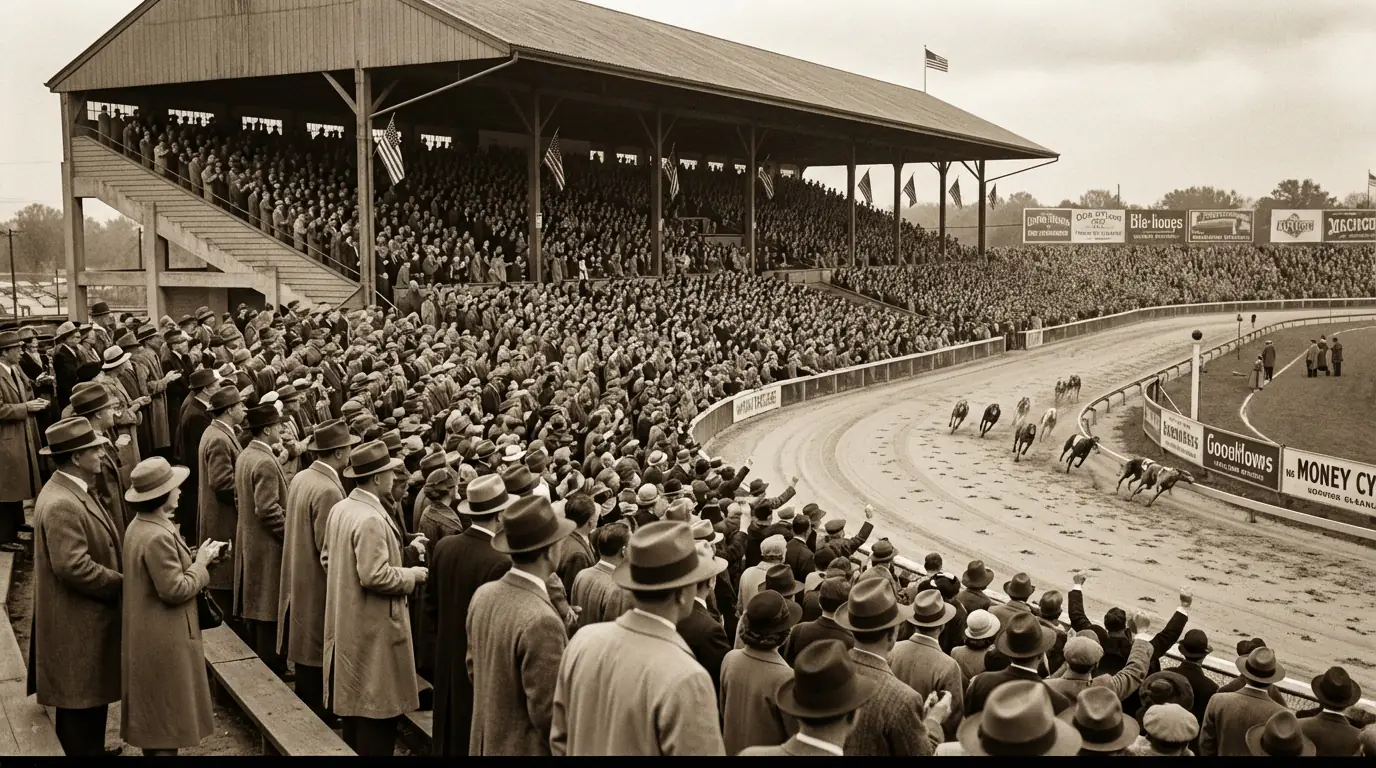
From the late 1920s through the 1960s, greyhound racing was a mainstream British entertainment. Annual attendance peaked at approximately 70 million in 1946 — a figure that placed the sport alongside football as one of the country’s most popular spectator events. Every major city had at least one greyhound stadium, and many had several. London alone supported more than thirty tracks at the sport’s height.
The betting economy around greyhound racing was enormous. Before the legalisation of off-course betting shops in 1961, the on-course Tote and bookmakers at the track were the primary channels for legal gambling on greyhounds. The volumes were staggering. Greyhound meetings generated more betting turnover than horse racing on a per-event basis during certain periods, because the frequency of meetings — evening racing several nights a week at multiple venues — produced a cumulative volume that flat racing’s seasonal schedule could not match.
The sport produced stars. Mick the Miller, who won the English Derby in 1929 and 1930, became arguably the first animal celebrity in British popular culture. He appeared in a feature film, was photographed for national newspapers, and attracted crowds that transcended the sport’s usual audience. Subsequent champions — Doohickey, Pigalle Wonder, Scurlogue Champ — sustained the public’s interest across the decades, though none achieved Mick the Miller’s crossover fame.
The golden age was also the era of the great stadiums. White City, Wimbledon, Wembley, Harringay, Walthamstow, Hackney Wick, Catford, and New Cross formed a London circuit that ran multiple meetings weekly. In the Midlands and the North, Belle Vue, Hall Green, Perry Barr, Owlerton, and dozens of others served regional audiences. These stadiums were purpose-built or adapted for greyhound racing, with grandstands, bars, restaurants, and Tote facilities that made the evening at the dogs a complete social outing.
Decline and Track Closures
The decline began in the 1960s and accelerated over the following decades. The Betting and Gaming Act of 1960, which legalised off-course betting shops from 1961, removed the monopoly that on-course gambling had given greyhound tracks. Punters could now bet in a shop near their home rather than travelling to the track, and the convenience factor eroded attendance at meetings across the country.
Television offered competing entertainment. Rising car ownership made it easier to spend leisure time elsewhere. The demographic that had filled greyhound stadiums — working-class men with limited evening entertainment options — now had alternatives that did not require leaving the house or paying an entrance fee.
The economic squeeze hit tracks hardest through land values. Greyhound stadiums occupied large plots in urban areas, and as property prices rose through the 1970s, 1980s, and beyond, the land beneath the tracks became worth more as development sites than as racing venues. Track after track was sold to developers. White City closed in 1984. Hackney Wick, Catford, and Walthamstow followed in subsequent decades. Wimbledon — the Derby’s home for over thirty years — closed in 2017 to make way for a new football stadium. Each closure removed a piece of the sport’s infrastructure and reduced the number of venues available for racing.
By the early 2000s, the number of GBGB-licensed tracks had fallen below thirty. By 2020, it had declined further. The closures were concentrated in London and the South East, where land values were highest, but regional tracks were also affected. The sport that had once operated more than seventy tracks was running on a fraction of that number.
The Modern Era: GBGB, Welfare, and Survival
The Greyhound Board of Great Britain oversees the sport today, managing regulation, welfare standards, and the integrity of racing. The modern GBGB has placed greater emphasis on greyhound welfare than its predecessors — partly in response to public concern about the treatment of racing dogs and partly because the sport’s long-term viability depends on maintaining a social licence to operate.
Welfare reforms have included mandatory injury reporting (all injuries sustained during racing or trials must be recorded and published), the introduction of retirement bonds (financial reserves to fund the rehoming of dogs when their racing careers end), and increased kennel inspections. The GBGB publishes annual welfare data, including injury statistics and rehoming figures, providing a level of transparency that was absent in earlier eras.
The betting landscape has also evolved. BAGS racing provides a stable revenue stream through broadcasting rights, ensuring that tracks receive income from bookmakers even when spectator attendance is low. Online betting has opened greyhound racing to a wider audience, and live streaming through bookmaker platforms means punters can watch and bet on races without attending in person. These revenue streams have not replaced the lost attendance income entirely, but they have helped sustain tracks that might otherwise have closed.
The sport faces ongoing challenges. The debate over greyhound welfare continues, with campaigners calling for stricter regulation and, in Wales, a proposed ban on greyhound racing that has been the subject of political discussion. Track closures remain a threat wherever land values make development more profitable than racing. And the competition for betting revenue from other sports, casino products, and virtual racing means that greyhound racing must continually justify its share of the bookmaker’s portfolio.
Still Running
British greyhound racing in 2026 is a smaller, quieter industry than the one that packed White City in the 1940s. But it is still here. Still running live racing at stadiums in England and Scotland, still producing athletes that cover 480 metres in under thirty seconds, still generating betting markets that reward the punter who studies the form. The sport’s survival is not guaranteed — no leisure industry’s is — but the fact that it survived the loss of its great stadiums, the shift to off-course betting, and decades of declining attendance suggests it has something durable at its core. Six dogs, a mechanical hare, and thirty seconds of controlled chaos. The format has outlasted nearly everything built around it.