

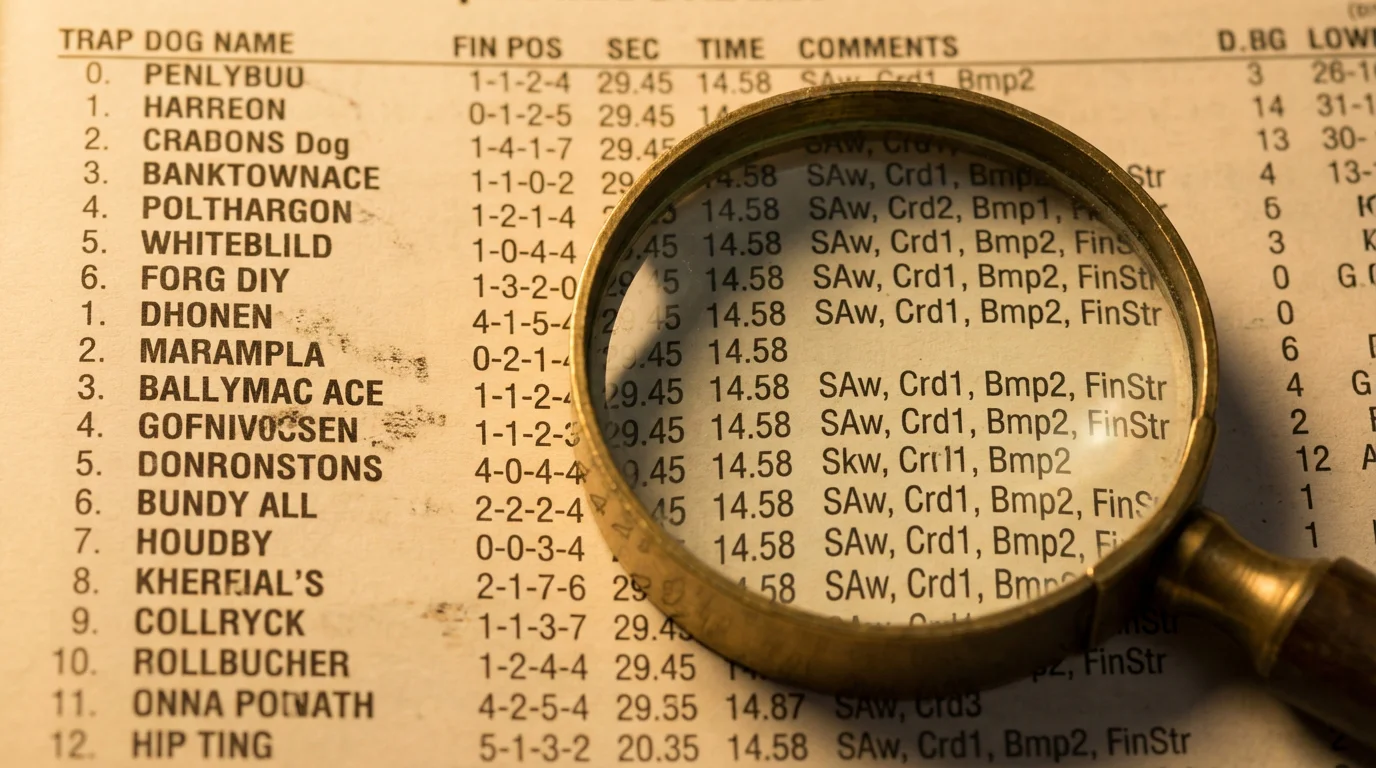
Greyhound form cards are written in a compressed language of abbreviations that looks impenetrable until you learn the vocabulary. Every running comment, position code, and behavioural note on the card has a specific meaning, and together they tell the story of what happened during the race in far more detail than the finishing position alone. A dog that finished fifth with the comment “SAw, Bmp1, CrdRnUp, FinFst” had a dramatically different race from one that finished fifth with “EP, Ld1, Wknd3” — and the distinction matters for predicting what happens next time.
This glossary covers the most common abbreviations used on UK greyhound form cards, organised by function. Keep it as a reference when studying race cards, and over time the abbreviations will become second nature.
Position and Running Codes
These abbreviations describe where the dog was positioned during the race and how its running unfolded from trap to line.
| Code | Meaning | What It Tells You |
|---|---|---|
| Ld | Led | Was in front at a specific point. Ld1 = led at bend 1, Ld1-4 = led from bend 1 to bend 4. |
| Disp | Disputed lead | Raced alongside another dog for the lead. Disp1 = disputed the lead at bend 1. |
| EP | Early Pace | Showed good speed from the traps. A general indicator of front-running tendency. |
| QAw | Quick Away | Fast exit from the traps. More specific than EP — refers to the actual trap break. |
| SAw | Slow Away | Poor start. The dog was left behind when the traps opened. |
| MsdBrk | Missed Break | Significantly slow start — worse than SAw. May indicate the dog was distracted or hesitant. |
| AlP | Always Prominent | Raced near the front throughout without necessarily leading. |
| Mid | Mid-division | Raced in the middle of the pack. Neither leading nor trailing. |
| Bhd | Behind | Raced at the rear of the field. |
| RnOn | Ran On | Maintained or increased pace in the closing stages. The dog was staying on at the finish. |
| FinFst | Finished Fast | Closed strongly in the final straight. Stronger indication of finishing speed than RnOn. |
| Chl | Challenged | Made a move to overtake. Chl3 = challenged at bend 3. |
| EvCh | Every Chance | Had a clear, unimpeded run and a fair opportunity to win. If the dog still lost, the form is reliable. |
| NvDngr | Never Dangerous | Was never in contention. The dog was outpaced from early in the race. |
| Wknd | Weakened | Faded in the closing stages. Wknd3 = started to fade from bend 3 onwards. |
| LdNrLn | Led Near Line | Hit the front only in the final strides. Indicates strong closing pace. |
The most useful codes for betting are those that describe pace. Dogs consistently showing EP, QAw, and Ld comments are confirmed front-runners. Dogs with FinFst and RnOn are confirmed closers. Knowing a dog’s running style from its form comments allows you to project how it will run from a specific trap draw in the next race.
Incident and Contact Codes
These abbreviations describe interference, crowding, and incidents that affected the dog’s run. They are the most important codes for identifying form that does not represent a dog’s true ability.
| Code | Meaning | What It Tells You |
|---|---|---|
| Bmp | Bumped | Made contact with another dog. Bmp1 = bumped at bend 1. The severity varies. |
| Ck | Checked | Forced to slow down due to another dog’s movement. More significant than a bump. |
| BCk | Badly Checked | Severely impeded. Lost significant ground and momentum. |
| Crd | Crowded | Squeezed for room. Crd2 = crowded at bend 2. The dog had to adjust its path. |
| CrdRnUp | Crowded Run Up | Squeezed on the home straight. Often happens when two dogs converge toward the rail. |
| Blk | Baulked | Severely impeded and forced to change direction. The most serious interference comment. |
| Fell | Fell | The dog fell during the race. Usually at a bend after contact or losing footing. |
| BmpFell | Bumped and Fell | Fell as a result of contact with another dog. |
| RnOut | Ran Out | Veered sharply off course, typically toward the outside fence. |
Any form line containing Bmp, Ck, Crd, or Blk should be treated with caution. The finishing position in that race may not reflect the dog’s ability. A dog that finished last after being baulked at bend two had its race ended by an incident, not by lack of speed. When assessing this dog for its next outing, mentally discount the affected run and weight the preceding clean runs more heavily.
The converse is also useful: a dog marked EvCh (every chance) that still lost was given a fair run and could not win. That form line is reliable. Do not make excuses for a dog whose running comments confirm it had every opportunity.
Behavioural and Miscellaneous Codes
These abbreviations describe the dog’s behaviour, running line, and miscellaneous aspects of its race.
| Code | Meaning | What It Tells You |
|---|---|---|
| Wide | Ran Wide | Raced on the outside of the track. Covers more ground than dogs on the rail. |
| RlsStt | Rails to Straight | Headed for the inside rail from the start. Indicates a natural inside runner. |
| MidTrk | Middle Track | Ran in the middle of the track, neither on the rail nor wide. |
| VSw | Very Slow | Track conditions affected the overall time. Not specific to the individual dog. |
| ImBy | Impeded By | Identifies which dog caused the interference (if specified). |
| SRnUp | Steadied Run Up | Eased in the home straight, usually because the outcome was decided. |
| FcdWde | Forced Wide | Pushed to the outside by another dog. Different from choosing to run wide. |
| StbStt | Stumbled Start | Lost footing when leaving the traps. |
| CmAg | Came Again | Was passed but rallied to challenge again. Indicates determination and stamina. |
Running-line codes — Wide, RlsStt, MidTrk — are important for projecting how a dog will handle a new trap draw. A dog that naturally goes to the rail (RlsStt) is best suited to inside traps. A dog that habitually runs wide may actually benefit from an outside draw where it does not have to cross the field. Matching a dog’s natural running line to its trap draw is one of the quieter edges in form analysis.
How to Use These Codes in Practice
Read the last three form lines for every dog in a race. Note the pattern, not the individual run. A dog that shows Bmp1 in one run might have been unlucky. A dog that shows Bmp1 or Crd1 in three consecutive runs has a positional problem — it is consistently finding trouble at the first bend, which suggests its trap draw or running style puts it in traffic repeatedly.
Build a mental profile of each dog’s running style from the codes: front-runner (EP, QAw, Ld), stalker (AlP, Mid, Chl), closer (Bhd, RnOn, FinFst). Then overlay that profile onto the trap draw for the upcoming race. A front-runner in trap one is well placed. A closer in trap one may get caught in traffic at the first bend because inside-drawn dogs are expected to lead or press the pace. The codes tell you how the dog runs; the trap draw tells you whether the position suits the style.
A Language in 3-Letter Chunks
Every abbreviation on the form card is a fragment of a thirty-second story. Individually, they are shorthand. Collectively, across three or four recent runs, they paint a picture of how a dog races, what trouble it encounters, and whether its results reflect its true ability. The punters who read these codes fluently have a permanent informational advantage over those who look at the finishing position and nothing else. The vocabulary is small. The returns from learning it are not.
