Best Greyhound Betting Sites – Bet on Greyhounds in 2026
Loading...
A betting exchange removes the bookmaker from the equation. Instead of betting against a bookmaker’s odds, you bet against other punters. One person backs a dog to win; another lays it to lose. The exchange matches the two sides, takes a commission on the winner’s profit, and lets the market set the odds. It is, at its core, a peer-to-peer marketplace for bets.
For greyhound racing, exchanges offer two distinct advantages over traditional bookmakers. First, the odds are often better — because the overround in a peer-to-peer market is typically lower than the margin built into a bookmaker’s fixed-odds prices. Second, you can lay as well as back, which opens up strategies that are impossible in the fixed-odds market. Whether those advantages are meaningful depends on liquidity — the amount of money available to be matched in the market — and on greyhounds, liquidity varies dramatically between high-profile events and everyday graded cards.
How Betting Exchanges Work
The exchange is a platform where backers and layers find each other. If you want to back Trap 3 at 5.0 (4/1), you submit a request on the exchange. If another user is willing to lay Trap 3 at 5.0, the exchange matches the bet. Your potential winnings come from the layer, not from the exchange itself. The exchange earns its money by charging commission on net winnings — a percentage deducted from the profit of the winning side after the race.
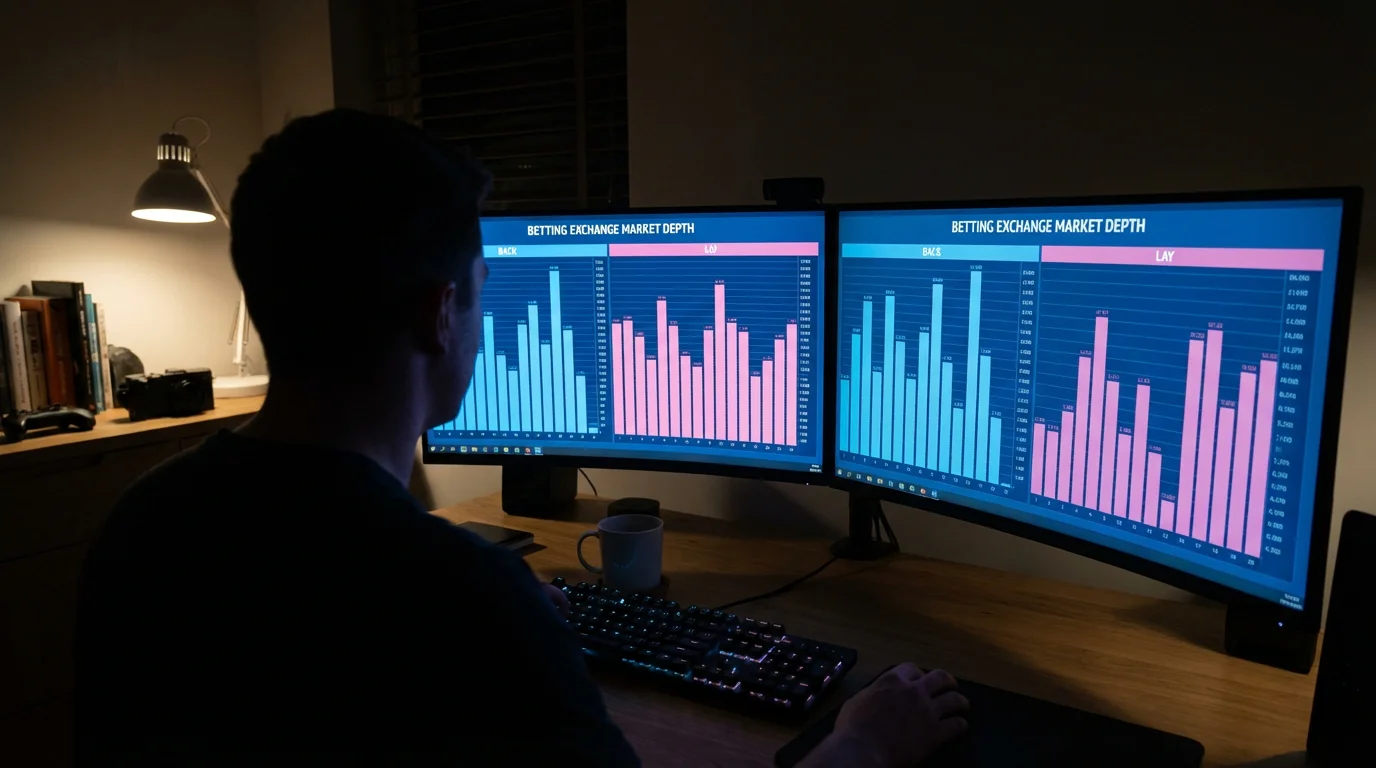
Prices on an exchange are set by the users, not by a central authority. The best available back odds (what you can bet at) and the best available lay odds (what you can accept from someone else) are displayed in a ladder format, similar to a stock order book. The gap between the best back price and the best lay price is called the spread. On liquid markets, the spread is tight — perhaps 4.8 back and 5.0 lay. On illiquid markets, it can be wide — 4.0 back and 6.0 lay — which makes getting a fair price more difficult.
You can request a price that is not currently available. If you want to back Trap 3 at 5.5 but the best available back price is 5.0, you can place your bet at 5.5 and wait for a layer to match it. This unmatched bet sits in the order book until it is matched or you cancel it. Close to the off, unmatched bets at unrealistic prices will simply expire unmatched. Timing is important: place your request too early and the market may move past your price; place it too late and there may not be enough time for a layer to see and match it.
Commission structures differ between exchanges and are the key variable in comparing platforms. Betfair charges a base rate of 5% on net market winnings, though long-term profitable customers may face a premium charge that increases the effective rate. Smarkets charges 2% commission. BETDAQ has varied between 2% and 5% depending on the period and the market. Commission directly affects your net profit on every winning bet, so the difference between 2% and 5% is material over hundreds of bets.
One structural point worth understanding: exchange bets are always settled at the odds you are matched at, not at the starting price. There is no SP option on an exchange. You see the price, you take the price (or request a better one), and that is the price your bet settles at. This gives you full control over your odds but also means you bear the risk of price movements — if you request a price and the market moves away from you before the bet is matched, you get nothing.
Betfair for Greyhounds
Betfair is the dominant exchange for greyhound racing in the UK. It offers the deepest liquidity, the widest coverage of meetings, and the most established market-making community. Virtually every UK and Irish greyhound meeting is covered on Betfair, from evening opens to daytime BAGS cards.
Liquidity, however, varies enormously between events. A Saturday evening open race at a major track might see tens of thousands of pounds matched across the market. A Tuesday afternoon BAGS C3 at a smaller venue might see a few hundred. On low-liquidity races, the spread between back and lay odds is wider, and getting matched at a favourable price requires patience and timing. On high-profile events — the English Derby heats and final, for example — the liquidity rivals horse racing, and the odds are sharp enough to beat most bookmaker prices after commission.
Betfair also offers in-play betting on greyhound races, which allows you to trade your position while the race is running. This is an advanced technique that requires fast reactions and a reliable live stream, but it enables strategies such as backing a dog pre-race and laying it in-play at shorter odds once it reaches the first bend in front. In-play exchange trading is not for beginners, but for experienced users, it adds a dimension that fixed-odds bookmakers cannot replicate.
The main drawback of Betfair for greyhound betting is the commission structure. The base 5% rate is higher than Smarkets, and the premium charge — applied to accounts with cumulative lifetime profits above a threshold — can raise the effective commission to 20% or higher. For consistently profitable greyhound bettors, the premium charge is a significant cost that must be factored into the long-term expected value of exchange betting.
Smarkets and BETDAQ
Smarkets positions itself as the low-commission alternative to Betfair, charging 2% on net winnings compared to Betfair’s 5%. For greyhound bettors, that three-percentage-point difference adds up. On a profitable month where you net one thousand pounds in winnings, Smarkets takes twenty pounds in commission; Betfair takes fifty. Over a year, the saving is substantial.
The trade-off is liquidity. Smarkets has a significantly smaller user base than Betfair, and greyhound markets on Smarkets are thinner. Major events attract reasonable volumes, but everyday graded races may have very little money available. Getting matched at your desired price on Smarkets often requires placing your bet earlier and accepting a longer wait, or adjusting your price to meet the available liquidity. For punters who primarily bet on major meetings and events, Smarkets is a viable platform. For those who want to trade on BAGS cards or in-play on evening meetings, the liquidity may not be there.
BETDAQ, founded by Irish billionaire Dermot Desmond and sold back to him by Entain in 2021, occupies a similar position. Commission rates have historically been competitive with Smarkets, though the exact rate has varied. Greyhound coverage on BETDAQ is comprehensive in terms of market availability — most UK meetings are listed — but the matched volumes are lower than both Betfair and Smarkets. BETDAQ’s integration with the Entain ecosystem means some cross-promotional opportunities exist for punters who also hold Coral or Ladbrokes accounts, but the exchange’s standalone appeal for greyhound betting is limited by its liquidity.
A practical approach is to maintain accounts on all three exchanges and use whichever offers the best odds for the specific bet you want to place. Compare back odds across all three platforms before committing. On races where Smarkets or BETDAQ liquidity is sufficient, the lower commission makes them the better option. On races where only Betfair has meaningful liquidity, use Betfair and accept the higher commission as the cost of access.
Exchange vs Bookmaker — When Each Wins
The exchange beats the bookmaker when the back odds, after commission, are higher than the bookmaker’s fixed odds. This happens frequently on longer-priced runners in competitive fields, because the exchange market is driven by punter opinion rather than the bookmaker’s need to maintain a margin across the full field. A dog priced at 6/1 with a bookmaker might be available at 7.0 or 7.5 on the exchange, and even after 5% commission, the effective odds are better.
The bookmaker beats the exchange when you want Best Odds Guaranteed, when exchange liquidity is too low to get matched, or when you want forecast and tricast markets (which exchanges do not offer). BOG on a bookmaker is a one-way upgrade that no exchange can replicate. If a bookmaker offers BOG on a meeting and the exchange odds are only marginally better, the BOG guarantee tips the balance toward the bookmaker, because the potential SP upgrade adds value that the exchange cannot match.
Forecast and tricast betting is exclusively a bookmaker product. Exchanges offer win markets only (and occasionally place markets), so if your analysis points to a forecast or tricast bet rather than a straight win, the exchange is not an option. Similarly, each-way betting is structured differently on exchanges — you place separate win and place bets rather than a single each-way bet — which adds complexity without necessarily adding value.
The most effective approach is to use both. Take early fixed prices with BOG when the bookmaker offers it. Use the exchange when the back odds are demonstrably better, when you want to lay, or when you want to trade a position in running. Treating bookmakers and exchanges as complementary rather than competing tools gives you the widest range of options and the best chance of finding value on any given race.
The Market Is the Bookmaker
On a betting exchange, there is no house to beat — just other punters whose opinions differ from yours. The exchange does not care which dog wins. It takes its commission regardless. This neutrality is what makes exchanges philosophically different from bookmakers, and it is what makes them attractive to bettors who believe their analysis is sharper than the crowd’s.
Whether that belief is justified is something only your results can answer. The exchange will not flatter you with promotional free bets or cushion your losses with insurance offers. It is a market, and markets reward accuracy and punish error. If your greyhound analysis consistently identifies value that the crowd has missed, the exchange is where that value pays the most — lower margins, fairer odds, and the ability to trade both sides of the market. If your analysis is no better than average, the commission will grind you down just as surely as the bookmaker’s margin would.