Best Greyhound Betting Sites – Bet on Greyhounds in 2026
Loading...
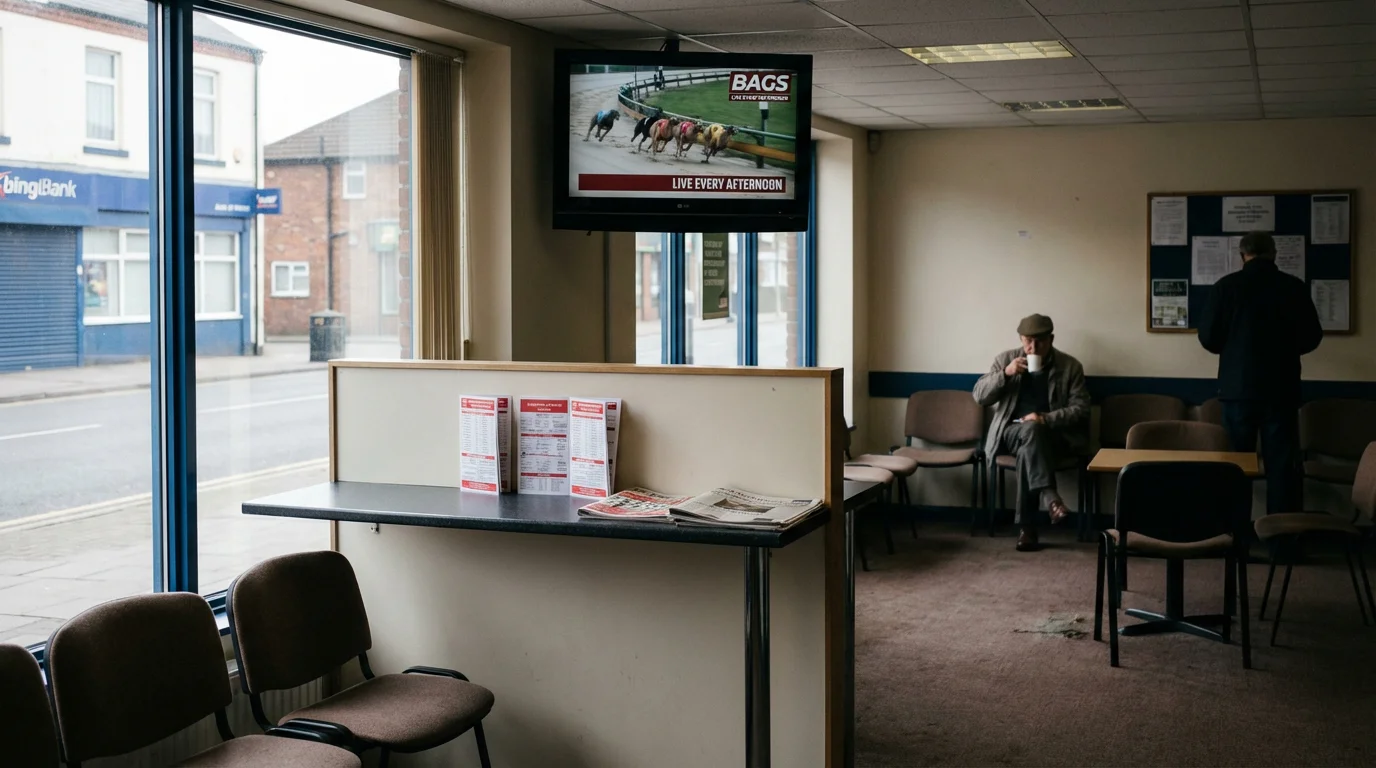
BAGS is the broadcasting backbone of daytime greyhound betting — races built for betting-shop screens and online platforms during hours when the evening cards have not yet started. The acronym stands for Bookmakers Afternoon Greyhound Service, and it describes both a schedule and a business model: greyhound tracks run afternoon meetings specifically to supply bookmakers with live racing content for their shops and websites.
For online bettors, BAGS racing represents the majority of available greyhound markets on any given weekday. While evening and Saturday meetings draw more attention and attract higher-quality fields, the daytime BAGS schedule runs from late morning through the afternoon, producing a steady flow of races across multiple tracks. Understanding how BAGS fits into the wider greyhound racing ecosystem — and where it creates opportunities that evening racing does not — is useful for anyone who bets on the dogs regularly.
What BAGS Is and How It Works
The Bookmakers Afternoon Greyhound Service schedules and broadcasts races from licensed tracks for off-course betting. The system is essentially a supply chain: tracks provide the racing, a broadcasting service distributes the signal, and bookmakers receive the feed for their shops and streaming platforms. The bookmakers pay for the service through a levy structure, and the tracks receive income from the broadcast rights — a significant revenue source for smaller stadiums that might not be financially viable on evening attendance alone.
BAGS meetings typically begin around 10:30 or 11:00 in the morning and continue until mid-afternoon. The races are staggered across tracks so that bookmakers receive a near-continuous flow of events, with a new race starting every few minutes. The scheduling is coordinated to avoid two BAGS races going off simultaneously, maximising the number of distinct betting opportunities across the day.
The broadcast itself is handled by Satellite Information Services, commonly known as SIS. SIS distributes the race feeds to licensed betting offices and to bookmaker platforms that stream greyhound racing online. If you watch a live BAGS race through a bookmaker’s app or website, you are watching an SIS feed. The commentary, camera angles, and on-screen graphics are all part of the SIS production.
Most GBGB-licensed tracks contribute to the BAGS schedule, though the allocation of fixtures varies. Some tracks host BAGS meetings multiple times per week; others contribute less frequently and focus their efforts on evening and weekend cards. The tracks that appear most often on the BAGS rota tend to be those with modern facilities and reliable track surfaces, since the broadcast schedule cannot afford cancellations due to poor conditions.
One important structural detail: BAGS races are almost exclusively graded events. You will rarely see open races, invitationals, or championship events on the afternoon card. The fields are assembled by racing managers using the standard grading system, which means the quality of competition at BAGS meetings follows the normal class hierarchy. The dogs racing in a BAGS C2 at Crayford on a Tuesday afternoon are, in general, of similar standard to the dogs in a C2 at the same track on a Thursday evening.
Which Tracks Host BAGS
Most GBGB stadiums contribute BAGS fixtures, though the frequency varies considerably. Tracks like Crayford, Romford, Swindon, Monmore Green, Sheffield, and Central Park are among the most regular BAGS contributors, appearing on the daytime schedule several times per week. These tracks have the infrastructure, the kennelling capacity, and the depth of active greyhounds to sustain a high frequency of fixtures without compromising field quality.
Other tracks — Nottingham, Newcastle, Sunderland, Perry Barr — contribute fewer BAGS meetings but still appear regularly on the rota. The scheduling is managed centrally to balance the load across the track network and to ensure geographical spread in the broadcast coverage.
The BAGS schedule is published several days in advance and is available through the Racing Post, Timeform, and most bookmaker apps. Checking the schedule for the following day allows you to identify which tracks are running and plan your form study accordingly. If you specialise in a particular track — and track specialisation is one of the most effective strategies in greyhound betting — knowing when that track appears on the BAGS rota lets you concentrate your effort where your knowledge is deepest.
Seasonal variation affects the BAGS schedule. During summer, when evening meetings are more plentiful (longer daylight hours and better weather reduce cancellations), some tracks shift their BAGS allocation. In winter, the BAGS schedule tends to be busier because evening meetings are more vulnerable to weather-related abandonments, and the daytime service picks up the slack.
BAGS vs Evening and Open Racing
BAGS fields tend to be graded, lower-profile races — but that does not mean lower quality analysis or lower value. The distinction is about attention, not class. Evening meetings, particularly at venues like Romford, Nottingham, and Towcester, attract more spectators, more media coverage, and more betting volume. Open races and championship events sit at the top of the hierarchy. BAGS racing sits below both in terms of profile, but the dogs are still real, the form is still trackable, and the markets are still beatable.
The reduced attention on BAGS meetings creates a specific advantage. Fewer eyes on the race cards means less informed money in the market. On an evening card at a major track, the prices tend to be sharp because experienced punters, on-course bookmakers, and exchange traders are all active. On a Tuesday afternoon BAGS card at a smaller venue, the market is thinner. Prices are set primarily by the bookmaker’s tissue rather than by the weight of informed opinion. When the tissue is wrong — and it is wrong more often than the evening market — value exists for punters who have done their homework.
The flip side is that BAGS markets can be less liquid on the exchanges. If you prefer to trade on Betfair, the matched volumes on BAGS races are often significantly lower than on evening events. This means wider spreads between back and lay prices, and less opportunity to get matched at your desired odds close to the off. For exchange bettors, BAGS racing requires more patience and sometimes a willingness to take a slightly worse price to ensure your bet is placed.
One more consideration: Best Odds Guaranteed is less consistently offered on BAGS meetings than on evening racing. Some bookmakers extend BOG to all greyhound races, but others restrict it to open and evening fixtures. If BOG is part of your strategy, verify its availability on the specific BAGS meeting before taking an early price.
Betting on BAGS — Tips
Form matters more in BAGS because the quality gap between runners is often smaller. In a graded BAGS race, the six dogs in the field are there because the racing manager considers them to be of similar standard. The margins are tighter than in an open race where a class dog might be head and shoulders above the rest. That closeness means small edges — a better trap draw, a slightly faster sectional, a trainer in form — carry more weight.
Specialise in one or two BAGS tracks. This is the single most practical piece of advice for daytime greyhound betting. Each track has its own characteristics: surface type, bend tightness, trap bias patterns, running rail position, and distance configurations. A punter who bets exclusively on BAGS races at Crayford will, over time, accumulate track-specific knowledge that no generalist can match. You will know which traps favour which running styles, which trainers produce consistent form at that venue, and how the track changes in wet conditions.
Pay attention to the morning market. BAGS races are priced up early, often by 9:00 or 10:00 AM, and the opening prices may not be revisited by the bookmaker until close to the off. That window between the opening price and the off is where informed punters find value — taking early numbers that the market will eventually correct, but not until enough money forces the bookmaker to adjust.
The Afternoon Assembly Line
BAGS exists to serve the bookmaker — it is a content pipeline designed to keep betting shops and platforms active during the working day. But a content pipeline built on real greyhound racing, with real form, real trap draws, and real grading, is also a pipeline of genuine betting opportunities. The races are less glamorous than a Saturday night at Nottingham, the prize money is lower, and the on-course atmosphere is minimal. None of that affects the form card.
The punters who profit from BAGS are the ones who treat it with the same analytical rigour they apply to evening racing — but exploit the thinner markets and lower attention that the daytime schedule attracts. The assembly line runs every weekday. The question is whether you are feeding it or working it.