

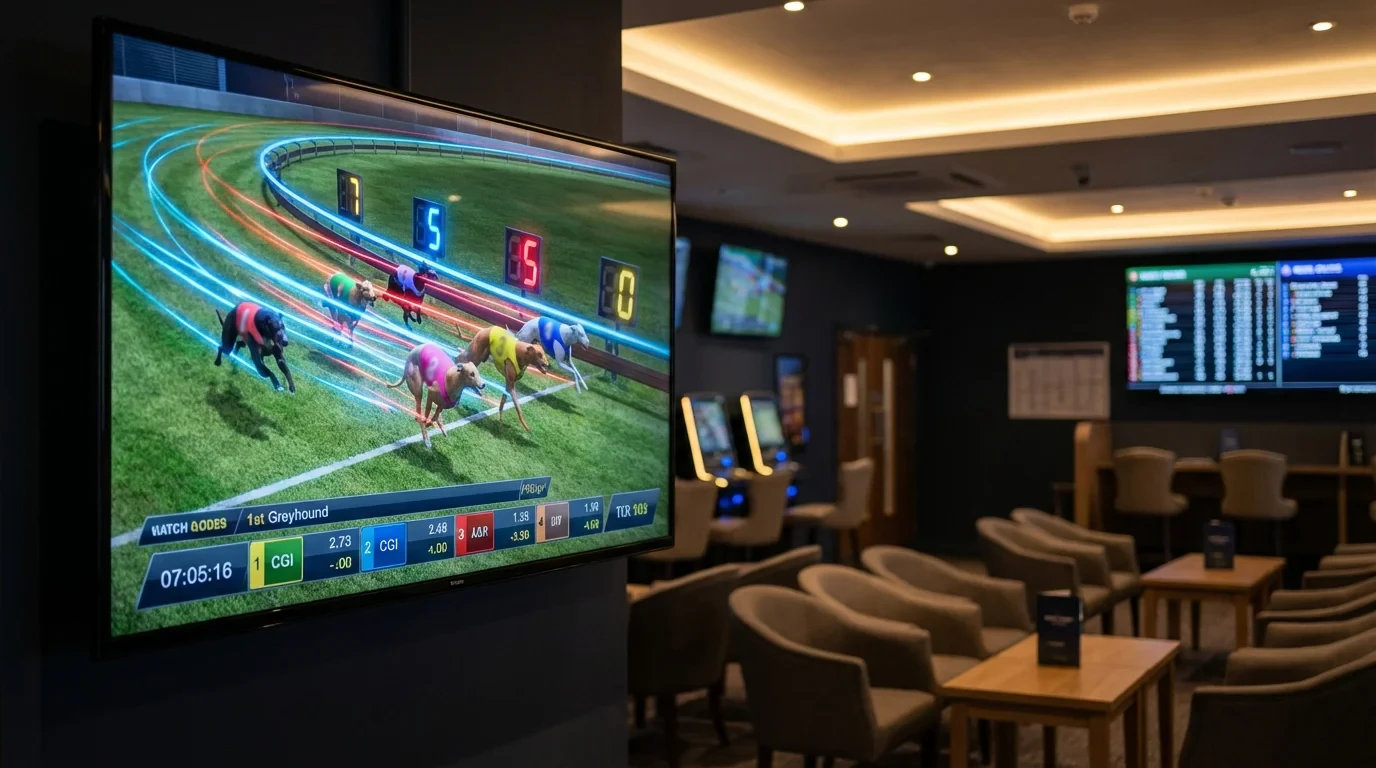
Virtual greyhound races run every sixty to one hundred and twenty seconds and are decided by algorithms, not legs. There is no track, no live dogs, no weather, no form guide, and no grading system. What you see on screen — the animated dogs sprinting around a CGI track — is a visual wrapper around a random number generator. The graphics exist to make the experience feel like racing. The outcome was determined the moment you loaded the market.
Virtual greyhound betting is a significant revenue stream for UK bookmakers. It fills the gaps in the real racing schedule, offering round-the-clock markets when the live cards have finished for the evening or between afternoon fixtures. For punters, it provides action at any hour. Whether that action carries any genuine value is a different question — and one that requires understanding what virtual racing actually is beneath the surface.
How Virtual Greyhound Racing Works
Random number generators produce results — the graphics are decoration. At its core, a virtual greyhound race is a software event. A certified RNG determines the finishing order before the visual race even begins to play on screen. The animated dogs you watch are following a predetermined script. The one in the red jacket was always going to win (or lose) — the suspense is simulated, not real.
The RNG is calibrated to produce outcomes at probabilities that mirror a standard betting market. Each dog in a virtual six-runner field is assigned a probability of winning, and the odds you see reflect those probabilities plus the bookmaker’s margin. A virtual favourite at 2/1 will win approximately 33% of virtual races over a large sample, just as the odds imply. There is no deviation from the programmed probabilities, no lucky breaks, and no interference at bend two.
The software providers behind virtual greyhound products — Inspired Entertainment and Leap Gaming are the two largest — must have their RNG systems independently tested and certified by regulators. In the UK, the Gambling Commission requires that virtual betting products meet standards for fairness, meaning the RNG must produce statistically random and unbiased results. The games are audited regularly, and the return-to-player percentage is typically disclosed in the product terms (usually between 80% and 90%, which is lower than real greyhound racing’s effective RTP for skilled bettors).
Each virtual meeting consists of a set number of races — usually twelve — and new meetings cycle continuously. A race plays out in thirty to forty-five seconds, with a new market opening immediately after. The speed of the cycle is deliberate: it maximises the number of betting opportunities per hour, which is how virtual products generate revenue.
One detail that surprises some punters: the form displayed for virtual greyhounds is cosmetic. The race card may show recent finishing positions, trap draws, and even simulated sectional times, but none of this data predicts the next result. Each virtual race is an independent event with no connection to previous races. The past results shown on the card are generated by the same RNG and carry zero predictive value. They exist to make the product feel familiar to real racing punters, not to provide genuine form analysis.
Available Bet Types
Win, place, forecast, tricast — the same markets you find on a real greyhound race, transposed onto a simulated one. Most bookmakers offer the full range of single-race bet types on their virtual greyhound products, including each-way betting at standard one-quarter the odds place terms.
Win bets are the simplest and most common. You pick a dog, and if it finishes first, you collect at the fixed odds displayed. Place bets pay if your selection finishes in the top two. Forecasts and tricasts follow the same structure as their real-racing equivalents, but the dividends are calculated differently. Since there is no Computer Straight Forecast system on virtual races, forecast and tricast payouts are determined by fixed-odds tables built into the software. These payouts are set by the provider, not by market dynamics, and they tend to be less generous than CSF dividends on real races.
Accumulators across multiple virtual races are also available. You can combine selections from consecutive virtual meetings into doubles, trebles, and longer multiples. The compounding effect is the same as in real racing, though the shorter cycle times mean you can resolve a five-fold accumulator in under ten minutes rather than waiting for an evening card to complete.
Some platforms offer additional markets specific to virtual racing, such as “trap challenge” (which trap finishes first across multiple races) or “match bets” between two specific virtual dogs. These are niche markets with limited appeal but high margins — the bookmaker’s overround on specialty virtual markets tends to be steeper than on straightforward win bets.
Real vs Virtual — Key Differences
No form, no trap bias, no trainer, no weather — the only variable is randomness. This is the fundamental distinction between real and virtual greyhound racing, and it has direct consequences for how you should approach virtual betting (if you approach it at all).
In real greyhound racing, skill has a measurable impact on long-term results. Punters who study form, understand trap bias, track sectional times, and follow trainer patterns can achieve a positive expected value over hundreds of bets. The information asymmetry between informed punters and the market creates exploitable edges. None of that exists in virtual racing. Every virtual race is a fresh random event. There is no information to gather, no patterns to detect, and no edge to find.
The pricing structure also differs. Real greyhound odds are set by a market — bookmakers and exchange users adjusting prices based on money flow and information. Virtual odds are set by software according to fixed probability tables. The bookmaker’s margin on virtual markets is typically higher than on real racing (the overround on a virtual six-dog field often exceeds 125%, compared to 115–120% on real greyhound markets). That higher margin means the expected loss per pound staked is greater on virtual than on real racing, all else being equal.
The pace of play is another critical difference. Real greyhound races are spaced ten to fifteen minutes apart on a typical card, with time between races to study the next field. Virtual races cycle every sixty to ninety seconds. That speed encourages rapid, repetitive betting — the exact behaviour pattern that erodes bankrolls fastest. There is no natural pause, no form to study, and no reason to wait. The product is engineered for volume.
Bookmaker Virtual Greyhound Platforms
The major UK bookmakers — bet365, William Hill, Coral, Betfred, Ladbrokes, and Paddy Power — all offer virtual greyhound products, though the specific software provider varies. bet365 and William Hill typically use Inspired Entertainment’s product, which features higher-quality graphics and a broader range of bet types. Coral and Ladbrokes have historically used a mix of providers across their virtual sports portfolio.
The visual quality of virtual greyhound products has improved significantly in recent years. Modern versions feature realistic track layouts, smooth animation, and broadcast-style camera angles that mimic the look of a real televised meeting. Some platforms add commentary and on-screen graphics that replicate the feel of watching a genuine BAGS race. These production values serve a marketing purpose — the closer the virtual product looks to real racing, the more comfortable punters feel betting on it — but they do not change the underlying RNG mechanics.
Minimum stakes on virtual greyhound bets are typically lower than on real racing, often starting at ten or twenty pence. Maximum payouts are also lower, with most bookmakers capping virtual race returns at five to ten thousand pounds per bet, compared to significantly higher limits on live racing. The lower limits reflect the higher frequency of betting and the absence of any skill-based edge that might lead to consistently large wins.
Fast, Frequent, and Formless
Virtual greyhounds fill the gaps between real meetings, and for punters who want action at two in the morning or during a slow Tuesday afternoon, they deliver exactly that. But they are a different game entirely. The skills that make you profitable on real greyhound racing — form reading, sectional analysis, trap bias, trainer knowledge — are worthless here. You are betting against a random number generator with a built-in house edge, and no amount of study changes that edge.
If you choose to bet on virtual dogs, treat it as entertainment with a fixed cost. Set a limit, stick to it, and do not carry over the analytical habits of real racing into a format where they have no application. The traps open, the numbers spin, and the algorithm decides. Everything else on screen is theatre.
