

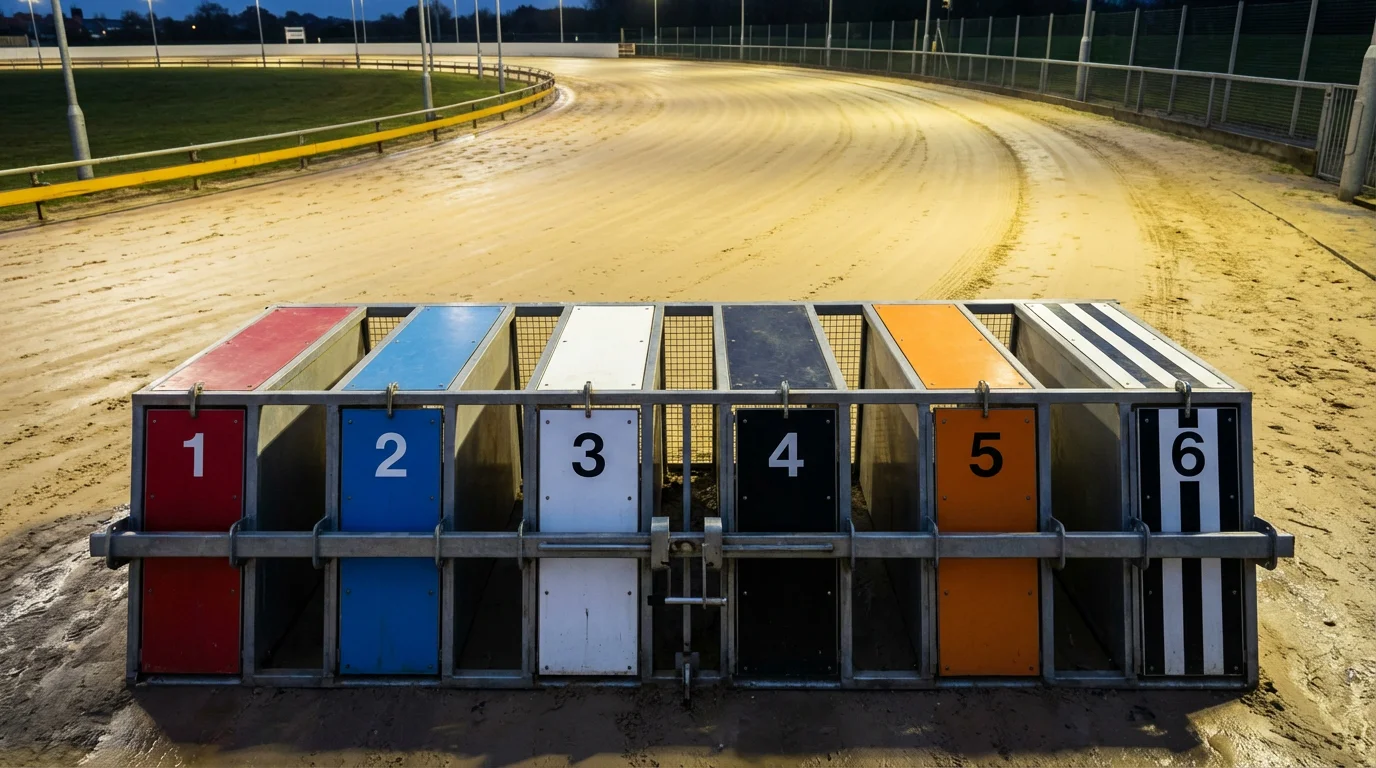
Six traps, six colours, six different angles to the first bend — and not all are equal. In a sport where races last thirty seconds and the first bend often decides the finishing order, the starting position matters more than casual punters assume. But how much it matters, and in which direction, depends on the track.
Trap bias is one of the most discussed concepts in greyhound betting, and one of the most misapplied. The idea is simple: at certain tracks, certain trap positions produce more winners than others over a large sample of races. The application is where it gets interesting — and where most punters get it wrong. A raw statistic that says Trap 1 wins 20% of races at a given track does not mean Trap 1 is a good bet in every race at that track. It means the geometry, the running style of dogs typically drawn inside, and the track conditions combine to produce a measurable edge. Understanding why the bias exists is more useful than simply knowing that it does.
Trap Colour Guide: 1–6
Red, blue, white, black, orange, striped — the jacket tells you the box. Every greyhound in a UK race wears a coloured jacket that corresponds to its trap number, and the system is universal across all GBGB-licensed tracks. The colours are always the same:
| Trap | Jacket Colour | Position |
|---|---|---|
| 1 | Red | Inside (closest to rail) |
| 2 | Blue | Second from inside |
| 3 | White | Middle inside |
| 4 | Black | Middle outside |
| 5 | Orange | Second from outside |
| 6 | Striped (black and white) | Outside (furthest from rail) |
The jacket colours serve a practical purpose for spectators and commentators tracking the race in real time, but they also carry associations in the betting market. Regular punters develop preferences — “I always back the red jacket” or “Trap 6 never wins here” — that harden into habits. Some of those habits happen to align with genuine statistical patterns. Others are pure superstition. The difference lies in the data.
In races with fewer than six runners due to withdrawals, the remaining dogs retain their original trap numbers and colours. A five-dog race might have runners in traps 1, 2, 3, 5, and 6, with trap 4 left vacant. The vacant trap does not change the geometry of the start, but it does create more space on the run to the first bend, which can affect how the race unfolds.
How Track Geometry Creates Trap Bias
Sharp tracks compress the field at the first bend — wide tracks let it breathe. This single observation explains most of the trap bias you will encounter in UK greyhound racing. The layout of the track, specifically the distance from the traps to the first bend and the tightness of that bend, determines how much of an advantage the inside position provides.
At tracks with a short run-up to a tight first bend, the dog in trap one has the shortest distance to travel before the field is forced to narrow. It can reach the rail quickly, take the inside line into the bend, and hold that position while the dogs drawn wider are pushed outward by the centrifugal compression of six animals converging on the same piece of track. This is why trap one tends to have an elevated win percentage at tight, short-run-up tracks.
At tracks with a longer run-up or a more sweeping first bend, the advantage diminishes. The extra distance gives outside dogs time to cross toward the rail before the bend tightens. A fast dog in trap five or six at a wide track may reach the first bend in a better position than a slower dog in trap one, because the geometry does not force an immediate squeeze. At these tracks, raw speed matters more than starting position, and trap bias tends to be flatter across the six boxes.
The second factor is the position of the traps relative to the bend. At some tracks, the traps are set on a slight curve rather than a straight line, which means the outside traps face a subtly different angle to the first bend than the inside traps. At other tracks, the traps are positioned mid-straight, giving a longer run before any bend comes into play. Each configuration produces a different dynamic.
Consider two contrasting examples from UK racing. Crayford has a tight circuit with a relatively short run to the first bend. Historical data consistently shows trap one outperforming the statistical average there, because the inside dog can hug the rail into a sharp turn. Towcester, before its reopening, had a much larger circuit with more generous bends. Trap bias was less pronounced, and outside runners could compete without the immediate positional disadvantage found at tighter venues.
Track surface adds another layer. Inside lanes receive more traffic — more dogs run along the rail than anywhere else on the track — which means the inside portion of the surface wears differently. At some tracks, the inside running line becomes faster because it is more compacted. At others, heavy use and drainage patterns make it slower, particularly in wet conditions. The surface variable interacts with the geometric variable, and together they produce the specific bias profile of each track.
Trap Win Percentages at UK Tracks
Here is what the numbers say across GBGB stadiums, and the first thing to note is that the data confirms what geometry predicts: there is no universal “best trap.” The trap that wins most often varies by venue.
Across all UK tracks combined, if there were no trap bias at all, each of the six traps would win approximately 16.7% of races. In practice, the distribution is uneven. Aggregated data from recent seasons shows trap one winning around 18–19% of races nationally, trap two around 17%, and trap six closer to 14–15%. The inside traps hold a slight overall edge, but the national average obscures significant track-level variation.
At tracks with pronounced inside bias — Crayford, Romford, and Swindon are typical examples — trap one’s win rate can exceed 21%, while trap six drops below 13%. The effect is most visible over sprint distances, where the first bend arrives sooner and positional advantage is harder to overcome. Over middle distances and staying trips, the bias moderates because there are more bends and more opportunities for positions to change.
At tracks with less pronounced bias — Nottingham, Sheffield, and Monmore Green historically show flatter distributions — the difference between the most and least successful traps might be only two or three percentage points. At these venues, the trap draw is a factor but not a dominant one, and the dog’s individual form and running style carry relatively more weight.
A few tracks occasionally show an outside bias, where trap five or six outperforms the inside boxes over certain periods. This can result from track maintenance changes, surface refurbishment, or sustained wet weather that degrades the inside running line. Outside biases tend to be temporary and revert once conditions normalise, but they can persist for weeks or even months. Monitoring recent results at a track — not just historical averages — is essential to detecting these shifts.
The most useful way to apply trap data is at the track-and-distance level. A trap that overperforms at 480 metres may not overperform at 640 metres on the same circuit, because the traps are positioned differently for each distance and the first bend arrives at a different point. Serious form students track win percentages by trap, by track, and by distance — a level of granularity that most recreational punters do not reach, which is precisely why the data creates value.
Weather and Its Impact on Trap Bias
Heavy rain can waterlog inside lanes and temporarily flip the bias. The inside running line, as the most heavily used portion of the track, is also the most vulnerable to weather-related changes. After sustained rainfall, drainage can pool along the rail, making the inside surface heavier and slower. Dogs that would normally benefit from an inside draw find themselves labouring through softer ground, while those drawn wider run on a firmer, less saturated surface.
This effect is not uniform. Tracks with modern drainage systems — sand-based surfaces with subsurface piping — handle rain better than older tracks with compacted soil surfaces. At well-drained venues, a heavy downpour might shift trap one’s win rate by a percentage point or two. At poorly drained venues, the shift can be dramatic, with outside traps suddenly producing winners at twice their normal rate.
Wind is the other weather variable that interacts with trap draw, though it receives less attention. At tracks where the home straight runs into a headwind, dogs that lead into the final straight face greater resistance, which can benefit closers who draft behind the leader before kicking in the final hundred metres. The trap draw does not directly determine which dog leads, but it influences the probability of leading through the first bend, and a headwind in the straight can negate that advantage.
The practical lesson is to check conditions before betting, not just form. If it has rained heavily at a track that normally favours trap one, that bias may be suspended for the evening. If the forecast shows dry conditions returning, the bias is likely to reassert itself within a meeting or two. Weather is a temporary modifier of a structural pattern — it does not eliminate the pattern, but it can suppress or invert it for a specific session.
Same Number, Different Odds
Trap position is a variable, not a verdict. It feeds into the probability of a dog reaching the first bend in a favourable position, but it does not override early speed, form, fitness, or class. A fast dog in trap six will beat a slow dog in trap one at any track in the country. The bias data tells you what happens on average, over hundreds of races, when all other factors are roughly equal. In individual races, all other factors are never roughly equal.
Treat trap data as context. Add it to your form analysis after assessing the dog’s ability, sectional times, running style, and class. If two dogs look inseparable on form and one is drawn in a statistically favourable trap, that is a tiebreaker worth using. If one dog is clearly superior on form but drawn in an unfavourable trap, the form still wins. The punters who lose money on trap bias are the ones who bet the trap number instead of the dog wearing it.
