

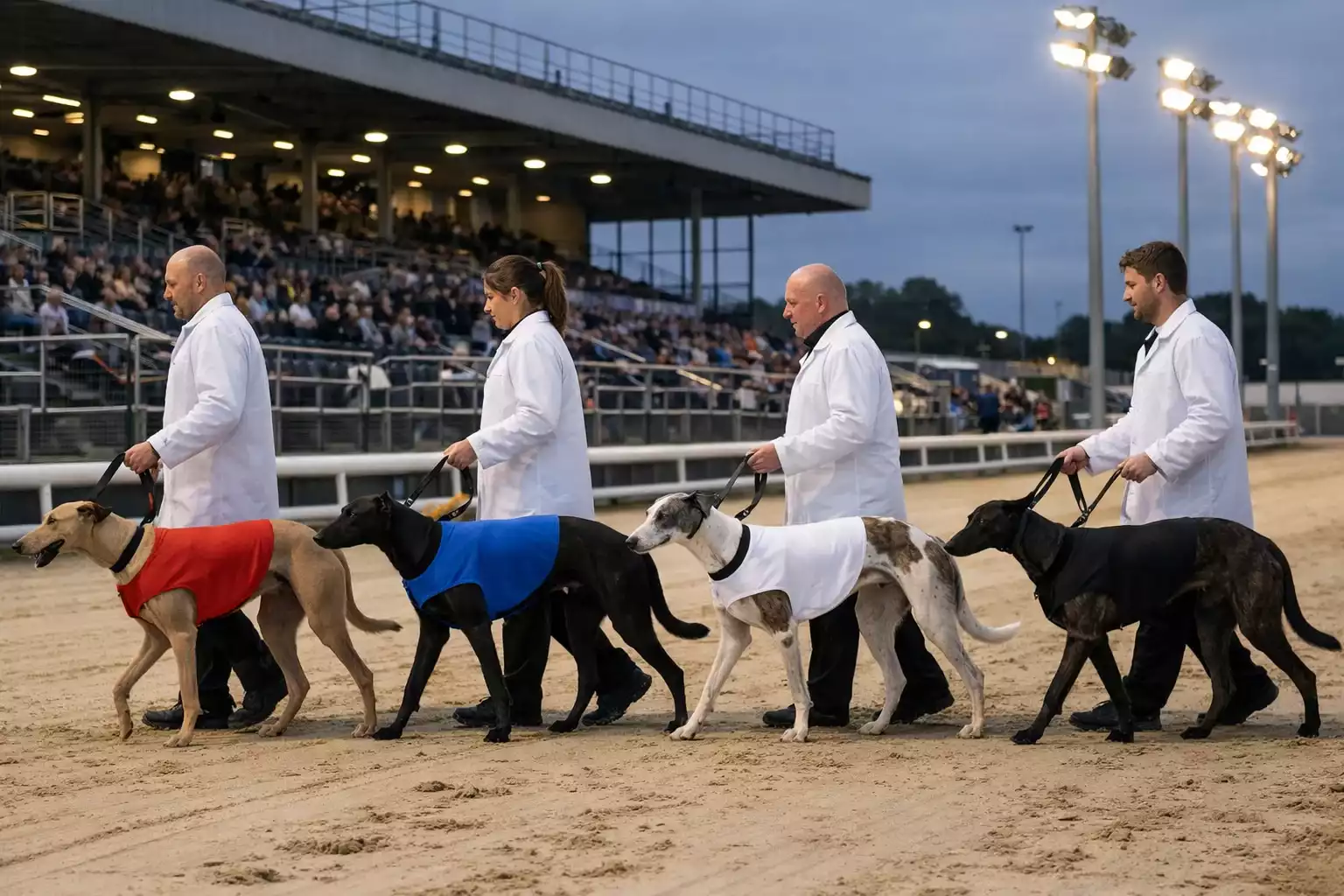
Grade is the single most important piece of context when comparing greyhound form. A dog that finishes third in an A2 race has run against faster opposition than a dog that wins a D3. The finishing position alone tells you nothing useful until you know the grade — and yet, a surprising number of punters scroll straight past it on the race card.
The grading system exists to produce competitive races. Dogs of similar ability are grouped together so that fields are evenly matched, which in turn creates better racing and fairer betting markets. But it also creates opportunities for anyone who understands how grades work, how dogs move between them, and what a class change signals about a runner’s chances in its next outing. The mechanics are not complicated, but they are specific to each track, which is where most of the misunderstanding begins.
How Grades Are Assigned
Racing managers grade dogs based on winning time over the track’s standard distance. Every licensed greyhound track in the UK employs a racing manager whose responsibilities include grading — the process of assigning each dog to a class that reflects its current ability. The primary metric is time. When a dog wins a race, its finishing time is recorded and compared against the track’s grading thresholds. If the time falls within a particular band, the dog is assigned to the corresponding grade.
The process begins when a dog first arrives at a track. It undergoes a series of trial runs, typically two or three, over the standard distance. The racing manager observes the trials, records the times, and assigns an initial grade based on where those times sit relative to the track’s bands. A dog that trials in 29.20 at a track where A3 covers 29.10 to 29.30 starts in A3. A dog that trials in 30.10 at the same track might begin in C2.
Once graded, the dog races against others in the same class. If it wins, the racing manager reviews whether the winning time warrants a grade change. A fast winning time might push the dog up a grade — from B4 to B3, or from C1 to B4. A sequence of poor results, particularly finishing positions outside the first three, may lead to a drop. The exact criteria vary by track, but the general principle is consistent: win fast, go up; lose repeatedly, come down.
Importantly, grades are not set by a central authority. The Greyhound Board of Great Britain oversees the sport’s regulation, but individual tracks have autonomy over their grading structures. This means a B3 at Romford is not the same as a B3 at Towcester. The time bands differ, the track configurations differ, and the depth of competition at each grade differs. A dog graded A4 at a strong metropolitan track might be faster in absolute terms than a dog graded A1 at a smaller regional venue.
Racing managers also consider factors beyond raw time. A dog that wins comfortably, pulling away in the final straight, may be upgraded even if the clock time sits within the current grade’s band — the racing manager recognises that the dog was not fully extended. Conversely, a dog that wins by a short head after a protracted battle might stay in the same grade, because the time was flattered by the pace of the race rather than the dog’s individual ability.
Trainers have some input into the process. They can request that a dog be entered in a specific grade or contest a grading decision. In practice, racing managers weigh these requests against the available evidence, and the time-based system generally prevails. Trainers who consistently campaign dogs below their ability level will find those dogs upgraded swiftly once they start winning.
Grade Table — A1 to D4 and Beyond
Each track sets its own time thresholds for each grade. The grading structure at most UK tracks follows a letter-and-number system. The letter indicates the broad class — A being the highest, D the lowest — and the number provides subdivision within that class. A1 is the top grade, A2 the next, and so on down to D4 at the bottom.
Not every track uses the full A1-to-D4 range. Smaller tracks with fewer dogs may only have grades from B1 to D3. Larger tracks with deep pools of talent, such as Nottingham or Romford, tend to have wider grading structures that accommodate more precise separations of ability. Some tracks add S grades (sprint) or M grades (marathon) for non-standard distances, though these sit alongside rather than within the primary A-to-D hierarchy.
As a general guide, the approximate time bands at a track with a 480-metre standard distance might look something like this:
| Grade Band | Approximate Time Range | Typical Field Quality |
|---|---|---|
| A1–A3 | 28.60 – 29.20 | Top-class open-race contenders |
| A4–B2 | 29.20 – 29.60 | Above-average, competitive fields |
| B3–C1 | 29.60 – 30.00 | Mid-range, bread-and-butter graded races |
| C2–C4 | 30.00 – 30.40 | Moderate ability, developing or declining dogs |
| D1–D4 | 30.40 – 31.20 | Lower-grade, often younger or older runners |
These numbers are illustrative and track-specific. The actual bands at Crayford will differ from those at Sunderland, because the track dimensions, surface, and prevailing conditions are different. Always reference the specific track’s grading when assessing form — a universal time threshold does not exist.
One additional class worth noting is the “puppy” designation. Young greyhounds under two years of age may race in puppy-specific grades that sit alongside the main hierarchy. Puppy races are graded more leniently, reflecting the fact that young dogs are still developing and their times are likely to improve. A puppy running 30.20 today might be an A-grader in six months. The puppy grades exist to protect immature dogs from racing against fully developed opposition too soon.
Open Races, Invitational, and Puppy Derbies
Open races sit outside the grading system entirely. The best dogs are invited regardless of their current grade, and the fields are selected based on form, time, and reputation rather than the rigid letter-and-number structure. Open races are the prestige events of greyhound racing — the category competitions, classic races, and feature events that headline major meetings.
The English Greyhound Derby, the St Leger, the Oaks, and the Golden Jacket are all open races. Entry is by invitation or qualification, and the fields represent the highest quality available. Dogs competing in these events may be graded anywhere from A1 to A4 in their regular racing, but the open-race designation means they race against each other regardless. For betting purposes, open races require a different analytical framework. You cannot rely on grade as a shorthand for ability because the grading system is not in play. Instead, form analysis, sectional times, and head-to-head comparisons take on greater importance.
Invitational races are similar but smaller in scope. A racing manager may organise an invitational event at their track, selecting dogs from various grades whose recent form suggests they would produce an interesting race. These events carry better prize money than standard graded races and often attract dogs that are between grades — too good for their current class but not quite ready for the next one up.
Puppy derbies and puppy classics follow the open format but are restricted by age. The events are designed to showcase the best young talent, and they often serve as early indicators of which dogs will go on to compete in the senior open-race circuit. From a betting perspective, puppy events carry more uncertainty than senior opens, because the form book on young dogs is thinner and their development trajectory is less predictable.
How Class Changes Affect Betting
A dog dropping from B3 to C1 is getting an easier race, and the odds may not reflect that quickly enough. This is where the grading system creates its most consistent betting opportunities. When a dog is regraded — moved up or down — the market often takes a race or two to recalibrate. In that adjustment period, the dog’s price may not fully account for the change in opposition quality.
A class drop is the clearest example. Suppose a dog has been running in B3, finishing fourth and fifth against strong opposition with respectable times. The racing manager drops it to C1 for its next run. In C1, the dog is suddenly facing slower opponents — dogs that it would have beaten comfortably at its peak. If the market prices this dog at 3/1 based on its recent poor finishing positions, there may be value, because those finishes came in a harder grade. The actual ability of the dog, as measured by its times, may be significantly higher than the C1 competition.
Class rises work in reverse. A dog that has been winning D2 races comfortably gets promoted to C4 or C3. It is now facing faster dogs, and its recent winning form may not translate. Punters who back the dog based on its three consecutive wins are ignoring the grade change. The dog that looked dominant in D2 might struggle to place in C3.
The key metric when evaluating a class change is time, not position. Compare the dog’s recent calculated times against the typical winning times in its new grade. If a B3 dog dropping to C1 has been running 29.80 and C1 races at that track are typically won in 30.10 or slower, the drop suggests the dog has a clear speed advantage. If the same dog has been running 30.20 in B3 — finishing last — the drop to C1 merely brings it level with the competition rather than giving it an edge.
Pay attention to how quickly the market reacts. At well-attended evening meetings, the adjustment tends to be faster because more informed money is flowing through the market. At daytime BAGS meetings with lower liquidity, the price correction can be slower, leaving more value on the table for punters who track grading changes systematically.
Grade Is Context, Not Quality
A fast D1 dog might be faster than a slow B3. Grading is track-specific, class-specific, and time-specific. It tells you what level of competition a dog has been facing, not what level of ability it possesses in absolute terms. Two dogs can hold the same grade at different tracks and be separated by half a second in raw speed — which, in greyhound racing, is the difference between leading the field and trailing it.
Use grade as the starting point for form analysis, not the conclusion. It frames the competition, narrows the comparison, and highlights changes that create value. But the number that matters most is always the time. Grade tells you where the dog has been running. Time tells you how fast it was going when it got there.
