

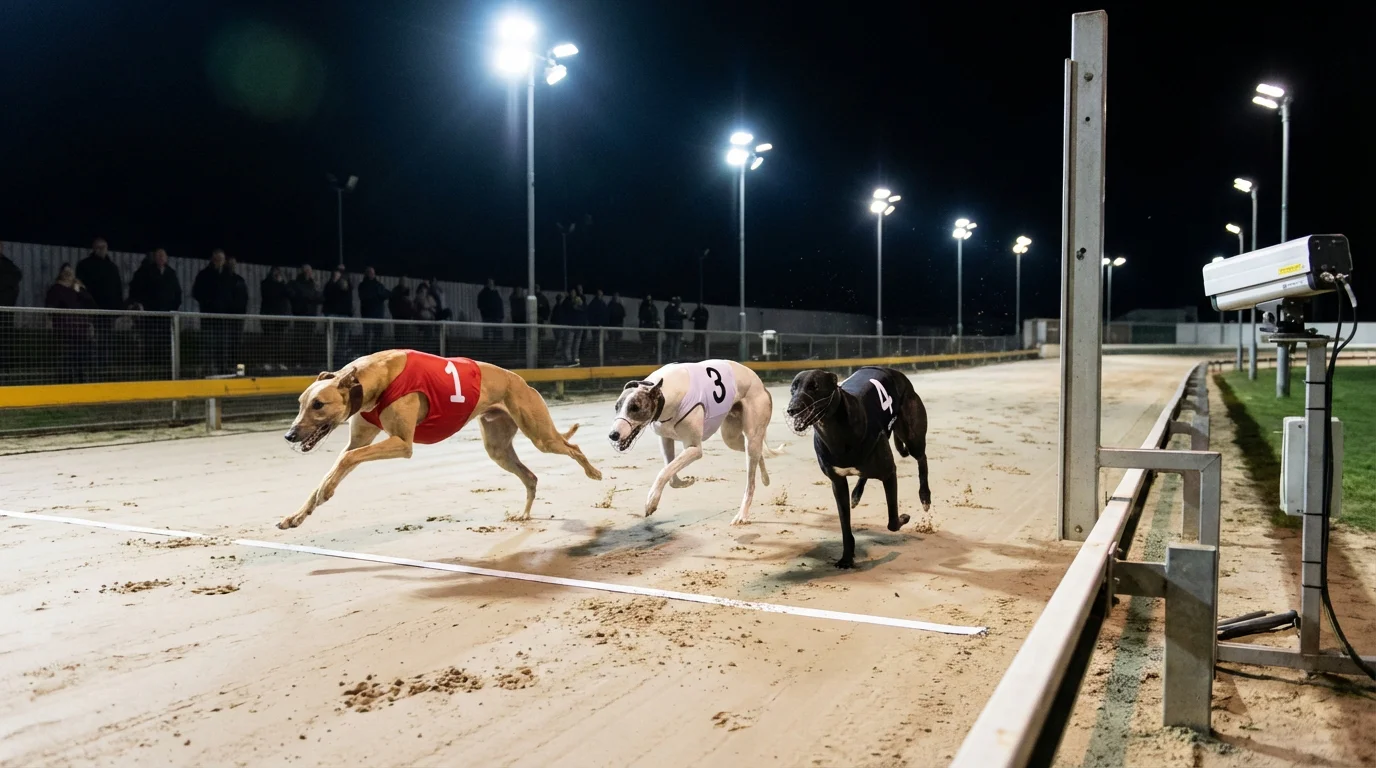
The tricast is greyhound betting’s highest-risk, highest-reward single-race market. Where a forecast asks you to name the first two in order, the tricast raises the bar: predict first, second, and third, all in their exact finishing positions. In a six-dog greyhound race, there are one hundred and twenty possible permutations for the first three finishers. Getting one right is, by definition, a long shot.
That difficulty is reflected in the payouts. Tricast dividends on greyhound races routinely reach three figures and occasionally push into four. A one-pound tricast involving three mid-price dogs can return more than some punters see from a month of win bets. The appeal is undeniable, but the probability is harsh — 1 in 120 at random, and not dramatically better even with strong form analysis. This guide explains the mechanics behind straight tricasts, combination tricasts, and the Tote Trifecta, then identifies the conditions where tricast betting shifts from pure speculation toward calculated opportunity.
Straight Tricast Mechanics
First, second, third — in that exact order. The straight tricast is the purest and most demanding version of the bet. You select three greyhounds from the field of six and assign each one a specific finishing position. Dog A must win, Dog B must finish second, and Dog C must finish third. Any other arrangement of those three dogs, or any result involving a different dog in the frame, and the bet loses.
The payout is calculated after the race using the Computer Tricast formula. Like the Computer Straight Forecast, this is an algorithm that takes into account the starting prices of all six runners, not just the three you selected. The key variables are the SPs of the first, second, and third finishers, the SP of the race favourite, and the number of runners. The formula is proprietary and complex, but the relationship between variables is straightforward: bigger SPs in the placed positions mean bigger dividends, and a strong favourite finishing outside the first three inflates the payout further.
To illustrate: in a six-dog race where the 2/1 favourite wins, a 5/1 shot finishes second, and a 4/1 shot finishes third, a typical Computer Tricast dividend might sit somewhere in the range of forty to sixty pounds per one-pound stake. Replace the favourite in first with a 7/1 outsider and leave the 5/1 and 4/1 in their positions, and the dividend can jump to two or three hundred pounds. When all three placed dogs are at long odds, dividends exceeding five hundred pounds are not unusual.
The minimum field size for a Computer Tricast is typically three runners, though most bookmakers require six or more for the market to be offered. If non-runners reduce the field below the threshold, tricast bets are usually voided and stakes returned. Some bookmakers will settle a tricast as a forecast on the first two if the field falls to five, but this varies — always check the operator’s specific terms before the race.
Straight tricasts are available on the vast majority of UK greyhound races, including BAGS meetings, evening cards, and open races. They can be placed online, in betting shops, and on-course at the tote windows. The minimum stake is generally one pound, though some bookmakers accept fifty pence.
Combination Tricast (All-Ways Trio)
Six bets covering every permutation of your three picks. That is the combination tricast — sometimes called the “all-ways trio” — and it removes the need to specify the exact finishing order of your selected dogs. You choose three greyhounds, and the bet covers all six possible arrangements of those three in the first three positions. If your three picks fill the frame in any order, one of the six bets wins.
The cost scales accordingly: a one-pound combination tricast is six pounds total, because it is six separate one-pound straight tricasts. A two-pound combination tricast costs twelve pounds. The return is the Computer Tricast dividend for the specific finishing order that actually occurred, paid on the one winning bet out of six. The other five bets lose.
For the combination tricast to be profitable, the Computer Tricast dividend on the winning permutation must exceed six times your unit stake. In practice, this means the combination tricast only makes financial sense when at least two of your three selections are at reasonably long odds. If you back three dogs all priced at 3/1 or shorter, the resulting dividend is often in the range of twenty to forty pounds — which, against a six-pound outlay, still shows a profit, but a relatively modest one given the difficulty of the bet.
Where the combination tricast excels is in races where you can identify three dogs that will dominate the frame but cannot separate the order. This happens more often than you might think in competitive graded races where the form points to a clear top three with little between them. Rather than guessing the exact order and staking on a single straight tricast, the combination tricast acknowledges the uncertainty and covers it — at the price of a six-fold increase in stake.
You can also extend the combination to four or more selections, though the costs escalate sharply. Four dogs generate twenty-four permutations; five dogs produce sixty. At one pound per permutation, a five-dog combination tricast costs sixty pounds — at which point the expected returns need to be substantial to justify the outlay. Most experienced punters limit combination tricasts to three, occasionally four, selections.
Tote Trifecta vs Computer Tricast
Pool dividends and algorithm dividends do not always agree, and understanding the difference can occasionally put you on the right side of a significant payout gap. The Tote Trifecta is the pool-betting equivalent of a tricast: you pick the first three in order, and the payout comes from the pool of money staked by all Trifecta bettors on that race, minus the tote’s deduction (typically around 26% on tricast pools).
The Computer Tricast, by contrast, is calculated by a fixed algorithm based on starting prices. The two systems can produce very different dividends for the same result. When a popular combination of dogs fills the first three places, the Trifecta pool — which is shared among all winning bettors — may pay less than the Computer Tricast because more people backed that combination. Conversely, when an unusual result occurs, the Trifecta pool may pay significantly more than the Computer Tricast if very few punters backed the winning permutation through the tote.
In greyhound racing, the liquidity of tote pools is generally lower than in horse racing. Fewer punters use tote betting on greyhounds, which means the pools are smaller and the dividends more volatile. A small pool can produce outsized returns on an unexpected result, but it can also produce disappointingly low returns on a popular result because the deduction takes a larger proportional bite.
For most punters, the Computer Tricast via a bookmaker is the standard route. The Tote Trifecta becomes interesting primarily at high-profile meetings — the English Derby, the St Leger, the Golden Jacket — where pool sizes are larger and the variety of bettors creates more opportunities for the pool dividend to exceed the algorithm-driven one. At ordinary BAGS meetings, the Computer Tricast is usually the more predictable and efficient option.
When Tricasts Offer Value
Open races with no clear favourite — that is where tricast hunting begins. In a tightly graded race where one dog is 6/4 and the rest stretch out to 7/1, the favourite dominates the tricast dividend calculation. If it wins, as it often will, the dividend is suppressed. But in an open race where the prices cluster between 3/1 and 6/1 with no standout, the Computer Tricast rewards any combination involving mid-price dogs more generously.
Look for races where the form points to a clear first three but the market has not priced that clarity in. Class drops are particularly useful here. A dog stepping down from B2 to C1 might have the ability to place in the first three almost regardless of how the race unfolds, but the market prices it at 5/1 because its recent form at the higher grade looks mediocre. That dog is your anchor in a tricast — not necessarily the winner, but a near-certain presence in the frame.
Avoid tricasts in races dominated by one very short-priced dog. The favourite suppresses dividends and absorbs most of the market’s confidence, leaving less reward when you get the first three right. The mathematics favour open, competitive fields where every dog that finishes in the frame adds genuine value to the payout.
Timing also matters. Tricasts on the first and last races of a meeting tend to attract more recreational money, which can occasionally inflate tote pools for those specific races. If you are considering a Trifecta rather than a Computer Tricast, these are the races where pool dynamics are most likely to work in your favour.
Three in a Row — Precision or Luck?
Tricasts reward those who see order where others see chaos. But honesty demands an acknowledgment: even the best form analysis cannot routinely predict the exact finishing order of three dogs in a thirty-second race where bumping, checking, and crowding at the bends introduce variables no data set fully captures.
The practical approach to tricast betting is not to treat it as a primary market. It is a secondary play — a calculated shot taken when the conditions align. Those conditions are specific: an open field, identifiable contenders, and prices that compensate for the difficulty. Combination tricasts soften the precision requirement at the cost of a higher stake. Straight tricasts offer the full dividend but demand the full prediction.
Whichever variant you choose, the tricast is the market that separates the punter who has truly studied the card from the one who is hoping for a number to come up. The dividends are there. The question is whether your analysis can get you close enough, often enough, to make the long odds work over time.
