

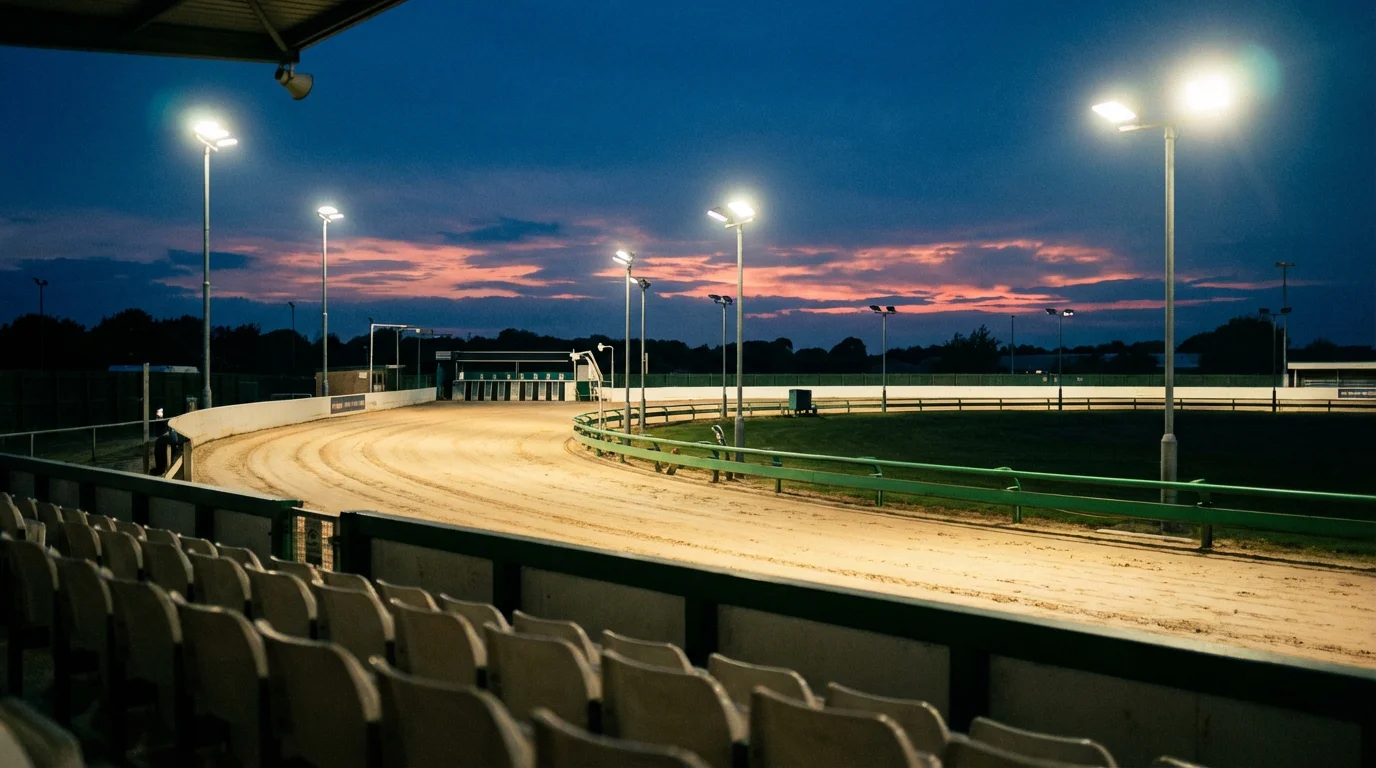
- GBGB Stadiums, 7 Days a Week — Where the Dogs Run
- How UK Greyhound Stadiums Operate
- London and the South East
- Midlands and the North
- South West, East, and Wales
- Trap Statistics by Track — Where the Bias Lives
- Attending a Meeting — What to Expect
- Concrete, Sand, and Floodlights — The Tracks That Shaped the Sport
GBGB Stadiums, 7 Days a Week — Where the Dogs Run
British greyhound racing has contracted for decades, but the GBGB stadiums that remain run almost every day of the year. In the 1940s there were seventy-seven licensed tracks across the country. By the turn of the century, that number had halved. Today, the Greyhound Board of Great Britain (GBGB) oversees around eighteen stadiums — a figure that has continued to shift, with Henlow closing in January 2024, Crayford in January 2025, and Perry Barr in August 2025, while the new Dunstall Park Greyhound Stadium in Wolverhampton opened in September 2025 to absorb Perry Barr’s operation. Collectively, these tracks stage thousands of meetings annually. The sport has shrunk in footprint but not in output.
For punters, this concentration matters. Fewer tracks means fewer variables to master. A bettor who commits to learning two or three stadiums can build the kind of deep, granular knowledge — trap biases, surface quirks, local trainers, standard times — that would take years to accumulate across a broader circuit. Every track on this list has its own geometry, its own character, and its own patterns. The dog that dominates at a tight, sharp circuit like Crayford may struggle at a galloping track like Nottingham, not because it has lost ability, but because the track does not suit its running style.
This guide profiles the key licensed UK greyhound stadiums relevant in 2026 — including some that have recently closed, given their historical importance to punters. It covers the physical layout — circumference, bend tightness, standard distances — alongside the practical details that affect betting: typical race-day schedules, surface conditions, and the trap biases that recur at each venue. The stadiums are grouped by region, starting in London and the South East, moving through the Midlands and the North, and finishing with the tracks scattered across the South West, East Anglia, and beyond.
Knowing which track you are betting on is not a minor detail. It is the first question any serious greyhound punter should ask before looking at a form card.
How UK Greyhound Stadiums Operate
Every licensed track follows the same core format — but the geometry and surface make each one distinct. A GBGB-licensed greyhound stadium runs races over set distances, always anticlockwise, on a sand-based oval track with mechanical hare. The traps open, six dogs chase the lure, and the first past the post wins. That much is universal. Everything else — the shape of the bends, the width of the running rail, the drainage, the camber — varies from stadium to stadium, and those variations shape every race that takes place there.
Track Geometry: Circumference, Bends, and Running Rail
UK greyhound tracks range from roughly 380 metres in circumference for the tightest circuits to over 460 metres for the largest. The circumference determines how sharp the bends are, and bend tightness is the single most important geometric factor in greyhound racing. A tight track compresses the field at every turn, channelling dogs towards the inside rail and creating more crowding, more bumping, and a heavier advantage for dogs drawn in the lower trap numbers. A wider track spreads the field, gives outside runners more room to hold their line, and produces fewer first-bend pile-ups.
The running rail — the inside fence that dogs follow around the bends — is typically positioned a few metres from the inner edge of the track. Its exact position can vary between meetings and even between races, as racing offices sometimes adjust the rail to manage wear on the surface. A rail moved outward by a metre or two can subtly change the effective track geometry, widening the bends and slightly altering trap bias patterns. Most form services do not flag rail movements, but track-side regulars notice the difference.
Standard race distances at UK tracks typically include a sprint (around 260-280 metres), a middle distance (460-500 metres), and a staying trip (640-700 metres or longer). Not every track offers all three categories. Some stadiums specialise in sprints and middle distances, while a handful offer marathon trips over 800 metres or beyond. The standard distance — the one most races are run over — is usually in the 460-500 metre range and is the distance for which the track’s grading system is primarily calibrated.
Sand Surfaces and Weather Impact
Every GBGB track runs on a sand surface, but “sand” is a broad term that covers a range of compositions. Some tracks use a finer grain that packs hard in dry conditions and becomes heavy when waterlogged. Others use a coarser mix that drains faster but offers less consistent grip. The composition affects running times directly: a fast, firm surface produces quicker times, while a wet or heavy surface slows the field and alters the advantage between early-pace dogs and closers.
Rain is the primary weather variable. A heavy downpour before a meeting can add several tenths of a second to race times and shift the balance towards stronger, more powerful dogs who can handle the extra resistance. Lighter, speedier dogs that excel on a fast surface may lose their edge when the track rides heavy. Seasoned punters check weather conditions before betting on afternoon and evening cards — a meeting that starts on a fast surface can slow significantly if rain arrives mid-card, changing the complexion of the later races.
Wind also plays a role, particularly at exposed stadiums. A strong headwind on the home straight slows finishing times and can benefit dogs that lead early, as the closers have further to make up against the resistance. Wind effects are harder to quantify than rain, but at venues like Yarmouth or Sunderland, which sit in exposed coastal or elevated positions, they are a genuine factor.
London and the South East
Romford is now London’s last remaining track — Crayford and Henlow are gone. London was once the heartland of British greyhound racing, with stadiums in nearly every borough. White City, Wimbledon, Catford, Walthamstow — all gone. In January 2024, Henlow in Bedfordshire closed its doors. In January 2025, Crayford followed, ending operations after nearly four decades at its current site. That leaves Romford as the sole surviving GBGB track in the Greater London area — a situation that would have been unthinkable even a decade ago.
Crayford Stadium (Closed January 2025)
Crayford sat in the borough of Bexley, south-east London, and ran one of the busiest schedules on the GBGB circuit until its closure in January 2025. The track was tight — around 380 metres in circumference — with sharp bends that heavily favoured inside-drawn dogs, particularly in sprint races. Trap 1 at Crayford had one of the strongest win-rate advantages of any trap at any UK track, consistently outperforming the expected 16.7% average for a six-dog field. Races were run over 380 and 540 metres as standard, with occasional longer trips for feature events.
The sharp geometry created crowding at the first and second bends, which meant interference was more common here than at wider circuits. Dogs with quick early speed drawn in Traps 1 or 2 had a genuine structural advantage. For punters who previously specialised at Crayford, the track’s closure left a gap — though some of its characteristics, such as tight-track bias dynamics, can be found at other compact venues like Monmore Green and Poole.
Romford Stadium
Romford, in the London borough of Havering, is another compact circuit that favours inside runners, though the bias is less extreme than at Crayford. The standard distances are 400 and 575 metres. Romford stages regular evening meetings and has a reputation for competitive graded racing — the standard of dog across the A and B grades here is consistently high, which means finding value requires careful form study rather than relying on obvious class advantages.
The track surface at Romford tends to run on the faster side in dry conditions, and the stadium is relatively sheltered from wind compared to some of the more exposed venues. This makes it a more predictable track for time comparisons, which is useful when assessing form from dogs transferring in from other stadiums. Romford is also one of the better-attended tracks for live spectators, with a well-maintained grandstand and regular hospitality events.
Henlow Stadium (Closed January 2024)
Henlow sat in Bedfordshire, technically outside London but firmly within the south-eastern racing cluster. The track was larger than both Crayford and Romford, with a circumference that allowed for wider, more sweeping bends. This gave outside-drawn dogs a better chance than they would get at the tighter London circuits, and the trap bias at Henlow was correspondingly more evenly distributed across all six boxes.
Standard distances at Henlow included 450 and 642 metres, making it one of the better venues for stayers. The longer trip at Henlow was a genuine test of stamina rather than the extended sprint that passes for staying at some smaller tracks. Dogs that excelled over 642 metres here tended to have a different profile from the sharp, speed-oriented dogs that dominated at Crayford — bigger frames, stronger finishing kicks, and a racing style that favoured patience over early aggression.
Henlow closed its doors in January 2024, ending a long history of racing at the venue. Punters who specialised in middle-distance and staying races at Henlow have since turned to alternatives like Nottingham and Towcester for similar form profiles.
Midlands and the North
Perry Barr, Nottingham, Monmore Green — the Midlands belt is the engine room of UK dog racing. The region between Birmingham and Manchester contains the densest concentration of licensed stadiums in the country, and the quality of racing across the Midlands and Northern tracks is consistently strong. Several of these venues host major open events and feature competitions that attract dogs from across the UK.
Perry Barr (Closed August 2025) and Dunstall Park
Perry Barr in Birmingham was one of the most significant stadiums in British greyhound racing until its final meeting on August 23, 2025. The track was a good-sized circuit with a circumference that allowed for fair racing across all trap positions, though a slight inside bias persisted in sprint events. Perry Barr was the home of the Birmingham Cup and hosted several other prestigious competitions throughout the year. The standard distances were 480 and 630 metres, with the 480 serving as the workhorse distance for graded racing.
Perry Barr’s operation has been transferred to the new Dunstall Park Greyhound Stadium at Wolverhampton Racecourse, which opened on September 19, 2025. Dunstall Park represents a multi-million-pound investment by the Arena Racing Company and is the first newly built greyhound venue in the UK in over a decade. Punters familiar with Perry Barr’s form book will find much of the same trainer and dog pool at the new venue, though the track geometry will require fresh data collection on trap biases and standard times.
Nottingham
Nottingham — officially Nottingham Greyhound Stadium at Colwick Park — runs on one of the larger circuits in the UK. The wider bends mean that outside traps are less disadvantaged here than at smaller venues, and the track has a reputation for producing fair results that reflect genuine form rather than trap-draw lottery. Standard distances are 500 and 680 metres.
The 500-metre trip at Nottingham is slightly longer than the standard middle distance at most tracks, which subtly changes the form profile. Dogs with stamina and strong finishes perform better here relative to their results at shorter-distance venues. When assessing a dog transferring to Nottingham from a 460-metre track, it is worth considering whether the extra forty metres will expose a lack of finishing speed that was not visible over the shorter trip.
Monmore Green
Monmore Green in Wolverhampton is a compact stadium with a sharp track that creates conditions similar to Crayford — tight bends, inside-trap advantage, and a high incidence of first-bend trouble. Races are run over 480 and 630 metres. The sprint programme is popular with punters because the short distance and sharp bends make sectional times and trap draw the dominant form factors, which suits analytical bettors who work from data rather than intuition.
Monmore stages racing on multiple evenings per week and is one of the BAGS circuit’s most productive venues. The volume of racing means there is always recent form to work with, and the consistency of the track surface — which the stadium maintains to a high standard — makes time comparisons from meeting to meeting more reliable than at venues where surface conditions fluctuate.
Sheffield, Sunderland, Newcastle, Belle Vue
The Northern tracks beyond the Midlands each have their own flavour. Sheffield runs on a medium-sized circuit with standard distances of 480 and 660 metres. The track is reasonably fair across all traps and produces solid graded racing without the extreme biases of the sharper southern venues. It is a good all-round track for punters who prefer to assess form on its merits rather than fighting geometric distortions.
Sunderland sits in an exposed position that makes it one of the most weather-sensitive tracks in the country. Wind and rain affect race times here more noticeably than at sheltered stadiums, and the going can change significantly within a single meeting. Punters who specialise at Sunderland learn to factor weather conditions into their assessments as a matter of routine — a discipline that pays off but requires attention that casual bettors rarely invest.
Newcastle stages a busy BAGS programme and draws dogs from a wide catchment across the North East. The track is medium-sized with standard distances that suit most running styles, and the grading is deep enough to produce competitive fields throughout the card. Belle Vue in Manchester has a long and storied history in greyhound racing. The track offers standard and middle distances and serves as the primary venue for the Greater Manchester racing community. Both Newcastle and Belle Vue are dependable BAGS tracks where regular punters can build familiarity quickly because the pool of resident dogs and trainers is relatively stable.
South West, East, and Wales
From Towcester’s Derby home to Poole on the coast, the remaining stadiums cover every corner. The tracks outside the London-Midlands-North corridor are more geographically scattered, but several are among the most important venues in British greyhound racing.
Towcester, Swindon, Poole
Towcester in Northamptonshire holds a unique position in the sport as the home of the English Greyhound Derby, the most prestigious race in the calendar. The track is one of the largest in the country, with sweeping bends and a long home straight that rewards stamina and finishing power. Standard distances are 480 and 680 metres, and the spacious layout makes Towcester one of the fairest tracks in the UK for outside-drawn dogs. Towcester has hosted the Derby for seven of the past ten years and was confirmed as the 2026 venue by the GBGB. The Derby meeting each year draws the best dogs from across Britain and Ireland.
Swindon runs on a medium-sized circuit in Wiltshire with standard distances and a reputation for solid, competitive racing. The track drains well and tends to hold its pace even in wet conditions, which makes it a useful venue for time comparisons. Poole on the Dorset coast is a smaller track with a tighter circuit that produces racing reminiscent of Crayford and Monmore — inside traps favoured, first-bend trouble common, and sprint form the most reliable guide to the card.
Harlow, Central Park, Yarmouth
Harlow in Essex runs a regular BAGS programme and sits within easy reach of the London punting market. The track is mid-sized and reasonably fair, without the extreme inside bias of the sharper circuits. Central Park in Kent — not to be confused with the New York park — stages racing over standard distances and is part of the busy south-eastern BAGS rota. Yarmouth on the Norfolk coast is one of the most exposed tracks in the country, and wind conditions are a constant factor in form assessment. Dogs that run well at Yarmouth in a headwind are often tougher and more resilient than their race times suggest.
Kinsley and Valley Stadium
Kinsley in West Yorkshire operates slightly outside the mainstream of the BAGS circuit but stages regular racing with a loyal local following. The track is compact and the grading tends to produce closely matched fields at the lower levels, which can make forecast and tricast betting productive for punters willing to study the local form book. Valley Stadium in Ystrad Mynach, South Wales, is the only licensed GBGB track in Wales and serves the Welsh greyhound community. However, in February 2025 the Welsh Government announced plans to ban greyhound racing in Wales, which would result in Valley’s closure. The future of the stadium remains uncertain as of early 2026.
Trap Statistics by Track — Where the Bias Lives
The same trap number can be an advantage or a dead weight depending on which track you are at. Trap bias is not a myth, not a theory, and not a superstition. It is a measurable statistical reality that varies from stadium to stadium based on track geometry, and any punter ignoring it is leaving information on the table.
In a perfectly fair race, each of the six traps would win roughly 16.7% of the time over a large sample. In practice, no track produces numbers anywhere close to that even split. At tight circuits like Monmore Green and Poole, Trap 1 consistently wins at rates above 20%, while Trap 6 falls below 13%. The inside advantage at these venues is structural — the dog in Trap 1 has the shortest run to the first bend and the natural rail to follow. On sharp bends, that head start compounds into a genuine, repeatable edge. The now-closed Crayford showed some of the strongest inside-trap bias of any UK track during its years of operation.
At wider circuits like Towcester and Nottingham, the bias flattens out. Trap 1 still holds a slight advantage, but the margin over Traps 4, 5, and 6 is much narrower. At some larger tracks, the outside traps occasionally outperform the inside over extended samples, particularly at staying distances where the first bend is reached later in the race and the initial trap advantage has more time to dissipate.
The most useful approach for punters is to check the trap statistics for a specific track over the most recent three to six months, rather than relying on historical averages that may stretch back years. Bias can shift. A change in running-rail position, a resurfacing project, or a sustained period of wet weather can all alter the way a track rides and redistribute the trap advantage. What was a strong Trap 1 venue six months ago may have become more balanced after maintenance work, and the punter working from outdated data will be applying the wrong correction.
Several online resources publish regularly updated trap statistics for GBGB tracks. The GBGB’s own website carries some of this data, and specialist sites like Greyhound Stats provide more granular breakdowns by distance and grade. When using these numbers, look at the sample size. A trap win percentage based on fifty races is noise. A percentage based on five hundred or more starts is a signal. The larger the sample, the more confidently you can treat the number as reflecting a genuine structural bias rather than short-term variance.
For practical purposes, trap bias data is most actionable in two scenarios. First, when two dogs are closely matched on form and you need a tiebreaker — if one is drawn in the statistically favoured trap and the other is not, the bias tilts the selection. Second, when the market has priced a dog without adequately accounting for its draw — an outsider drawn in Trap 1 at a strong inside-bias track may offer more value than the headline odds suggest, because the public often underweights positional advantage when setting their own assessment of the race.
Attending a Meeting — What to Expect
Greyhound racing remains one of the most affordable live sports experiences in the UK. Admission to most GBGB stadiums ranges from free to a few pounds, depending on the venue and the day of the week. Even at feature meetings, the cost of entry is a fraction of what you would pay at a horse racing fixture, and the atmosphere is correspondingly more relaxed — fewer top hats and morning suits, more pint glasses and paper race cards.
A typical evening meeting runs twelve to fourteen races, with intervals of roughly fifteen minutes between each. The pace is quick. You arrive, buy a race card, study the form, place your bets, watch thirty seconds of furious racing, and then start again for the next one. The entire meeting takes around three hours. Afternoon BAGS meetings follow the same format but are primarily televised for the betting market rather than designed for live attendance, and crowds at afternoon fixtures are usually sparse.
Most stadiums have on-site Tote facilities where you can place pool bets, as well as independent on-course bookmakers who offer fixed-odds betting. The on-course bookmaker boards are where starting prices are determined — the prices displayed at the moment the traps open form the basis of the SP calculation. Watching the boards change in the minutes before a race is an education in market dynamics: you can see which dogs are attracting money, which are drifting, and where the smart money appears to be going.
Facilities vary between stadiums. The larger venues — Dunstall Park, Towcester, Romford — offer restaurant dining with track-view tables, bars, and hospitality packages. Smaller venues are more functional: a grandstand, a few food outlets, and an atmosphere that leans towards working-class tradition rather than corporate entertainment. Both have their appeal. If you are visiting for the first time, an evening meeting at a busy stadium is the best introduction — the crowd is livelier, the racing is usually stronger than afternoon cards, and the experience gives you a feel for the sport that no amount of online form study can replicate.
For the analytically minded punter, attending live offers one advantage that remote betting cannot match: you can watch the dogs in the pre-parade and at the traps. A dog that looks agitated or unsettled before loading may not trap cleanly. A dog that walks calmly to the boxes and loads without fuss is more likely to break evenly. These visual cues do not appear in any form guide, and while they should never override solid data, they occasionally provide the marginal information that separates a confident bet from a borderline pass.
Concrete, Sand, and Floodlights — The Tracks That Shaped the Sport
Every stadium on this list has outlived dozens of others. White City closed in 1984, bringing the curtain down on the sport’s original flagship venue. Wimbledon held its last race on 25 March 2017. Walthamstow, the grand old lady of London greyhound racing, shut its gates in 2008. More recently, Henlow (2024), Crayford (2025), and Perry Barr (2025) have joined the list of closures. The tracks that remain are survivors, and their survival is not accidental. Each has found a way to sustain a racing programme, maintain facilities, and attract enough dogs, trainers, and punters to keep the lights on and the sand raked.
That does not mean the circuit is static. Track ownership changes, stadium improvements happen, and the odd venue faces periodic uncertainty about its future. The GBGB’s licensing process provides a baseline of regulation and standards, but the commercial viability of each stadium depends on factors that go beyond the quality of the racing: location, transport links, the local betting market, and the willingness of ownership to invest in the product. Some tracks thrive. Others operate on thin margins and rely on the BAGS broadcast contract to keep revenue flowing.
For the punter, the practical takeaway is specialisation. You do not need to know every track. You need to know two or three of them well enough that you can read a race card and immediately understand the context: which trap is favoured, how the surface is likely to ride, which trainers dominate the local circuit, and what the standard times should be for each grade. That depth of knowledge transforms greyhound betting from a guessing game into an analytical exercise where your information is often better than the market’s — because most of the money flowing into the pools comes from casual bettors who do not know one track from another.
Greyhound stadiums are not glamorous. They are functional, purpose-built venues of concrete, sand, and floodlights, designed to stage thirty-second races under all weather conditions, fifty-two weeks a year. But within that simplicity lies a sport with enough variation, enough data, and enough quirks at every venue to reward anyone willing to take the track as seriously as they take the form. The dogs do not run in a vacuum. They run on sand, around bends, under lights — and the track itself is always part of the story.
