

- The Form Card Is the Race Before the Race
- Anatomy of a Greyhound Race Card
- Sectional Times and Calculated Times
- The Grading System — A1 to D4 and Beyond
- Running Comments and Abbreviations Decoded
- Trainer and Kennel Form
- Putting It All Together — A Form Analysis Walkthrough
- Beyond the Numbers — When Form Meets the Track
The Form Card Is the Race Before the Race
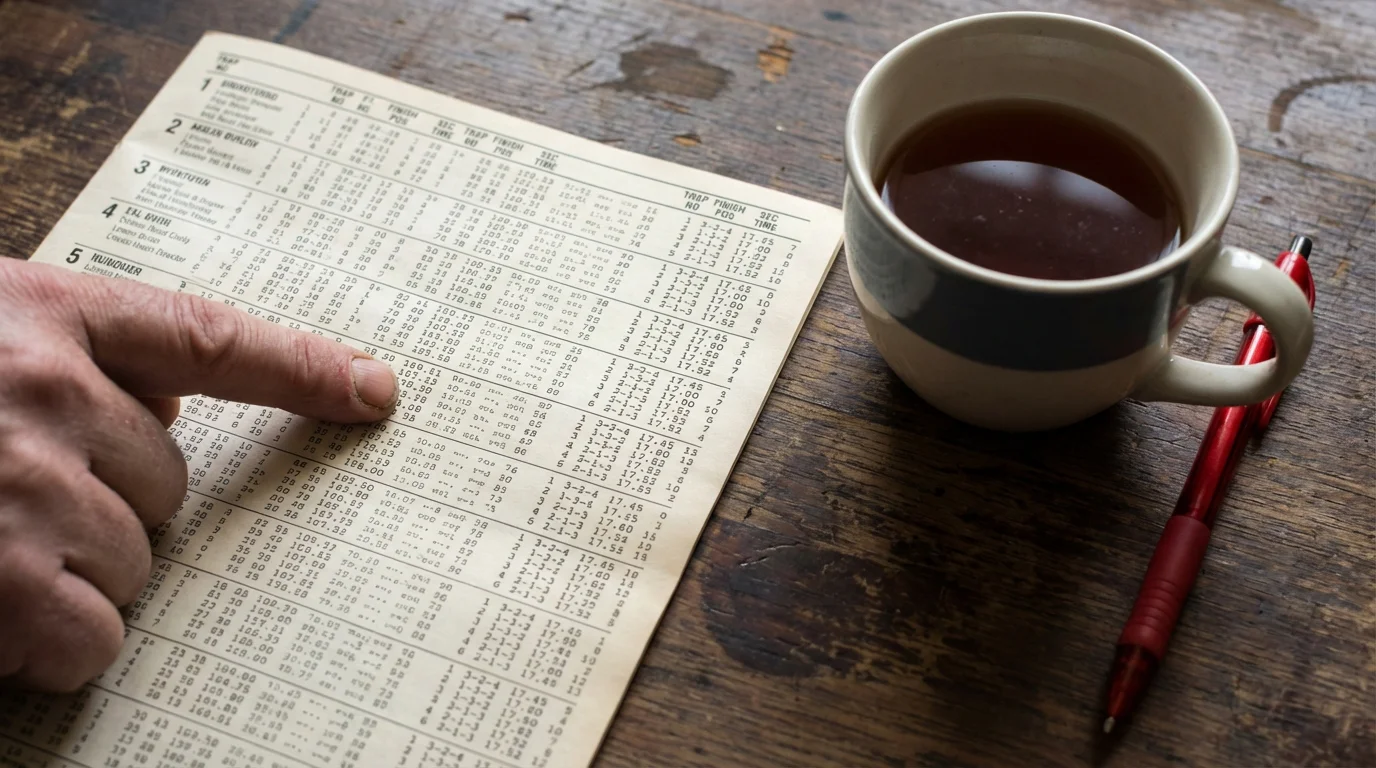
Every line on a greyhound form card compresses a 30-second race into data you can bet on. That is simultaneously its power and its difficulty. Unlike horse racing, where form guides run to pages of commentary, trainer interviews, and going reports, the greyhound form card is compact. It packs a dog’s recent history — finishing positions, times, running comments, grade, trainer, weight, and trap draw — into a few dense lines. Learning to read those lines fluently is the single most valuable skill in greyhound betting.
The reason is simple: greyhound racing moves fast, and not just on the track. With BAGS meetings running through the afternoon and licensed fixtures filling the evening, a committed punter in the UK might face sixty or more races in a single day. There is no time to research each dog the way you might study a horse in a Saturday feature. The form card is your shortcut — a pre-compressed analytical tool that, once you learn its language, lets you assess a six-dog race in a few minutes rather than a few hours.
But it is a language, and like any language, the symbols only make sense once you know the grammar. A finishing position of “3” tells you very little on its own. A finishing position of “3” followed by a running comment showing “Ld1-Bmp3” tells you the dog led until the third bend and was then bumped out of contention — a completely different story. Sectional times look like random numbers until you understand that a difference of five hundredths of a second to the first bend can mean two or three lengths on the track. Grade designations like A3 or D1 mean nothing unless you know how the grading system maps onto the competitive level of the race.
This guide works through every field on a UK greyhound race card, from the basic identifiers at the top through the sectional data and running comments that experienced punters use to build their selections. It covers the grading system, how calculated times differ from actual times, and how to interpret the shorthand abbreviations that racing offices use to describe in-race incidents. The final section pulls everything together with a walkthrough of a complete form analysis on a six-dog card, ranking runners using only the data available on the form.
The form card is not a crystal ball. It will not tell you who wins. What it will tell you is who should win, who has excuses, and who is running above or below their ability. That is more than enough to build a betting opinion — and it is more than most punters ever bother to learn.
Anatomy of a Greyhound Race Card
Left to right, top to bottom — here is what each field means and why it matters. A standard UK greyhound race card follows a consistent layout across all GBGB-licensed tracks, though the exact presentation varies slightly between bookmaker websites, the Racing Post, and track-side programmes. The core data fields are the same everywhere.
Dog Name, Trainer, Age, Weight, Season
Each runner is listed by name, followed by the trainer’s name. The trainer matters more in greyhound racing than many punters realise — certain kennels consistently produce dogs in peak condition, and a trainer’s recent strike rate across all their runners can be a useful secondary indicator. Age is given in years and months. Most racing greyhounds are between two and five years old, with peak performance typically falling between two and a half and four. Dogs outside that window are not automatically at a disadvantage, but you should look more closely at their recent form to check for signs of decline or late development.
Weight is recorded in kilograms and is listed for the current race alongside the dog’s recent previous weights. Weight fluctuations of half a kilogram or more between races can signal changes in fitness, particularly if the dog is lighter than its running average. A slight drop might indicate peak sharpness; a larger drop could suggest an underlying issue. Going the other direction, a noticeable weight gain in a sprinter may dull the explosive early speed you are relying on.
For bitches, the form card indicates the current season status. A bitch returning from a season break will often need a run or two to regain peak form, and the market does not always account for this. The notation “Szn” or a similar marker flags this on the card.
Trap Number and Jacket Colour
The trap number determines the starting position, and in greyhound racing, it determines far more than that. Each trap is associated with a fixed jacket colour under GBGB Rule 118: Trap 1 is red, Trap 2 is blue, Trap 3 is white, Trap 4 is black, Trap 5 is orange, and Trap 6 is black and white striped. These colours are not decorative — they are standardised across all UK tracks and let you identify runners instantly during a race broadcast.
The trap number is also one of the most powerful pieces of form data. A dog drawn in Trap 1 on a tight track like Crayford has a fundamentally different race to run than the same dog drawn in Trap 6. Inside traps favour early-speed dogs that rail tightly around the first bend. Outside traps suit wide runners who can maintain a longer running line without getting boxed in on the fence. The interaction between a dog’s natural running style and its trap draw is one of the most important factors in form analysis.
Recent Form Figures (Last 6 Runs)
The form figures show the dog’s finishing positions in its last six races, listed from left to right with the most recent result on the right. A form line of 321112 tells you the dog finished third, then second, then first three times in a row, and then second in its most recent outing. The trend is at least as important as the individual numbers — a sequence showing consistent improvement (like 543211) is a stronger signal than a flat line of seconds.
Non-finishes are marked differently. “0” typically indicates the dog finished outside the placed positions. Letters may appear to denote disqualification, non-completion, or a void race. When you see a break in the form line — a gap or a date jump between runs — it often means the dog has been off for a period, which could be due to injury, a season break, or a change of kennel. Dogs returning from a break should be treated with particular caution until you can see at least one or two runs in the current sequence.
Sectional Times and Calculated Times
Sectional times tell you who reaches the first bend first — calculated times tell you who should have won. These two related but distinct measurements are the analytical backbone of serious greyhound form reading, and misunderstanding the difference between them is one of the most common mistakes intermediate punters make.
What Sectional Times Measure
A sectional time records how long a dog takes to reach a specific point in the race, usually the first bend or the halfway mark. The most commonly referenced sectional is the time to the first bend, often called the “split” or “run-up time.” This figure is measured in seconds and hundredths — a typical split over the first 270 metres at a standard 480-metre track might be 3.85 seconds for a quick dog and 4.05 for a slower one.
That gap of twenty hundredths translates to roughly two lengths on the track, which at the first bend can mean the difference between leading comfortably and being squeezed into the rail. The dog with the faster sectional does not necessarily win the race — some dogs are closers who time their run from behind — but the dog that leads at the first bend wins the race more often than any other runner. Across the UK greyhound programme, the first-bend leader wins approximately 35-40% of the time. That statistic alone makes sectional times the most predictive single data point available on the form card.
Sectional data is listed on most form services and in racing programmes. When comparing sectionals between dogs in the same race, always check they were recorded over the same distance and at the same track. A 3.90 split at Romford is not equivalent to a 3.90 at Nottingham — track geometry, run-up distance to the first bend, and surface speed all differ.
Calculated Time vs Actual Time
The actual time is the clock time a dog took to complete the race from trap to line. This is the raw data, and it is useful but incomplete. A dog might record a slow actual time not because it ran slowly, but because it was checked at the third bend, lost two lengths recovering, and then finished fast. The time says 30.25 seconds; the reality says “fast dog, bad trip.”
The calculated time attempts to correct for this. It adjusts the actual time based on factors like the going (track speed), the dog’s running position at various points in the race, and any recorded interference. The result is an estimate of how fast the dog would have run in a clear, unimpeded race on a standard-pace track.
Calculated times are not available on every form service, and the methodology varies between providers. Timeform’s calculated time is one of the most widely used in UK greyhound racing, but the Racing Post and various specialist form sites have their own versions. The important thing is not which system you use but that you understand the principle: calculated time is the better comparator between dogs, and actual time is the better indicator of what happened in a specific race. Use both, but lean on calculated time when ranking runners.
The Grading System — A1 to D4 and Beyond
Grade changes are one of the strongest signals in greyhound form — if you know where to look. The UK greyhound grading system is the mechanism that keeps races competitive. It works by grouping dogs into bands based on their recent race times at a specific track, ensuring that the fastest dogs race against each other and the slower dogs have their own contests. The result, in theory, is a series of closely matched fields at every level of the card.
How Grades Are Assigned
Grades at GBGB-licensed tracks typically run from A1 at the top down to D4 at the bottom, though the exact range varies between tracks. A1 is the highest grade for standard graded races, populated by the fastest dogs at that stadium. D4 is the lowest. The letter indicates the broad band (A being the quickest, D the slowest), and the number indicates the tier within that band.
Each track’s racing office assigns grades based on the dog’s most recent finishing times at that track. The grading criteria are track-specific — an A3 dog at Romford is not automatically an A3 at Crayford, because the tracks run at different speeds and distances. When a dog moves between tracks, the racing office at the new venue will assess its times and assign a grade accordingly. This is why you sometimes see a dog that was winning comfortably at one track suddenly struggling at another: the grade it was assigned does not necessarily reflect its actual competitiveness at the new venue.
Open races sit outside the grading structure. These are invitation events, often feature races or cup competitions, where dogs are selected by the racing manager based on ability rather than assigned grades. The English Greyhound Derby, for instance, is an open event. Within the graded programme, there are also “OR” (open race) designations that function similarly at a local level.
Spotting Class Drops and Class Rises
The most actionable piece of grading data is the direction of movement. When a dog drops in grade — moving from A2 to A3, or from B1 to B2 — it means the racing office has assessed that the dog’s recent times place it below the standard for its previous grade. On paper, this looks negative. In practice, it often means the dog is about to face easier competition, which can make it a much more attractive betting proposition.
A class drop is particularly powerful when the dog’s recent form shows a string of unlucky runs rather than genuine decline. If a dog graded at A2 has finished fourth three times in a row, but the running comments show “Bmp1” (bumped at the first bend), “CrdRnUp” (crowded on the run-up), and “Blk3” (blocked at the third bend), those results may not reflect the dog’s true ability. Drop it into A3 where the opposition is slightly slower, and it may suddenly win easily.
Class rises work in reverse but are trickier to interpret. A dog moved up from B3 to B2 has earned the promotion through fast times, but it is about to face quicker rivals. The question is whether the times that earned the promotion represent the dog’s ceiling or its new normal. Recent trends in sectional times — particularly whether the first-bend splits are still improving — give you the best clue. A dog whose sectionals are getting faster on each run is more likely to handle the step up than one whose last fast time was an outlier.
Running Comments and Abbreviations Decoded
Ld, Bmp, CrdRnUp, RlsStt — these shorthand notes hold the story the numbers miss. If the finishing position tells you where a dog ended up, and the time tells you how fast it got there, the running comments tell you what happened along the way. They are the narrative of the race compressed into a few cryptic abbreviations, and they are where the best betting edges hide.
Position Comments (Ld, 2nd, 3rd at Each Bend)
Position comments track the dog’s placement at various stages of the race. “Ld” or “Led” means the dog was leading at a particular point. You will often see sequences like “EP,Ld1” (early pace, led at the first bend), “2nd2” (second at the second bend), or “Ld1-3,2nd4” (led from the first bend to the third, then dropped to second at the fourth).
These positional markers are invaluable for understanding running style. A dog that consistently shows “Ld1” or “EP,LedTo3” is a front-runner that relies on early speed. A dog that regularly appears as “3rd1,2nd3,Ld4” is a closer who picks up dogs in the second half of the race. Knowing these patterns lets you predict how a race will unfold before the traps open — which dogs will contest the lead, which will sit behind, and where the overtaking is likely to happen.
This information feeds directly into trap draw analysis. A front-runner drawn inside (Traps 1 or 2) has a shorter run to the first bend and a natural rail advantage. A closer drawn outside (Traps 5 or 6) has room to make a wide sweeping run without interference. When the running style and trap draw align, the dog’s chance improves. When they clash — a front-runner drawn wide, for example — the form figures may not tell the full story.
Incident Notes (Bmp, Ck, Crd, Blk)
Incident abbreviations document interference during the race. The most common ones you will encounter are Bmp (bumped), Ck or Ckd (checked, meaning the dog lost momentum), Crd (crowded), Blk (blocked), and SAw (slow away from the traps). Each is usually followed by a number indicating which bend the incident occurred at — “Bmp1” means bumped at the first bend, “Blk3” means blocked at the third.
These notes are the form analyst’s most powerful tool. A dog that finished fourth but shows “Bmp1,Ckd2” in the running comments may have been one of the quickest dogs in the race — derailed by contact, not outpaced. When you see a pattern of incident-affected runs followed by a clear run, you are often looking at a dog whose next performance will be significantly better than its recent form figures suggest. The market, which tends to focus on finishing positions rather than running comments, will often underrate these dogs.
Conversely, a dog that shows clean running comments — no bumps, no checks, no crowding — in a race where it finished fourth should concern you. It had every chance and still could not place. That is a genuine form reflection, not an excuse.
Behavioural and Track Notes
Less common but worth noting are behavioural abbreviations. “RlsStt” (rails to straight) means the dog ran the rail before moving off it on the home straight. “W1” or “Wide1” means the dog ran wide at the first bend. “MsdBrk” (missed break) indicates a slow start from the traps that may not be the same as SAw — a missed break can be a one-off mechanical issue with the trap, while repeated slow-away notes suggest the dog is a habitually poor trapper.
Track-specific notes sometimes appear too, particularly regarding the going. If the track was running significantly fast or slow on a given race day, this may be noted alongside the time. These notes help contextualise the actual time — a 29.90 run on a track noted as “fast” is less impressive than a 30.10 on a track noted as “slow.” Calculated time adjustments are supposed to account for this, but the notes give you the raw information to check for yourself.
Trainer and Kennel Form
Some kennels run hot for weeks — knowing which trainers are in form adds a layer the market often ignores. Greyhound racing is an individual sport in the sense that each dog runs alone, but behind every dog is a kennel operation. Trainers manage diet, exercise, trial scheduling, and the decision of when and where to race each dog. A good trainer places their dogs in races they can win. A great trainer does it consistently enough that their kennel’s strike rate becomes a form factor in its own right.
Trainer form in UK greyhound racing can be tracked through most major form services. What you are looking for is not just the overall win percentage — which is useful but static — but the recent trajectory. A trainer who has saddled four winners in the past week from twelve runners is in better form than a trainer who has saddled two from thirty. The total numbers matter less than the current streak, because training form tends to cluster. When a kennel hits a good patch — healthy dogs, good condition, smart race selection — the wins often come in bunches.
This is particularly relevant when a trainer is sending a dog to a track for the first time, or when a dog is returning from a break. If the trainer’s other runners at that track have been performing well recently, it raises the probability that the new entry has been prepared with the same attention. If the kennel has been quiet or underperforming across the board, even a well-credentialed dog should be treated with caution.
The practical application is straightforward: before finalising your selection, check what else the trainer has been running in the past seven to fourteen days. A two-minute scan of their recent results can either reinforce your pick or raise a flag you would otherwise have missed. This information is freely available on the GBGB website and through services like Timeform. It does not replace individual dog form, but it adds context that very few casual punters bother to investigate — and that gap between what the public knows and what the data shows is where value lives.
Putting It All Together — A Form Analysis Walkthrough
Let’s break down a real six-dog race card and rank the runners using only the form data. Suppose you are looking at a standard A3 graded race over 480 metres at an evening meeting. Six dogs, six traps, and a form card full of numbers. Here is how to work through it systematically.
Start with the sectional times. Pull the first-bend split for each dog from their last three runs at this distance. You are looking for consistency first, speed second. A dog that has recorded 3.88, 3.91, and 3.87 to the first bend is more predictable than one showing 3.82, 4.01, and 3.90. The first dog gives you confidence about where it will be at the crucial early stage of the race. The second dog might be faster on its best day, but you do not know which version is turning up tonight.
Next, cross-reference the sectionals with the trap draw. Identify which dogs have early pace and where they are drawn. If the two fastest sectional dogs are in Traps 1 and 2, expect them to dispute the lead around the first bend with the inside rail as the prize. If one of them is in Trap 5, that early speed might be wasted running wide. Look at the running comments to confirm: does the Trap 5 dog show “W1” (wide first bend) regularly, or does it have a record of crossing to the rail despite a wide draw? The comment history resolves what the raw sectional cannot.
Now look at recent finishing positions, but do not just read the numbers — read the story behind them. A form line of 432216 looks mediocre at first glance. But if the fourth-place finish shows “Bmp1,Ckd2” and the third-place finish shows “SAw,RanOn” (slow away, ran on), those two results are not reflective of the dog’s ability. Strip out the interference runs, and you might be looking at a dog whose “clean” form reads 2216 — a dog that is improving and just needs a clear run.
Check the grade history. Is any dog dropping in grade for this race? A dog that was A2 last week and is now A3 might be the class act of the field, running against slightly slower opposition. Look at why it dropped — was it beaten on merit in A2, or did incident-affected runs push it down? If the running comments show interference rather than lack of speed, the class drop is a green light.
Factor in weight and trainer form. A dog that has gained a full kilogram since its last run is carrying extra bulk into a sprint — not ideal. Check whether the trainer has been in form across their other runners. If three of the trainer’s last five runners at this track have won or placed, that kennel is operating well.
Finally, build your ranking. The dog with the best combination of fast and consistent sectionals, favourable trap draw, clean recent running, and form trending in the right direction goes to the top. The dog with slow or erratic sectionals, an awkward draw, and a pattern of interference that is likely to recur (perhaps a habitual wide runner drawn inside) goes to the bottom.
You are not trying to predict the winner. You are trying to separate the dogs into tiers of probability. If your top-ranked dog is also the market favourite, you may not find value in a straight win bet. But if your top pick is the market’s third or fourth choice because the public is focused on finishing positions rather than running comments, you have found the gap between form and price that makes greyhound betting worthwhile.
Beyond the Numbers — When Form Meets the Track
Form tells you probability; the race tells you reality. There is always a gap between the two, and that gap is where greyhound racing lives. You can read the form card perfectly, identify the dog with the fastest sectionals, the cleanest recent runs, the ideal trap draw, and the best grading trajectory — and still watch it get bumped at the first bend and finish last. That is not a failure of analysis. That is the sport.
The form card’s value is not in eliminating uncertainty. It is in tilting the balance. Over one race, anything can happen. Over a hundred races, the punter who reads form properly will identify more winners, spot more value, and avoid more traps than the punter who picks dogs based on names, colours, or gut feeling. The edge is cumulative. It shows up in the long run, not in any single race.
What makes greyhound form reading distinct from its horse racing counterpart is the density of the data relative to the size of the field. Six runners means fewer variables to track, fewer interactions to model, and a higher probability that your top-rated dog will actually contend. The form card for a six-dog greyhound race contains enough information to build a genuine opinion in minutes. The equivalent exercise for a twenty-runner horse race would take significantly longer and produce a less confident outcome.
The best approach for anyone new to form analysis is to start with one track. Learn the standard times, the trap biases, the regular trainers, and the quirks of the circuit. Build familiarity with the dogs that race there regularly. Over a few weeks, the form card will start to read less like a cryptic code and more like a conversation — one where the data tells you something the market might not have fully priced in.
The form card is the race before the race. Learn to read it, and every subsequent decision — which bet type to use, how much to stake, whether to play or pass — becomes sharper. That is not a promise of profit. It is a promise of better questions, which is where all profitable betting begins.
