

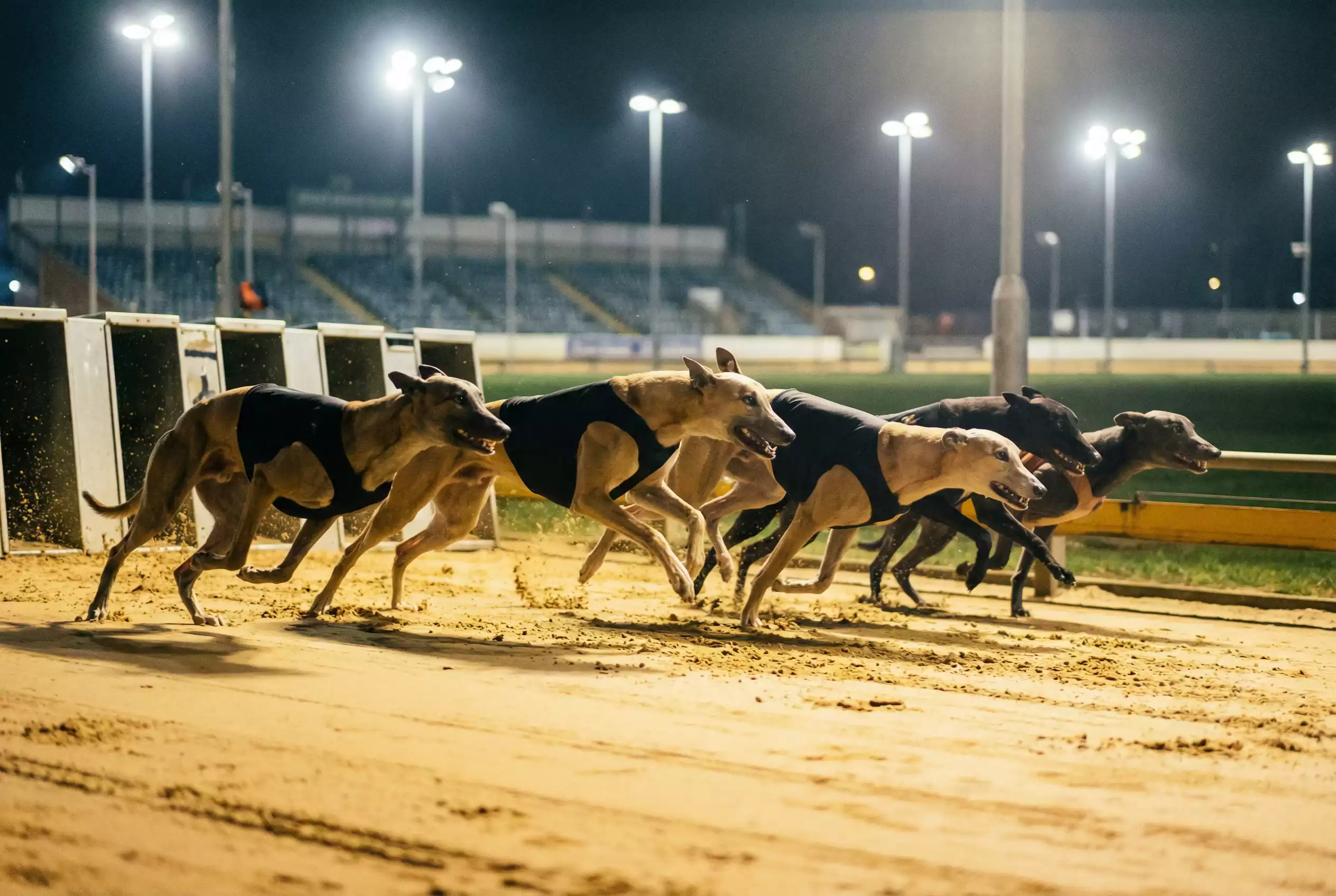
In greyhound racing, the first bend is the most important moment of the race. The dog that reaches it in front — or at least in a clear position — avoids the crowding, bumping, and checking that costs the pack behind it lengths and momentum. The statistics bear this out: across UK tracks, dogs that lead at the first bend win the race more often than any other positional group. Not always, not inevitably, but consistently enough to make early speed the single most predictive form variable available.
Understanding why early pace matters, how to identify it from the form card, and how it interacts with the trap draw gives you a framework for assessing every greyhound race on the card. It does not replace other form factors — class, conditions, trainer form — but it sits above them in the analytical hierarchy because it speaks to the structural reality of how six-dog races are run.
Early Speed Stats: First-Bend Wins Data
The correlation between first-bend leadership and winning is one of the most robust statistical relationships in greyhound racing. Across large samples of UK races, dogs that lead at the first bend go on to win approximately 35–40% of the time. In a six-runner race where each dog has a baseline 16.7% chance of winning, a first-bend lead more than doubles the expected probability.
The effect is even stronger at certain tracks. At venues with tight first bends and short run-ups — Crayford and Romford are the textbook examples — the first-bend leader’s win rate can exceed 45%. The geometry of these tracks compresses the field at the first bend, making it harder for dogs running in the pack to find running room. The leader has clear track, clear air, and the rail to follow. The rest of the field is negotiating traffic.
At tracks with wider bends and longer run-ups, the first-bend advantage is less extreme but still present. The leader’s win rate might sit at 30–35% instead of 40–45%, because the more generous geometry gives packed dogs more opportunity to find gaps and improve their position. But even at the widest track in the UK, leading at the first bend is the single strongest predictor of winning.
These numbers also demonstrate why trap draw matters. Traps on the inside have a shorter path to the first bend, which means dogs drawn inside need less raw speed to reach the bend in front. A moderately fast dog in trap one at a tight track may reach the bend ahead of a faster dog in trap six simply because it had less ground to cover. The interaction between early speed and trap draw is where the most informed betting decisions are made.
One nuance to consider: the first-bend leader statistic includes all grades. In higher grades (A and B races), the quality differential between runners is smaller, and the first-bend advantage is slightly less dominant because multiple dogs have strong early pace. In lower grades (C and D races), where the speed range across the field is wider, a fast dog from a good trap can lead by several lengths at the first bend and effectively race alone. The lower the grade, the more predictive early speed tends to be.
Identifying Early Pace from Form
The most direct indicator of early speed is the first-sectional time. Every greyhound form card that includes sectional data gives you a number — typically in seconds to two decimal places — that measures how quickly the dog reached the finish line on its first pass. A dog posting a sectional of 4.48 is reaching the line faster than one posting 4.62, and in practical terms, that 0.14-second gap translates to roughly a length and a half of early positional advantage.
Compare first-sectional times from recent outings at the same track and distance. A dog that consistently posts sectionals in the fastest quarter of the field is a confirmed early-pace runner. A dog whose sectionals vary — fast one week, slow the next — may be affected by trap draws or inconsistent trapping (the speed at which it exits the boxes). Consistency of sectional times is as important as outright speed, because a dog that traps fast every time is a more reliable front-runner than one that is brilliant from the traps one race in three.
Running comments provide supporting evidence. Abbreviations like QAw (quick away), EP (early pace), and Ld1 (led at bend one) all flag dogs with confirmed early speed. Conversely, SAw (slow away) and MsdBrk (missed break) indicate dogs that routinely start slowly — and those dogs, regardless of their other qualities, are unlikely to lead at the first bend unless drawn inside with very slow opponents around them.
Race replays, where available, are the richest source of early-speed data. Watching a dog leave the traps, accelerate down the straight, and position itself at the first bend gives you information that no number on a form card can replicate. A dog that traps cleanly and powers to the bend is a natural front-runner. A dog that traps adequately but drifts wide toward the first bend may have early speed but struggles to convert it into a positional advantage. The distinction matters.
Early Speed vs Trap Draw
Early speed and trap draw are not independent variables — they interact, and the interaction determines the race at the first bend. A dog with the fastest sectional in the race but drawn in trap six faces a longer path to the first bend than the same dog would face from trap one. The question is whether the dog’s speed advantage is large enough to overcome the geometric disadvantage of the wider draw.
At tight tracks, the answer is often no. The run-up is too short and the bend too sharp for a wide-drawn dog to cross the field and reach the rail before the squeeze begins. At wider tracks, the answer shifts: a genuinely fast dog from trap five or six can use the longer run-up to gain momentum and reach the bend in a competitive position, even if it does not hold the rail.
The most reliable combination is fast early speed from an inside trap. A dog with the best sectional time in the field, drawn in trap one or two at a track with an inside bias, is the closest thing to a banker that greyhound racing produces. The speed reaches the bend first; the geometry confirms the advantage; and the rail provides a guide for the rest of the race.
The most dangerous combination is moderate early speed from an inside trap. A dog that is not the fastest in the field but is drawn inside may lead for the first half of the race on positional advantage alone — only to be overtaken by a genuinely faster dog that was caught behind traffic at the first bend but powers through in the second half. Backing inside-drawn dogs with moderate sectional times is a common error that the first-bend advantage statistic obscures. The statistic tells you that leaders win more often; it does not tell you that all inside-drawn dogs are leaders.
When Late Pace Beats Early Speed
Early speed is the dominant factor, but it is not the only one. Late closers win greyhound races too — and they win most often under specific conditions that are identifiable in advance.
When two or more confirmed front-runners are drawn in adjacent traps, they frequently interfere with each other at the first bend. The resulting check slows both dogs and opens a gap for a mid-pack or rear-running dog to exploit. Races with multiple early-pace dogs drawn together are the most common scenario for a closer to prevail. Look at the sectional times and trap draws for the entire field, not just your selection. If traps two and three both have fast early pace and are likely to clash, a patient closer from trap five or six may inherit the race.
Over longer distances, the advantage of early speed diminishes. In staying races over 640 metres or more, there are additional bends and additional straights for the race to develop. A dog that leads at the first bend in a staying race still has a long way to go, and stamina — not trap speed — determines the outcome. Closers with high cruising speeds and efficient running actions are more competitive at staying trips than at sprints or standard distances.
Get Out and Go
Early speed is the foundation of greyhound race reading. The dog that gets out, gets to the bend, and gets clear has the race on its terms. Every other dog in the field is running a reactive race — finding gaps, avoiding trouble, hoping for space that may never come. When you identify the likely first-bend leader from the form and see it drawn in a favourable trap, you are looking at the dog that controls the race. And the dog that controls the race is the dog you want to back.
