

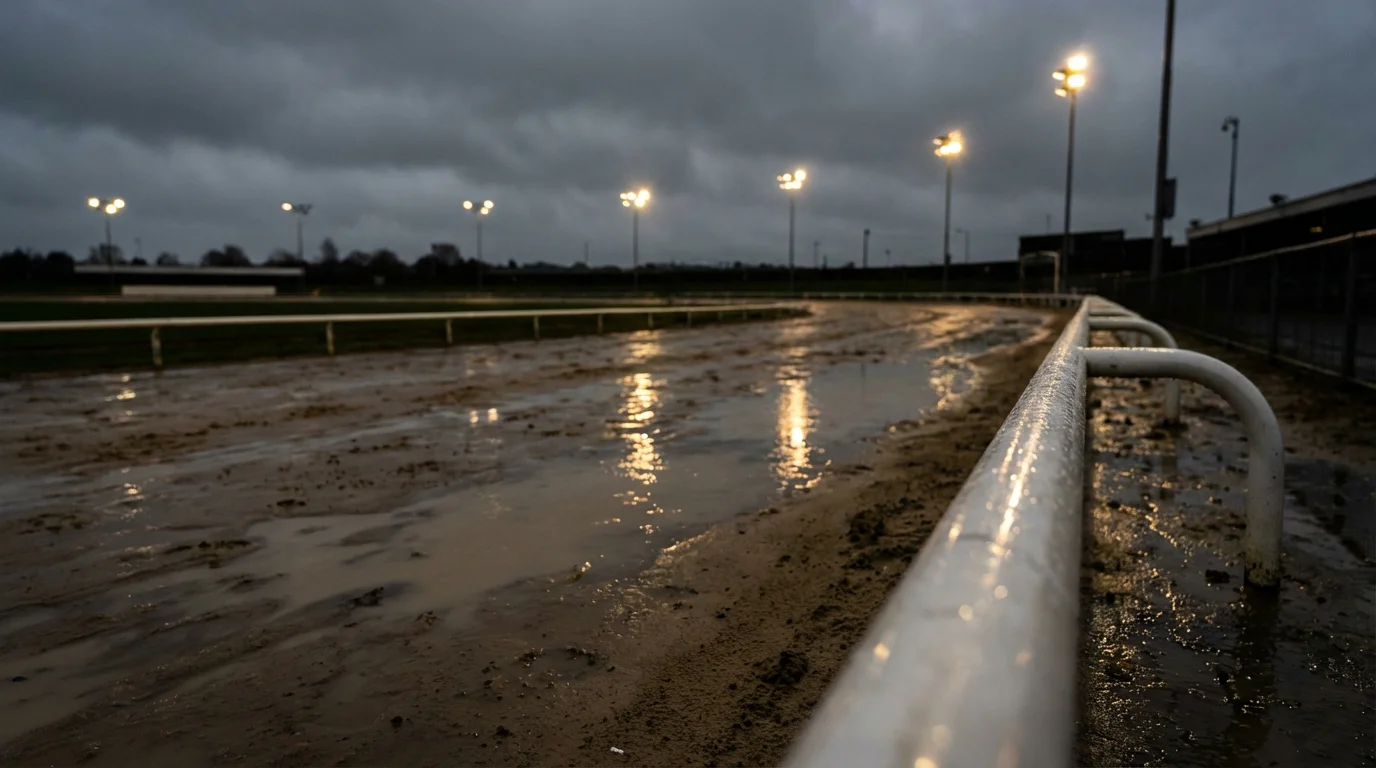
Greyhound racing takes place outdoors, on sand-based surfaces, in a country where the weather rarely cooperates for long. Rain, wind, temperature swings, and frost all affect how the track runs, which in turn affects how dogs perform — and which dogs perform best. A dog that dominates on fast, dry sand may struggle when the surface is waterlogged. A front-runner that thrives in calm conditions may be blunted by a headwind down the home straight.
Most greyhound bettors ignore the weather. They study the form, check the trap draw, glance at the prices, and place their bet. The conditions underfoot and overhead do not feature in the analysis. That omission creates value for the punters who do account for it, because weather-affected form is routinely misread by the market. A dog that ran slowly on a heavy track last week is not necessarily a slow dog — it might be a fast dog that hated the going.
How Weather Affects Greyhound Racing
Rain is the primary weather variable. It changes the track surface from firm to yielding to heavy, and each state produces different racing dynamics. On dry, firm sand, the surface is fast and consistent. Dogs with explosive early pace have the best chance of translating their raw speed into a positional advantage. Times are quicker, and the correlation between ability and results is strongest.
On wet sand, the surface softens. Dogs expend more energy with each stride, and the slower surface compresses the speed differential between the fastest and slowest runners. This means competitive fields become even tighter, and races are decided by smaller margins. Dogs with a strong, driving running action — those that push through the ground rather than skimming across it — tend to handle wet conditions better than lighter, more elegant movers.
Heavy going — the result of sustained or torrential rain — pushes the surface beyond merely soft. Standing water can form in low-lying areas of the track, particularly on the inside running line where drainage is weakest. Dogs drawn in inside traps may encounter the worst of the ground, effectively negating any positional advantage the trap draw would normally provide. In extreme cases, the racing manager may move the starting traps to a different position or, if conditions are dangerous, abandon the meeting altogether.
Wind affects racing in a more subtle way. A headwind down the home straight penalises front-runners disproportionately. The leader faces the full force of the wind throughout the final straight, while closers running in the slipstream of the pack benefit from a degree of aerodynamic shelter. At tracks where the home straight is long and exposed — Towcester, for instance — a strong headwind can measurably change the finishing order compared to calm conditions. At tracks with shorter straights or more sheltered layouts, the effect is less pronounced.
Temperature has a less direct impact but is still relevant. Cold conditions can affect greyhound performance — muscles are slower to warm up, and older dogs in particular may show reduced early speed in low temperatures. Frost can make the track surface hard and unyielding, which some dogs dislike. Racing on frosty tracks is generally permitted provided the surface is safe, but the going is atypical and form produced on frozen ground should be treated with caution.
Track Surface Conditions — Going Reports
Unlike horse racing, greyhound racing does not have a formal going description system that is standardised across all tracks. There is no official “good to firm” or “heavy” designation published before every meeting. Track conditions are at the discretion of the racing manager, who assesses the surface before the meeting and may comment on its state if conditions are unusual.
In practice, the going at a greyhound track falls into three broad categories: fast (dry, firm sand), standard (normal conditions, neither particularly fast nor slow), and slow (wet, softened surface). The race times themselves are the most reliable indicator of going. If the first two races on a card produce times significantly slower than the track average for those grades, the surface is riding slow. If times are quicker than average, the going is fast.
Calculated times — the adjusted times provided by Timeform and other data services — account for going to some degree. The adjustment factors in the track condition to estimate what a dog would have run on a standard surface. This is useful for cross-referencing form between dry and wet meetings, but the adjustment is imperfect and should be treated as an approximation rather than a precise correction.
Some punters maintain their own going records. By logging the weather conditions and first-race times at their specialist tracks over a season, they build a dataset that reveals how specific conditions affect times at that venue. This is a level of detail that most punters do not reach, and it provides a structural advantage when assessing form that was produced in unusual weather.
Rain, Wind and Temperature Effects
Rain changes trap bias. This is one of the most actionable effects for bettors. At tracks where trap one normally has an elevated win rate due to the inside-rail advantage, heavy rain can waterlog the inside running line and temporarily neutralise or reverse the bias. Dogs drawn wide, on firmer ground further from the rail, may find better footing than those on the saturated inside. If you rely on trap bias data in your form analysis — and you should — adjust your expectations when the track has been rained on.
Rain also changes the relative importance of early pace. On a fast surface, the dog that leads at the first bend usually stays in front because the ground allows it to maintain its speed. On a heavy surface, the energy cost of leading is higher. Front-runners tire more quickly, and closers — dogs that sit behind the pace and finish strongly — have a proportionally better chance of catching the leader in the final straight. If you back a lot of front-runners, factor in the going before committing.
Wind patterns are track-specific and worth learning for your specialist venues. Note which direction the home straight runs and check the forecast before the meeting. A consistent westerly at a track where the straight runs east-to-west produces a regular headwind that affects every race on the card. An easterly at the same track produces a tailwind. The dogs do not change; the conditions do.
Temperature-related effects are most relevant at the extremes. Midwinter meetings on cold evenings can see slower sectional times across the board, particularly in the first and second races of the card before the dogs have fully warmed up. Summer meetings on hot days may see the track surface dry out during the meeting, with the going becoming progressively faster from the first race to the last. If you notice times improving through a card, the surface may be drying out — and dogs in later races benefit from quicker going than dogs in earlier races received.
Adjusting Your Bets for Conditions
Check the weather before you study the form. This simple habit reversal — conditions first, form second — changes how you interpret the race card and prevents you from making selections that are undermined by the going.
When rain is expected, downgrade front-runners drawn on the inside and upgrade closers drawn wider. Look for dogs with a proven record in wet conditions — form that shows competitive performances on slow going, or running comments that indicate the dog handles soft ground without losing its action. Conversely, when the track is fast and dry, trust the early-speed data and favour front-runners in the traps most likely to reach the first bend ahead.
When wind is a factor, check which direction the home straight runs and estimate the impact. A strong headwind benefits closers; a tailwind benefits front-runners who can extend their lead without resistance. This adjustment is less dramatic than the rain effect but can be decisive in tight races.
Finally, keep an eye on conditions changing during a meeting. A card that starts on dry ground can become rain-affected by race eight if a shower passes through. The going for the first three races and the going for the last three may be different. If you see times slowing down mid-card, reassess your later selections rather than relying on analysis that assumed fast ground throughout.
The Track Beneath the Paws
Weather is the one variable that no form card fully accounts for. It changes the surface, shifts the bias, and rewards different running styles from one meeting to the next. The punters who check the forecast before they check the form have an informational advantage that costs nothing to acquire. The track runs the race. The weather sets the track. Start there.
