

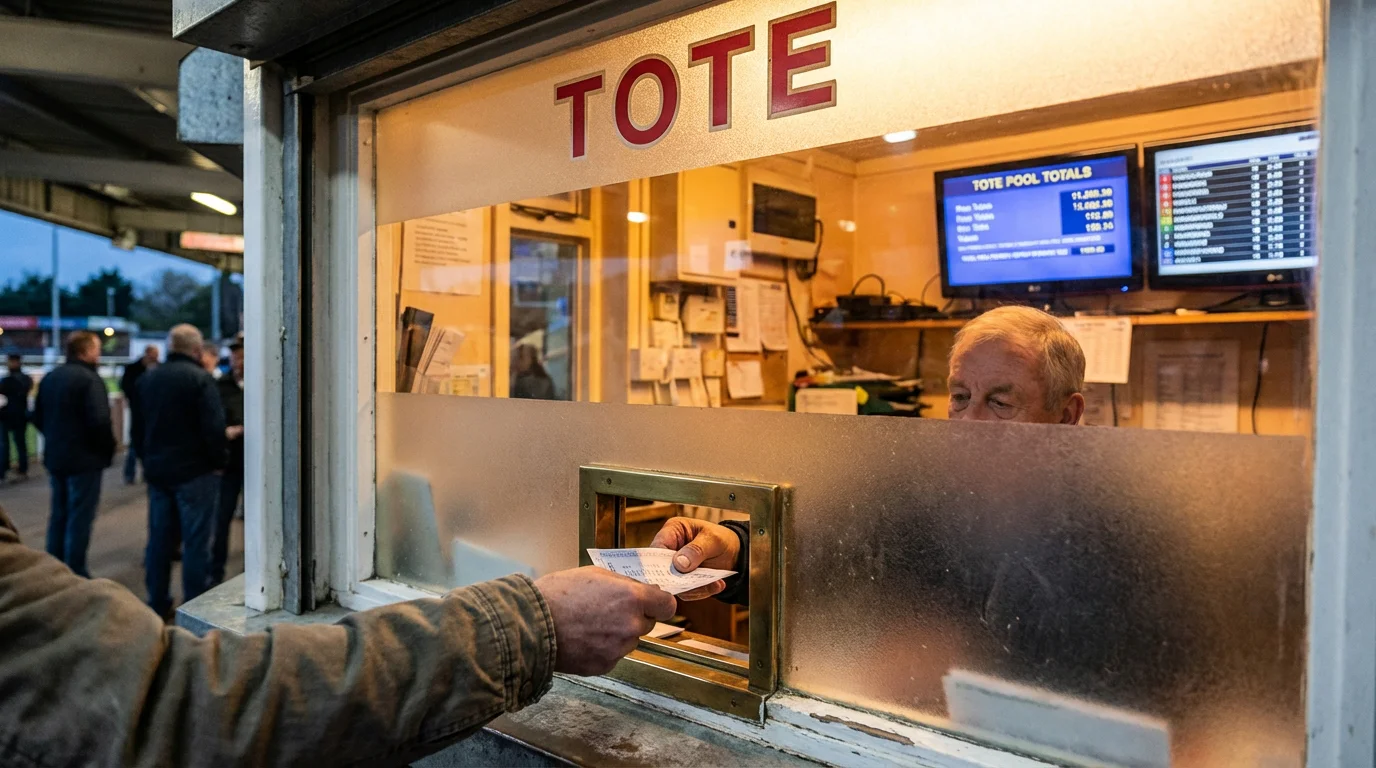
Pool betting is a fundamentally different model from fixed-odds betting, and at the greyhound track it operates under the Tote brand. Instead of accepting a set price from a bookmaker, you contribute your stake to a communal pool. After the race, the total pool — minus the operator’s deduction — is divided among everyone who backed the winning outcome. Your return depends not on the price you were offered, but on how many other people made the same bet.
The Tote has a long history in UK greyhound racing, running alongside on-course bookmakers and fixed-odds betting shops for decades. At many tracks, the Tote windows are the first point of contact for spectators who want a quick bet without browsing bookmaker boards. Online, the Tote’s pool products are integrated into several bookmaker platforms. Understanding how pool betting works — and when it pays better than fixed odds — is a useful addition to any greyhound bettor’s toolkit.
How Pool Betting Works
Every pound staked on a particular pool goes into a single pot. The Tote takes its deduction — a percentage of the total pool — and the remainder is distributed to winning bettors in proportion to their stake. You do not know the payout until after the race, because the dividend depends on the total pool size and how many winning tickets were sold.
The deduction is the Tote’s margin. On greyhound racing, the standard deductions are significantly higher than in horse racing — typically between 25% and 34% depending on the track, applied uniformly across all pool types. These percentages are higher than the effective margin on most fixed-odds bookmaker markets, which is why pool betting is generally considered less favourable in mathematical terms. However, the dividend system can produce payouts that exceed fixed-odds returns in specific circumstances — particularly when an unexpected result occurs and very few bettors hold winning tickets.
The dividend is declared as a return per unit stake. If the Tote win pool dividend is declared at £4.20, that means a one-pound stake returns four pounds twenty, including your original stake. A ten-pound stake returns forty-two pounds. The dividend is calculated after the race and published within minutes of the result being confirmed.
Pool sizes in greyhound racing are smaller than in horse racing. A typical on-course Tote win pool at an evening meeting might total a few thousand pounds. At a daytime BAGS meeting, the pool can be considerably smaller. The practical consequence of small pools is volatile dividends — a single large bet can shift the payout for everyone else. If one punter places a hundred-pound Tote win bet on a dog in a pool that totals five hundred pounds, that single bet depresses the dividend for all winning ticket holders on the same dog.
This volatility is a double-edged characteristic. It makes Tote returns less predictable than fixed-odds returns, but it also means that when an overlooked dog wins, the dividend can be dramatically higher than the fixed-odds price suggested. The pool system rewards contrarian outcomes because fewer winning tickets means more money per winner.
Tote Bet Types: Win, Place, Exacta, Trifecta
The Tote offers four main pool types on greyhound racing, each corresponding to a different bet type with its own deduction rate and dividend structure.
The Win pool is the simplest. Pick the winner. All stakes go into the win pool, the deduction is taken, and the remainder is divided by the total amount staked on the winning dog. The win pool deduction on greyhounds is the same as for other pool types at that track — typically between 25% and 34%.
The Place pool pays if your selection finishes in the first two. The mechanics are similar to the win pool, but the dividend is lower because more tickets qualify as winners. Place pools on greyhounds are smaller than win pools, which amplifies the volatility effect — a popular dog placing can compress the dividend to near-minimum levels, while an outsider placing can produce generous returns.
The Exacta is the Tote’s version of the forecast. Pick the first and second in the correct order. The Exacta pool produces larger dividends because the bet is harder to land. In a six-dog field, there are thirty possible Exacta combinations, so the pool is spread more thinly and the winning dividend can be substantial. Exacta dividends on greyhound races regularly reach double or triple figures, and on unusual results they can exceed the Computer Straight Forecast dividend from the bookmaker.
The Trifecta is the Tote’s tricast — first, second, and third in order. The potential returns are the largest of the four pool types. In a six-dog field with one hundred and twenty possible Trifecta permutations, the pool is divided very thinly among winning tickets. Trifecta dividends in the hundreds are common, and four-figure dividends occur when three outsiders fill the first three places. The pool deduction is steep, but on races with unexpected results, the dividend can far exceed what the Computer Tricast formula would have paid.
Some tracks and online platforms also offer Jackpot and Placepot pools on greyhounds, requiring you to find the winner (or a placed dog) in multiple consecutive races. These pools carry higher deductions and are harder to win, but the accumulated dividend can be significant. They are entertainment bets rather than value plays.
Pool Dividends vs Fixed Odds Returns
The Tote dividend and the fixed-odds return for the same outcome can differ substantially, and neither is consistently better. The relationship depends on three variables: the size of the pool, the distribution of money across the field, and the result.
When the favourite wins, the Tote dividend is almost always lower than the fixed-odds return. This is because the majority of pool money is concentrated on the favourite, and the deduction comes off the top. Fixed-odds bookmakers have already priced the favourite at a margin, but the pool deduction on top of the favourite’s share of the pool typically produces a worse return. If you consistently back favourites, fixed odds or exchange odds will serve you better than the Tote.
When an outsider wins, the Tote dividend can exceed the fixed-odds return. With less money in the pool staked on the outsider, the winning share is proportionally larger. The deduction still applies, but the dilution from other bettors is minimal. This effect is strongest in Exacta and Trifecta pools, where an unusual combination of results can produce dividends that dwarf the equivalent CSF or Computer Tricast payout.
The middle ground — mid-priced dogs at 3/1 to 5/1 — is where the comparison is least predictable. The Tote might pay slightly more or slightly less than fixed odds depending on how the pool money was distributed. There is no systematic edge in either direction for this price range.
When Tote Pays Better
Target the Tote for Exacta and Trifecta bets on races where you expect an upset. If your form analysis points to a result that the general betting public is unlikely to have backed — a mid-price dog beating the favourite, or two outsiders filling the first two places — the Tote pool will have less money on that outcome, and the dividend will be inflated relative to the fixed-odds equivalent.
Major meeting finals are another favourable context. The pool sizes are larger at high-profile events, which reduces volatility and produces more stable dividends. At the same time, the concentration of recreational money on popular dogs can leave value in the Tote for anyone backing a less fancied selection. The English Derby final, for instance, generates Tote pools large enough that the win dividend is a reasonable comparison to fixed-odds prices — and the Exacta and Trifecta pools can produce dividends that justify the higher deduction.
The Pool Takes All
Pool betting is a collective market — your return is shaped by every other bettor in the pool, not by a price quoted to you individually. That communal structure means you are never sure of your payout until after the race. On most greyhound races, fixed odds or the exchange will give you a better expected return, because the pool deductions are steeper than the bookmaker’s margin. But on the races where the crowd gets it wrong and you get it right, the pool pays a premium that no fixed-odds bookmaker would have offered. The Tote rewards dissent — provided you are dissenting correctly.
