
The English Greyhound Derby is the most prestigious race in British greyhound racing. First run in 1927 at White City Stadium in London, it has served as the sport’s ultimate test for nearly a century — a knockout competition that demands speed, consistency, and the nerve to perform across multiple rounds against the best dogs in Britain and Ireland. Winning the Derby defines a greyhound’s career. For trainers, it is the pinnacle. For bettors, it is the single event that generates the most ante-post activity, the deepest markets, and the largest individual payouts in the sport.
The race has moved homes multiple times across its history, reflecting the broader fortunes of greyhound racing in the UK. From White City to Wimbledon, from Wimbledon to Towcester, each relocation has carried controversy and nostalgia in equal measure. But the competition itself has survived every upheaval, and the Derby final remains the night when greyhound racing commands its widest audience.
History of the Greyhound Derby
The first English Greyhound Derby took place on 15 October 1927 at White City Stadium in West London, less than two years after the introduction of modern greyhound racing to Britain. The inaugural winner was Entry Badge, owned by Edwin Baxter. The event immediately established itself as the flagship of the sport, drawing large crowds to White City and generating significant betting turnover.
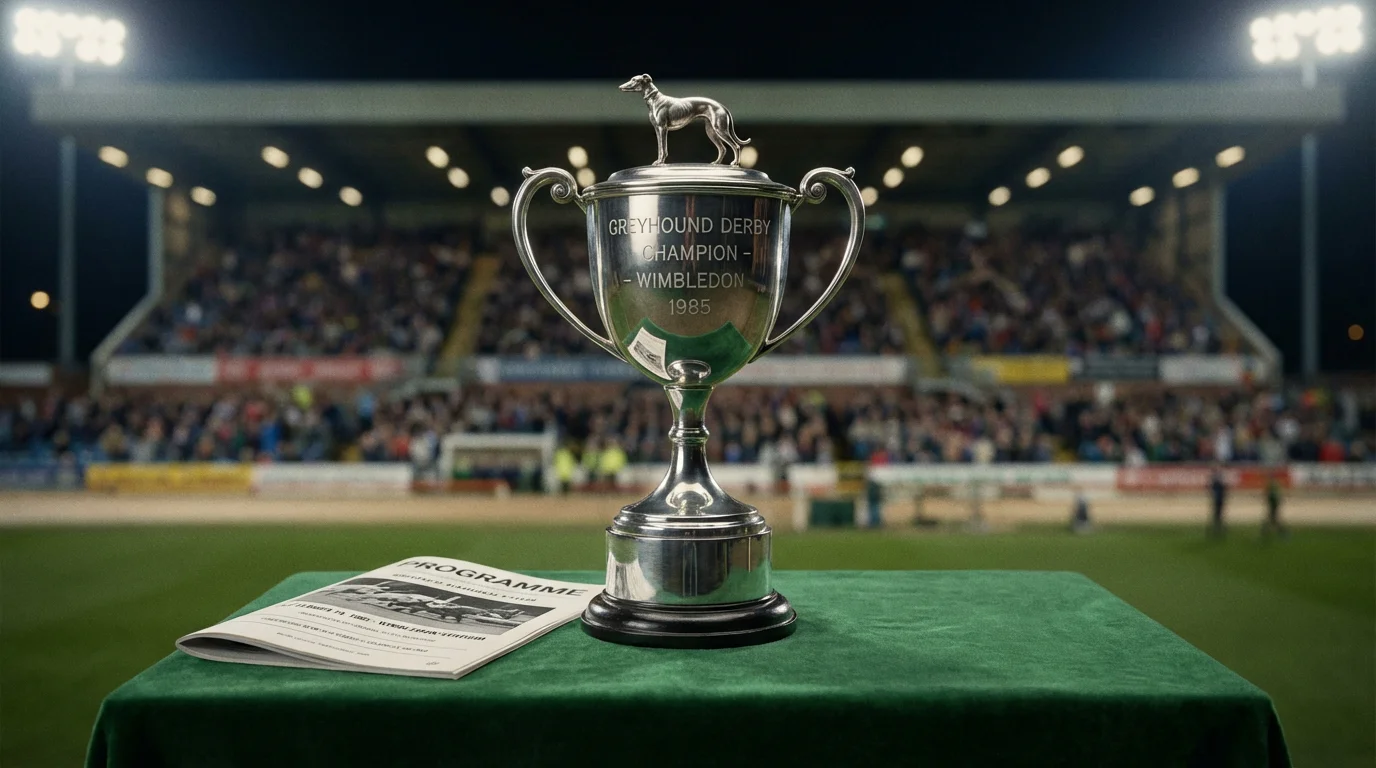
White City remained the Derby’s home for the majority of the twentieth century, hosting the final until 1984. The stadium’s closure that year forced the first of several relocations. The race moved to Wimbledon Stadium in South London, which became its home for over three decades — the longest continuous tenancy outside White City. Wimbledon hosted some of the Derby’s most memorable finals, and its tight, demanding track was considered a true test of a champion greyhound.
Wimbledon hosted its last Derby in 2016, and the stadium closed in March 2017. The Derby then relocated to Towcester in Northamptonshire. Towcester’s circuit is significantly different from Wimbledon’s: larger, with more sweeping bends and longer straights. The change of venue altered the type of dog that thrived in the competition. Where Wimbledon favoured compact, nippy dogs that could handle tight bends under pressure, Towcester rewards rangier, faster dogs with the scope to use a bigger track. That shift has influenced how trainers prepare their Derby contenders and how punters assess the form.
The Derby has been won by some of the greatest greyhounds in the sport’s history. Mick the Miller won it in 1929 and 1930, becoming the first greyhound to achieve mainstream celebrity status. Patricias Hope won back-to-back in 1972 and 1973. Rapid Ranger repeated the feat in 2000 and 2001 at Wimbledon, and Westmead Hawk became the fourth dog to win the Derby twice, in 2005 and 2006. Each generation produces its champion, and the roll of Derby winners doubles as a timeline of the sport’s evolution.
The prize money has grown substantially over the decades. Modern Derby finals carry a first prize exceeding one hundred thousand pounds, making it the richest single race in British greyhound racing. The total prize fund across all rounds is considerably larger, with prize money distributed to heat winners and finalists throughout the competition.
Current Format and Venue
The English Greyhound Derby is currently staged at Towcester Greyhound Stadium in Northamptonshire. The competition follows a multi-round knockout format that typically spans several weeks during the summer months. The exact structure can vary slightly between years, but the general progression is: first-round heats, second-round heats, quarter-finals, semi-finals, and the final.
Entry is open to greyhounds from Britain and Ireland, and the competition typically attracts several hundred entries that are whittled down through qualifying rounds. Trainers nominate their dogs, and the competition organisers seed and draw the heats. In each round, the top two finishers from each heat advance to the next stage. The format means that a dog must produce consistent performances across multiple races to reach the final — a single poor run in a heat can end a campaign.
Towcester’s standard race distance is 500 metres over four bends. The track is one of the largest in the UK, with a long home straight and relatively open bends compared to tighter circuits like Romford or Crayford. The surface is sand-based and well-drained, which means the Derby has rarely been affected by weather-related delays since the move to Towcester.
The final is traditionally staged on a Saturday evening with full Sky Sports Racing coverage. The build-up includes parade ring footage, trainer interviews, and expert analysis of the six finalists’ paths through the competition. For the greyhound betting market, Derby final night is the highest-liquidity event of the year — exchange volumes on Betfair reach levels that no other greyhound race approaches.
Betting on the Derby — Markets and Odds
The Derby generates the widest range of betting markets in greyhound racing. Ante-post markets open months before the first heats, with bookmakers pricing up dozens of potential contenders based on open-race form from the preceding season. As the competition progresses through rounds, the market narrows and the odds shorten on the remaining contenders.
The most significant ante-post value typically exists before the first-round heats, when the field is largest and the uncertainty is highest. A dog priced at 25/1 ante-post may shorten to 5/1 by the time it reaches the semi-finals, having demonstrated its form across three qualifying rounds. Capturing that early price requires conviction and acceptance of the non-runner risk — but the potential reward is substantial.
During the heats, race-by-race betting is available on each qualifying round. These markets operate like any standard greyhound race: win, each-way, forecast, and tricast bets at fixed odds or on the exchange. Heat betting can be valuable in itself, because the structure of the competition means that some heats contain clear mismatches — a high-class contender drawn against weaker qualifiers — while others are highly competitive affairs where the top dogs are drawn together.
For the final itself, the market is deep and competitive. Bookmakers offer Best Odds Guaranteed, enhanced odds promotions, and special bet types such as “Derby winner without the favourite” or match bets between specific finalists. Exchange liquidity is at its peak, and the spread between back and lay odds is typically tighter than on any other greyhound race in the calendar.
One strategic approach that experienced Derby bettors use is to back a dog ante-post and then trade the position on the exchange as it progresses through rounds. If your 25/1 ante-post selection reaches the semi-final and is now trading at 6/1 on Betfair, you can lay it on the exchange to lock in a profit regardless of the final outcome. This trading approach requires exchange accounts and familiarity with back-and-lay mechanics, but it turns the ante-post gamble into a managed position.
Past Winners and Notable Stories
The Derby’s history is populated with dogs that transcended the sport. Mick the Miller’s consecutive wins in 1929 and 1930 made him a household name in an era when greyhound racing rivalled football in attendance. He later appeared in a feature film and became the first greyhound preserved by the Natural History Museum after his death.
In the modern era, Rapid Ranger’s back-to-back victories in 2000 and 2001 at Wimbledon are often cited among the finest Derby performances. The dog, trained by Charlie Lister, dominated the 2000 competition from first round to final, winning with authority in every round. He returned the following year to successfully defend his title, becoming only the third dog in history to win the Derby twice.
Controversy has also featured. The 2012 Derby was marred by a disputed finish, and various years have seen pre-competition favourites withdraw through injury at the final stage, reshaping the final-night market. The vulnerability of ante-post favourites to last-minute withdrawal is a recurring theme — and a recurring lesson for punters who back too early without considering the physical demands of the multi-round format.
Irish-trained greyhounds have a strong record in the English Derby, reflecting the depth of the sport across the Irish Sea. Several recent winners have been trained in Ireland, and the cross-border rivalry adds an extra layer of interest to the competition. Irish dogs often bring form from the Irish Derby and other major events, giving punters additional form lines to analyse when assessing their prospects on the English stage.
The Night the Traps Mean Everything
Derby final night is the one evening each year when greyhound racing reaches beyond its core audience. The betting volumes spike, the coverage expands, and the six dogs that have survived weeks of qualifying rounds step into the traps with a career-defining thirty seconds ahead of them. For punters, it is the race that rewards months of form study, ante-post patience, and careful tracking of a competition’s progression.
But it is also, at the end, a greyhound race. Six dogs, four bends, and a mechanical hare. The form tells you plenty. The traps open, and the rest is speed.
