

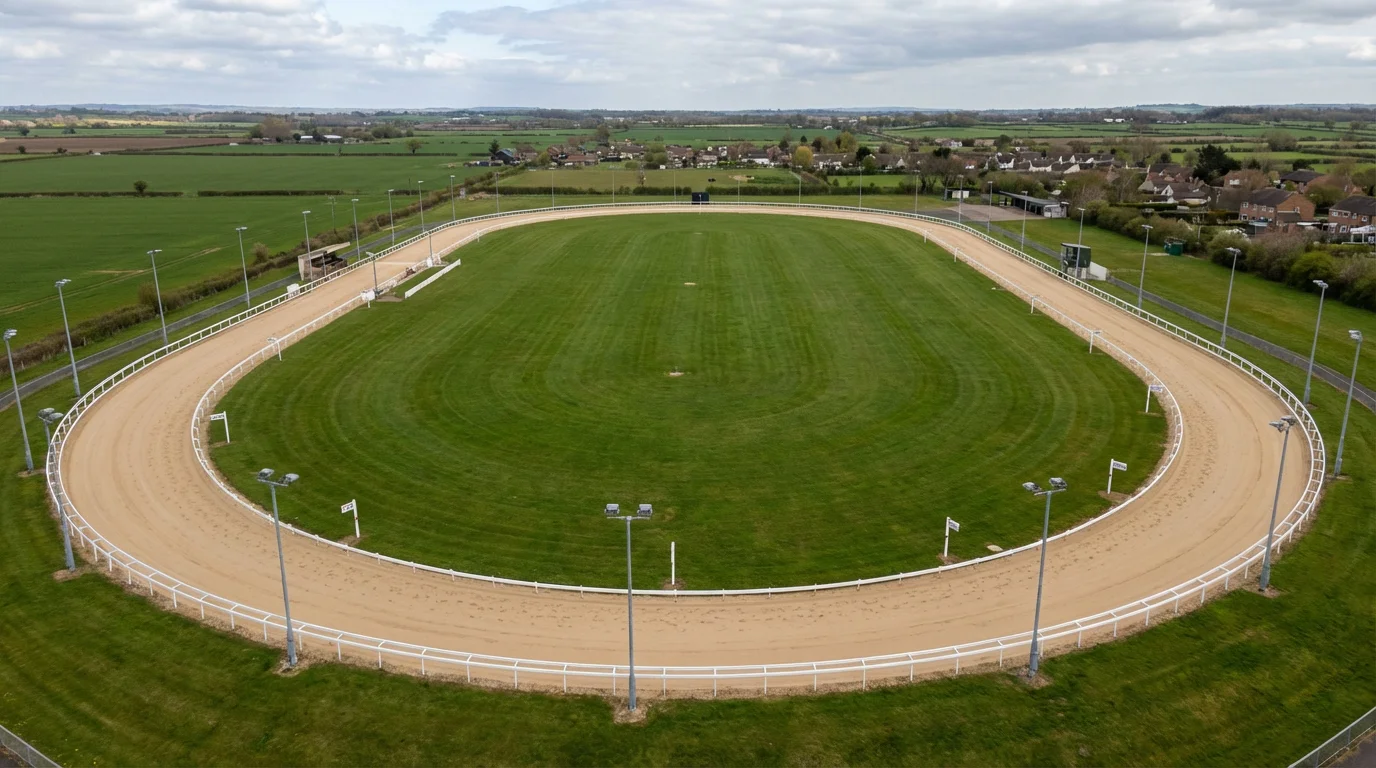
Distance changes everything. A sprint greyhound and a stayer are built differently, run differently, and should be assessed differently. The compact sprinter with explosive early pace that dominates over two bends may finish tailed off if asked to run four bends at 480 metres. The rangy stayer with a high cruising speed and relentless closing ability may struggle to get into the race over a short sprint before stamina ever becomes relevant.
UK greyhound racing offers a range of distances, from sprint trips under 300 metres at some tracks to staying events over 700 metres at others. Most racing takes place over the standard distance — four bends, typically between 480 and 525 metres depending on the track — but sprint, middle-distance, and staying races appear regularly on cards across the country. Each distance category demands different physical attributes from the dogs and different analytical priorities from the punter. This guide breaks down those categories and explains how distance should shape your approach to form reading and bet selection.
Sprint Races
Two bends, pure speed — early pace is everything. Sprint races in UK greyhound racing are contested over distances under 400 metres, with the most common configurations being around 262 to 285 metres. These races take place over two bends rather than the standard four, and the shortened course fundamentally changes the racing dynamic.
In a sprint, the dog that leads out of the traps and reaches the first bend ahead of the field wins more often than at any other distance. There is simply not enough race left for a slow starter to make up ground. The two-bend format gives closers one bend to pass and one short straight to finish — nowhere near enough to overcome a significant early deficit. Sprint races are dominated by dogs with fast trap exits and strong first-sectional times.
For betting purposes, sprint races are often more predictable than standard-distance events. The correlation between first-sectional time and finishing position is higher, which means your form analysis can focus narrowly on one metric: who gets to the first bend first? Trap draw is amplified in sprints because the run to the first bend is proportionally a larger part of the total race. A dog with good early speed drawn in trap one at a tight track has a compounding advantage — short run, inside line, fast break — that is very hard to overcome.
The downside for bettors is that predictability compresses odds. Sprint favourites tend to be shorter-priced than standard-distance favourites because the outcome is more foreseeable. Finding value in sprint races requires identifying dogs whose early speed is underestimated by the market, often because their recent form was over longer distances where their stamina limitations masked their raw pace.
Not all tracks offer sprint races. The configuration depends on where the starting traps can be positioned relative to the standard circuit. Tracks like Romford, Crayford, and Swindon regularly stage sprints; others may only offer them occasionally as part of special meetings. Check the race card for the distance — if it is listed as 265m or 285m rather than the track’s standard distance, you are looking at a sprint.
Standard Distance
Four bends, the standard test — and where most graded racing takes place. The standard distance at UK greyhound tracks falls between 480 and 525 metres, depending on the size and configuration of the circuit. This is the default distance for the grading system, the benchmark for time-based classifications, and the distance over which the vast majority of daily BAGS and evening racing is contested.
At standard distance, the race is long enough for the initial burst from the traps to be important but not decisive. Early pace still matters — the dog that leads at the first bend has a structural advantage — but there are three further bends and two additional straights for the race to develop. Dogs can lose ground at the first bend, recover through the middle of the race, and close in the final straight. Running style becomes more varied, and the interplay between front-runners, mid-pack stalkers, and late closers creates a more complex tactical picture than a sprint.
Form analysis at standard distance requires a broader set of metrics. First-sectional time remains important, but overall calculated time, finishing speed (how fast the dog runs the final straight), and running comments about in-race positioning all contribute to a useful form profile. A dog that consistently runs fast calculated times but finishes third because it gets squeezed at the second bend is a different proposition from a dog that consistently finishes third because it lacks the pace to be competitive.
Grading at standard distance is the most precise because it is the distance with the largest sample of races. The racing manager has more data points to assess each dog’s level, which means the grading bands tend to be tighter and the fields more evenly matched. For punters, this means standard-distance races are generally more competitive and harder to predict than sprints — but also more rewarding when your analysis identifies a genuine edge.
Standard distance is also where trap bias data is most extensive. The majority of trap bias statistics quoted for UK tracks are based on standard-distance results, because those races account for the bulk of the sample. If you see a stat claiming that trap one at Crayford wins 21% of the time, that figure almost certainly refers to standard-distance races at that track.
Middle Distance and Staying Races
Six bends or more — stamina, tenacity, and closing pace dominate. Middle-distance races typically cover 600 to 660 metres, while staying events extend beyond 660 metres, with some marathon trips running to 840 metres or further at tracks with the circuit size to accommodate them.
The extended distance transforms the race profile. Early pace is less decisive because the race is long enough for a slow starter to make up multiple lengths over additional bends. Stamina becomes the primary differentiator. Dogs that fade in the final straight of a standard-distance race are exposed even more brutally over staying trips, while dogs with efficient running actions and the cardiovascular capacity to maintain speed over six or eight bends come into their own.
For bettors, staying races require different form indicators. Instead of focusing on first-sectional times, look at finishing speeds and the pattern of recent results at longer distances. A dog that consistently finishes strongly at 480 metres may have untapped staying potential. Conversely, a dog that has only raced at sprints and standard trips is an unknown quantity over a staying distance, and the market may underprice or overprice that uncertainty.
Staying races attract fewer runners in some instances, because not all greyhounds are suited to the trip. Fields of five are more common at middle and staying distances than at standard distance, which changes the each-way terms (most bookmakers pay two places regardless, but check the rules on five-runner fields). Fewer runners also means a smaller pool of form to analyse, which can make these races simultaneously easier to narrow and harder to predict with confidence.
Track specialisation matters even more at staying distances. Not every track offers middle-distance or staying races, and those that do may run them infrequently. Towcester, with its large circuit, has historically been the premier staying venue. Nottingham and Monmore Green also stage staying events. Knowing which tracks offer which distances — and which dogs are proven at those trips — is an advantage that most casual bettors do not have.
Hurdle Races
A niche discipline within greyhound racing: same distances, plus four flights of hurdles placed along the back straight. Greyhound hurdling exists as a separate category with its own grading, its own specialists, and its own betting dynamics. The hurdles are low barriers that the dogs jump while running at full speed, and the ability to clear them cleanly is a skill separate from flat-racing pace.
Not all greyhounds can hurdle. The technique requires coordination, nerve, and a jumping style that does not break the dog’s stride. Dogs that clip the hurdles lose momentum and can fall or check, which disrupts the entire field behind them. This added variable makes hurdle races inherently less predictable than flat races, because even a dog with strong form can be brought down by a rival’s clumsy jump.
Hurdle form is best assessed separately from flat form. A dog that wins flat races comfortably may be a poor hurdler if it lacks the natural jumping instinct, and vice versa. Look for dogs with consistent hurdle form — clean jumps, no falls in recent outings, and competitive finishing times over hurdle trips. Tracks that regularly stage hurdle events include Perry Barr and Swindon, though the schedule varies across the calendar.
Betting on hurdle races carries higher variance than flat racing. The possibility of falls and interference at the hurdles injects randomness that no amount of form study can fully account for. Straight win bets on proven hurdlers at fair prices are the most practical approach. Forecasts and tricasts on hurdle races are speculative even by the standards of those markets, because the finishing order is more susceptible to in-race incidents.
Distance Is the First Filter
Before you look at times, look at the trip. A fast time over 480 metres tells you nothing about a dog’s prospects over 660 metres, and vice versa. The first question when opening a race card should always be: what distance is this race, and does my selection have proven form at this trip?
Distance dictates which physical attributes matter most, which form metrics carry the most weight, and which running styles are likely to prevail. Get the distance assessment right and the rest of your analysis has a solid foundation. Get it wrong — or ignore it entirely — and you are building on sand.
